Home Blog Page 23

The Mahābhārata Was Never About Winning—It Was About Dharma Under Pressure

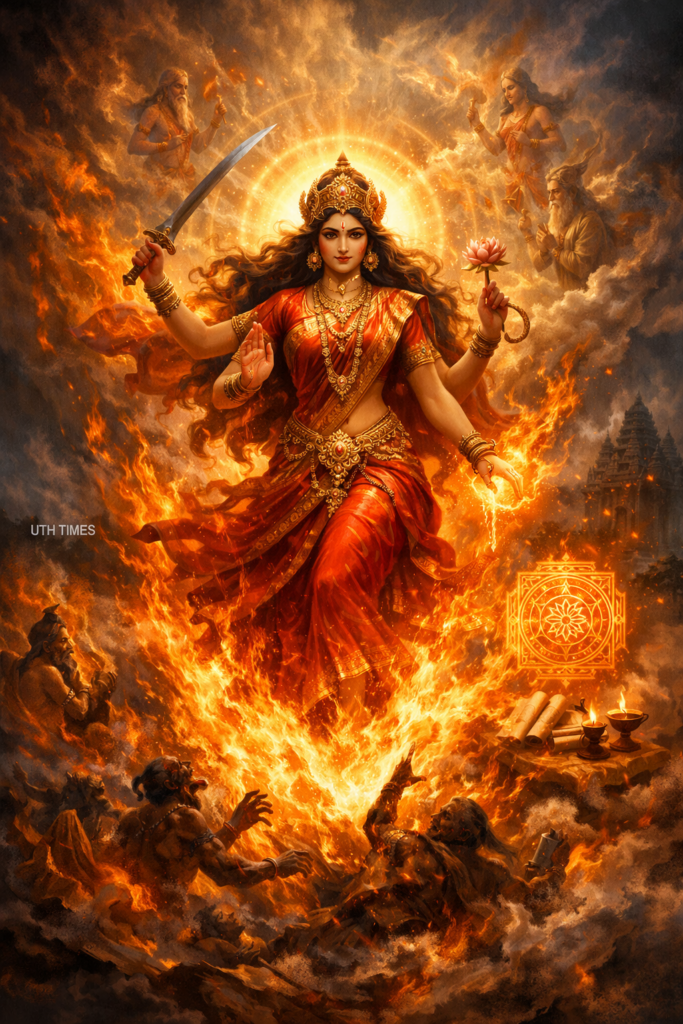
The Mahābhārata is often remembered as a grand war—armies clashing on Kurukṣetra, heroes falling, kingdoms changing hands. But to reduce it to a tale of victory and defeat is to miss its true intent. The Mahābhārata was never written to celebrate triumph. It was written to examine dharma when it is tested, twisted, and forced to survive under unbearable pressure.
🔱 Kurukṣetra: A Battlefield of Conscience

Kurukṣetra was not merely a physical battleground; it was a moral laboratory. Every character entered the war knowing that no choice would remain pure. Dharma was no longer comfortable—it was conditional, situational, and painful. The epic repeatedly asks: What is the right action when every option carries guilt?

👉 Winning was inevitable. Staying righteous was not.

🧠 Krishna: The Guide, Not the Judge

Krishna never promised the Pāṇḍavas a spotless victory. He promised clarity in chaos. His teachings in the Bhagavad Gītā do not glorify war; they explain responsibility. Action without attachment. Duty without ego. Choice without illusion.

Krishna’s role proves a critical truth: dharma is not about moral perfection, but conscious decision-making under uncertainty.

⚔️ Yudhiṣṭhira: The Burden of Truth

Yudhiṣṭhira, often called Dharmarāja, faced the cruelest irony—his commitment to truth led him into falsehood. His silence during Aśvatthāmā’s death announcement remains one of the epic’s most disturbing moments. Yet the Mahābhārata does not condemn him. It shows us that even truth can fracture under pressure.

👉 Dharma here is not clean. It is costly.

🔥 Karna, Bhīṣma, Droṇa: When Loyalty Betrays Dharma

Karna’s unwavering loyalty to Duryodhana, Bhīṣma’s vow-bound silence, Droṇa’s emotional manipulation—none were born from evil. They were born from misplaced duty. The Mahābhārata warns that loyalty, when detached from ethical awareness, can become destructive.

👉 Not all wrongdoers are wicked. Some are simply rigid.

🪔 Draupadī: The Moral Spark

When Draupadī was humiliated in the royal court, the war became inevitable. Her unanswered questions—“Was I lost before or after Yudhiṣṭhira lost himself?”—exposed the hollowness of dharma when it refuses to protect dignity.

👉 The war began not with weapons, but with silence.

🏁 Dharma Is Tested, Not Proved

The Mahābhārata ends without celebration. Victory feels heavy. Survivors are burdened with loss. The message is unmistakable: winning means nothing if dharma collapses in the process.

This epic endures because it does not offer comfort. It offers clarity. It tells us that dharma is not about choosing the good—it is about choosing the least destructive path when goodness itself is under siege.

The Mahābhārata is not a story of who won.

It is a warning about what it costs to be right.

Kashi: From Sacred City to Global Tourism Powerhouse

0

Kashi has always been timeless. In 2025, it became unstoppable.

A Sacred City That Captivated the World

In 2025, Kashi (Varanasi) didn’t just welcome pilgrims — it rewrote global tourism records. With an astonishing ~146.97 million visitors, the world’s oldest living city emerged as a global tourism epicenter, blending spirituality, heritage, infrastructure, and modern urban revival like never before.

What was once seen purely as a spiritual destination has now transformed into a multi-dimensional global attraction — where faith meets experience, and tradition meets transformation.

📍 Why the World Is Flocking to Kashi

Kashi’s rise is not accidental; it is the result of strategic redevelopment and cultural rebranding.

✨ Kashi Vishwanath Corridor – A spiritual and architectural marvel that redefined temple-town experiences

✨ World-class riverfront ghats – Revamped, illuminated, and globally admired

✨ Seamless connectivity – Expanded airport, expressways, and modern railway infrastructure

✨ Global events & festivals – From Ganga Aarti spectacles to international cultural summits

✨ Clean, safe, and tourist-friendly city planning

Together, these changes elevated Kashi from a pilgrimage stop to a world-class destination city.

🌍 A New Global Identity for an Ancient City

Kashi in 2025 stands tall alongside cities like Rome, Jerusalem, and Mecca — not just in spiritual importance, but in visitor volume and global relevance.

🔥 International tourists now account for a rapidly growing share

🔥 Luxury hotels coexist with ancient ashrams

🔥 Digital guides, smart tourism tools, and multilingual services enhance accessibility

🔥 Cultural tourism, heritage walks, wellness retreats, and river cruises thrive

Kashi has successfully positioned itself as India’s spiritual capital with a global soul.

📈 Economic, Cultural & Social Impact

This tourism boom has reshaped the city’s economy and social fabric:

💼 Massive employment generation across hospitality, crafts, transport, and services

🏺 Revival of local arts like Banarasi silk, metal crafts, and classical music

🏙️ Urban renewal without cultural erasure

🌱 Sustainable tourism models centered on heritage preservation

Kashi’s growth proves that development and tradition can grow together.

✨ The Kashi Phenomenon

146.97 million visitors in a single year isn’t just a statistic — it’s a global statement. Kashi has shown the world how an ancient city can reinvent itself without losing its soul.

Kashi is no longer just a destination you visit once in a lifetime.

In 2025, it became a place the world keeps returning to.

How Akshaye Khanna Delivered Highest Grossers at Box Office Without Chasing the Spotlight

0

In 2025, the phrase “Akshay Khanna supremacy” isn’t just fan hype — it’s the industry finally catching up to what cinephiles have known for years: when Akshay Khanna appears on screen, a film automatically gains gravity.

The recent success of Chhaava and Dhurandhar has cemented this perception at a mass level. In Chhaava, his portrayal of Aurangzeb stood out as one of the most discussed performances of the film. Without resorting to loud theatrics, he brought menace, intellect, and restraint — the kind that lingers long after the scene ends. The film’s massive box-office run only amplified conversations around his performance, with many viewers calling him the film’s quiet scene-stealer.

That momentum carried into Dhurandhar, where his role as Rehman Dakait became a cultural talking point. The film’s success wasn’t just about scale or spectacle; it was about credibility — and Akshay Khanna’s presence added exactly that. When a film crosses into blockbuster territory while being anchored by such controlled performances, it sends a clear message: substance and box office can coexist.

What makes this phase even more compelling is Akshay Khanna’s personality off-screen. In an era dominated by relentless self-promotion, social media optics, and constant visibility, he remains strikingly reserved. He is not attention-hungry, avoids unnecessary media appearances, and rarely engages in PR-driven narratives. This distance from the spotlight has only strengthened his mystique. The audience senses that he shows up only for the work — and nothing else.

This philosophy has been consistent throughout his career. From Border to Dil Chahta Hai, from Humraaz and Race to Ittefaq, Mom, Section 375, and Drishyam 2, Akshay Khanna has always chosen roles that rely on intelligence, restraint, and internal conflict rather than noise. His performances age well because they are built on craft, not trends.

The current “supremacy” isn’t a sudden comeback — it’s a delayed recognition. Chhaava and Dhurandhar didn’t reinvent Akshay Khanna; they simply reminded the industry and audiences that true power on screen doesn’t need volume. Some actors chase relevance. Akshay Khanna lets relevance find him.

How Regional Indian Cinema Is Shaping the National Narrative

0

Indian cinema has long been associated with Bollywood—the glitzy, song-filled world of Mumbai. But the true power of Indian storytelling often lies beyond the Hindi heartland. Regional cinema, from Tamil and Telugu to Marathi, Malayalam, and Bengali films, is quietly reshaping the national narrative and redefining how India sees itself.

🌟 Rise of Regional Cinema

Regional films are no longer confined to local audiences. With streaming platforms like Netflix, Amazon Prime, and Disney+ Hotstar, movies in Tamil, Telugu, Kannada, Marathi, Malayalam, and Bengali are reaching millions nationwide and even globally. Hits like KGF, Jigarthanda, Sairat, Drishyam, and RRR have demonstrated that powerful storytelling transcends language barriers.

🎭 Stories Rooted in Local Culture

One of the biggest strengths of regional cinema is its authenticity. These films explore local traditions, dialects, and social issues in a way mainstream Bollywood rarely does. For example:

  • Sairat (Marathi) tackled caste discrimination and young love in rural Maharashtra.
  • Asuran (Tamil) highlighted systemic inequality and agrarian struggles.
  • Jallikattu (Malayalam) delved into human instincts through a unique lens of Kerala’s rural life.

By bringing these stories to a national platform, regional cinema shines a light on untold social realities and broadens the Indian cultural conversation.

💡 Redefining Genres

Regional filmmakers are experimenting boldly:

  • Telugu and Tamil cinema have mastered high-octane action dramas with global appeal.
  • Malayalam films are known for realistic narratives and human-centric stories.
  • Marathi cinema continues to produce socially conscious films that challenge the status quo.

This genre diversity is pushing Bollywood to rethink its formulaic approach, encouraging more nuanced and experimental storytelling nationwide.

🌍 Global Recognition

Regional cinema is now India’s strongest cinematic export. RRR won international acclaim and global awards, while Marathi films like Court and Bengali classics like Pather Panchali have made their mark in festivals worldwide. This not only elevates the status of Indian cinema globally but also reinforces that India’s identity is multi-lingual, multi-cultural, and diverse.

📈 Shaping National Conversations

Beyond entertainment, regional films influence societal perspectives:

  • Highlighting rural struggles and urban-rural divides.
  • Encouraging conversations around caste, gender, and social justice.
  • Inspiring youth to embrace regional identity and pride.

In essence, these films are building a pan-Indian narrative that is inclusive, authentic, and socially aware.

🎥 Conclusion

Regional Indian cinema is no longer “regional.” It’s national and global in reach, power, and impact. By telling stories rooted in specific cultures yet resonating universally, it is reshaping how India perceives itself and how the world sees India.

The future of Indian cinema may not be Bollywood alone—it will be a tapestry woven from the voices of every language and every region, telling the country’s story one authentic tale at a time.

The World’s Biggest Problems India Helped Solve—Unnoticed

0

History often remembers the loudest voices, not the most effective hands. While global narratives are dominated by Western breakthroughs and institutions, some of the world’s most pressing crises were quietly addressed by India—without applause, awards, or sustained recognition.

From hunger and healthcare to climate action and digital inclusion, India has repeatedly stepped in when the world needed solutions—not slogans.

🌾 Hunger: Turning a Food-Deficit Nation into a Global Model

In the mid-20th century, global famine was a real and immediate threat. India itself stood on the brink of mass starvation.

🔹 India’s intervention

  • Revolutionised agriculture through improved crop varieties, irrigation, and research
  • Built self-sufficiency in food grains within a decade
  • Shifted from dependency on food aid to surplus production

India’s agricultural transformation became a template for food security in Asia and parts of Africa. Millions avoided starvation—not through charity, but through a scalable model. Yet the global narrative rarely credits India for reshaping how developing nations fight hunger.

💊 Healthcare: Making Survival Affordable for the Global South

Healthcare inequality remains one of the world’s deadliest problems—where treatment exists, but access doesn’t.

🔹 India’s intervention

  • Emerged as the world’s largest supplier of generic medicines
  • Reduced costs of HIV/AIDS, TB, cancer, and vaccine treatments dramatically
  • Supplied affordable drugs to over 150 countries

Entire public health programs in Africa and Latin America depend on Indian pharmaceuticals. Millions are alive today only because India made treatment affordable, even when it challenged powerful global drug monopolies.

🧪 Pandemics: Acting When Vaccine Nationalism Took Over

During the COVID-19 crisis, the world fractured along supply lines. Vaccines became strategic assets.

🔹 India’s intervention

  • Manufactured vaccines at scale when global supply chains failed
  • Exported doses to dozens of nations despite domestic pressure
  • Treated vaccines as humanitarian tools, not leverage

For many developing countries, India was the first responder in a global health emergency. Yet once wealthy nations secured their stockpiles, India’s role faded from headlines.

🌱 Climate Change: Growth Without Hypocrisy

Climate responsibility has often been framed as a luxury of the developed world.

🔹 India’s intervention

  • Met climate targets ahead of schedule
  • Built one of the world’s fastest-growing renewable energy programs
  • Founded the International Solar Alliance to help developing nations transition

India proved that development and climate action are not mutually exclusive. While others debated responsibility, India demonstrated feasibility—without preaching or posturing.

📲 Digital Divide: Governance at Population Scale

Digital exclusion threatens economic mobility worldwide.

🔹 India’s intervention

  • Built public digital infrastructure for over a billion people
  • Enabled financial inclusion, direct welfare transfers, and digital identity
  • Open-sourced its model for other nations to replicate

India showed that digital governance can be inclusive, affordable, and scalable—a solution many countries now study, though few acknowledge its origin.

🚢 Humanitarian Aid: Help Without Conditions

In global crises, aid often comes with strategic strings attached.

🔹 India’s intervention

  • Conducted rapid disaster relief across Asia, Africa, and island nations
  • Provided food, medicine, evacuation, and rebuilding support
  • Avoided political conditionality or resource demands

India emerged as a trusted first responder, especially for nations ignored by larger powers. Yet its humanitarian diplomacy remains underreported.

🔚 Conclusion: Quiet Impact, Lasting Legacy

India doesn’t brand its generosity.

It doesn’t monetize its morality.

And it doesn’t wait for permission to help.

While recognition may be uneven, outcomes are undeniable. The world eats, heals, connects, and recovers—often because India stepped in when it mattered most.

Sometimes, the most powerful global leadership is the kind that doesn’t ask to be noticed.

5 Reasons India’s Global Influence Is Rising Faster Than Expected 🌍🇮🇳

0

Beyond headlines and hype, India’s ascent is being driven by deep structural shifts that the world didn’t fully anticipate.

1️⃣ India Became the Voice of the Global South 🤝

While major powers focused inward, India stepped up as a credible bridge between developed nations and emerging economies.

From G20 leadership to development diplomacy, India positioned itself not as a hegemon, but as a partner — amplifying concerns of Africa, Latin America, and Asia on debt, climate finance, and development equity.

This moral leadership earned India trust — a rare currency in global politics.

2️⃣ Strategic Autonomy in a Polarised World 🧭

In an era of rigid alliances, India chose strategic autonomy over bloc politics.

Maintaining ties with the US, Russia, Europe, West Asia, and the Indo-Pacific simultaneously, India proved it could cooperate without surrendering sovereignty.

This flexibility made India indispensable — everyone needs a partner who isn’t locked into one camp.

3️⃣ Economic Scale Backed by Demographic Power 📈

India isn’t just growing fast — it’s growing big.

With a massive domestic market, rising manufacturing capacity, and the world’s largest young workforce, India offers something few countries can: scale plus stability.

Global supply chains are increasingly rebalancing toward India, accelerating its economic and political leverage.

4️⃣ Technology as Soft Power, Not Control 💡

Unlike many digital powers, India exported public digital infrastructure, not surveillance tools.

UPI, digital identity systems, and governance platforms are now being studied and adopted globally.

By offering open, low-cost, people-centric tech, India built influence without coercion — a model that resonates strongly with developing nations.

5️⃣ Crisis-Time Leadership That Delivered Results 🚑

Whether it was vaccine supply during the pandemic, disaster relief, or evacuation missions, India consistently showed up when it mattered.

This reliability transformed perception — from a “rising power” to a responsible global stakeholder capable of action, not just statements.

🔚 Final Take

India’s global rise isn’t loud — it’s strategic, steady, and systemic.

Its influence is growing faster than expected because it isn’t built on dominance, but on trust, scale, and solutions.

In a fractured world, India’s greatest power is credibility. 🇮🇳✨

India’s Unmatched Supremacy in Global Roll Ball

0

In a sport contested fiercely across continents, one nation has risen above all — not occasionally, not partially, but completely. That nation is India. 🇮🇳

A Historic Sweep That Redefined Excellence 🏆

India currently stands at the absolute pinnacle of world Roll Ball, holding all four major world titles simultaneously:

🔹 Men’s World Champions

🔹 Women’s World Champions

🔹 Junior Men’s World Champions

🔹 Junior Women’s World Champions

This is not just dominance — it is total control across generations and genders. Very few sports, at any level, have witnessed a single nation command such comprehensive success on the global stage.

Four Finals, One Rival, One Result 🔥

A fascinating constant runs through all four world championships — Kenya in the finals.

🔹 Four world finals

🔹 Against the same elite opponent

🔹 Four decisive Indian victories

Kenya, widely regarded as one of the strongest Roll Ball nations, brought speed, strength, and aggression. Yet, when the pressure peaked and the stakes were highest, India’s tactical intelligence, composure, and execution prevailed every single time. These finals became showcases of Indian mental toughness and championship DNA.

India at the Top of an Elite Global Order 🌍

Roll Ball is seriously played by 10–15 nations worldwide, with 4–5 countries forming the elite competitive core.

🔹 India – Tactical depth, consistency, and structure

🔹 Kenya – Power-packed, high-intensity play

🔹 Iran – Discipline-driven, strategic systems

🔹 Egypt – Rapidly emerging with athletic flair

What separates India is not just talent — it is sustained excellence. While others peak occasionally, India delivers every tournament, every category, every time.

The System Behind the Supremacy ⚙️

India’s dominance is built on a rock-solid foundation:

🔹 Strong grassroots programs across states

🔹 Early international exposure for junior players

🔹 Seamless progression from junior to senior teams

🔹 High-quality coaching and match awareness

🔹 A winning mindset ingrained from the start

This system ensures that when one champion generation steps aside, another is already prepared to take over.

Setting the Global Benchmark 🚀

India is no longer chasing standards — India is the standard. Teams around the world now study Indian formations, conditioning levels, and game tempo to stay competitive. The tricolour doesn’t just appear at podiums; it defines the future direction of global Roll Ball.

In the story of world Roll Ball today, one chapter stands taller than all others — and it is written in Indian colours. 🇮🇳

Payal Nag: The Archer Who Redefined Human Limits

0

When life took everything away, Payal Nag chose to aim higher. From the heart of Odisha, a legend was born—not with limbs, but with limitless will.

From Tragedy to Turning Point

At just five years old, Payal Nag’s life changed forever. A devastating electrocution accident claimed all four of her limbs, a reality that could have ended dreams before they even formed.

Hailing from Balangir, Odisha, a region better known for struggle than sporting infrastructure, Payal grew up surrounded by physical, social, and emotional barriers. But where the world saw disability, Payal discovered possibility.

Choosing Archery Against All Odds

Archery is a sport that demands balance, control, precision, and strength—abilities usually dependent on arms and legs. For Payal, this wasn’t a limitation; it was a challenge waiting to be conquered.

She learned to shoot arrows using her mouth and shoulders, mastering posture and breath control through relentless practice. Each arrow released was not just a shot at the target, but a statement to the world.

👉 What makes her historic?

Payal Nag became the world’s first archer to compete without any limbs, a feat that has never been recorded before in global sports history.

Rise of a National Champion

Through discipline sharper than any arrowhead, Payal rose through competitions to become a national-level champion. Her achievements are not symbolic victories—they are competitive, merit-based triumphs.

Her journey includes:

🎯 National medals and titles earned purely on performance

🎯 Competing alongside able-bodied athletes and para-athletes

🎯 Setting a new benchmark for adaptive sports globally

She didn’t ask for sympathy. She demanded fair competition—and won.

More Than an Athlete: A Movement

Payal Nag is not just rewriting sports records; she is reshaping mindsets.

🔥 She stands as a symbol of India’s untapped human potential

🔥 A voice for inclusive sports and equal opportunity

🔥 An inspiration for millions who believe circumstances define destiny

Her story challenges society’s narrow definition of “ability” and replaces it with courage, innovation, and grit.

Why Payal Nag’s Story Matters

In an era obsessed with shortcuts and instant success, Payal’s journey reminds us that true strength is internal. She didn’t overcome disability—she outgrew it.

Payal Nag doesn’t shoot arrows to hit targets.

She shoots them to shatter limits—and she never misses.

On the Battlefield of Kurukshetra: 5 Gita Lines Spoken by Krishna Realign With Dharma

Kurukshetra was not just a battlefield of weapons—it was a battlefield of the mind. Amid confusion, fear, and moral collapse, Shri Krishna spoke not to Arjuna alone, but to every seeker who would ever struggle with duty and doubt.

The Bhagavad Gita: Dharma Spoken in the Middle of Chaos

The Bhagavad Gita was not delivered in silence or isolation.

It emerged when emotions were loud, choices were heavy, and escape felt easier than responsibility. Krishna’s words were meant to realign the human mind with Dharma—right action, right intention, right awareness.

1️⃣ Karma Is Your Duty, Not Your Burden

🔹 “कर्मण्येवाधिकारस्ते मा फलेषु कदाचन”

➡️ Act without attachment to outcomes.

✨ Krishna breaks the illusion that success defines worth.

Dharma begins when action is performed honestly, without fear of failure or hunger for reward.

When results stop controlling the mind, clarity replaces anxiety.

2️⃣ Stability First, Action Next

🔹 “योगस्थः कुरु कर्माणि”

➡️ Be established in balance, then act.

🧘 Yoga here means inner steadiness.

Krishna teaches that decisions taken from emotional turbulence distort Dharma.

A balanced mind sees clearly—even in conflict.

Calm is not weakness; it is control.

3️⃣ Knowing the Eternal Self Restores Courage

🔹 “न जायते म्रियते वा कदाचित्”

➡️ The soul is eternal.

🔥 Fear is the greatest obstacle to Dharma.

Krishna dissolves it by reminding Arjuna—and us—that the true self neither begins nor ends.

When fear of loss disappears, righteous action becomes possible.

4️⃣ Faith Aligns the Mind With Truth

🔹 “श्रद्धावान् लभते ज्ञानम्”

➡️ Faith leads to wisdom.

📖 Krishna clarifies that Dharma is not found through endless argument.

Shraddha is trust combined with discipline.

Without faith, knowledge remains fragmented.

With faith, understanding becomes lived truth.

5️⃣ Surrender Completes Dharma

🔹 “मामेकं शरणं व्रज”

➡️ Surrender to the higher order.

⚔️ This surrender is not passive—it comes after effort.

When ego steps aside, Dharma flows unhindered.

Krishna asks for alignment, not abandonment.

Why These Verses Matter Today

🌍 In a world obsessed with results, speed, and validation, Krishna’s Gita offers:

• Action without anxiety

• Courage without fear

• Faith without blindness

• Surrender without weakness

Kurukshetra still exists—within us.

And Krishna’s Gita remains the compass that realigns the seeker with Dharma.

India Strikes Gold: Four Mega Discoveries Reshaping 2025

0

In 2025, India quietly redrew its mineral map. Beneath forests, plateaus, and ancient cratons, four powerful gold zones emerged—signalling not just mineral wealth, but a strategic shift in India’s economic future.

A Golden Leap for India’s Resource Power

India’s latest gold discoveries are not scattered surprises—they are geologically strategic finds backed by advanced surveys, deep drilling, and modern mineral exploration. Together, these zones promise to reduce import dependence, boost domestic mining, and fuel downstream industries.

🟡 Odisha: Eastern India’s Hidden Gold Belt

Odisha has stepped into the spotlight with the identification of 1.7 tonnes of gold ore spread across multiple districts.

🔹 Key Highlights:

✨ Discovered through systematic Geological Survey of India (GSI) exploration

✨ Indicates a broader greenstone belt potential

✨ Opens doors for future commercial-scale mining

✨ Strengthens Odisha’s position beyond iron ore and bauxite

This discovery hints that eastern India may still be vastly underexplored when it comes to precious metals.

🟡 Madhya Pradesh: Central India’s Massive Gold Promise

In the Jabalpur region, surveys have detected lakhs of tonnes of gold-bearing ore, making this one of the most volumetrically significant finds.

🔹 Why It Matters:

✨ Sheer scale suggests long-term mining viability

✨ Central location offers logistical advantages

✨ Potential to attract large private and PSU mining investments

✨ Could transform MP into a core gold-producing state

This isn’t just gold—it’s industrial-scale opportunity.

🟡 Andhra Pradesh: Jonnagiri’s Multi-Tonne Potential

The Jonnagiri Gold Project in Kurnool has reaffirmed southern India’s historic gold legacy.

🔹 Strategic Importance:

✨ Multi-tonne gold ore potential confirmed

✨ Known mineralised zones now upgraded with modern data

✨ Ideal candidate for technology-driven extraction

✨ Strengthens India’s southern gold corridor

Jonnagiri could become a benchmark project for sustainable gold mining in India.

🟡 Karnataka: High-Grade Gold Meets Lithium

Karnataka delivers the most exciting combination—high-grade gold ore (12–14 g/tonne) along with lithium, a critical mineral.

🔹 Dual Advantage:

✨ High-grade gold improves economic feasibility

✨ Lithium boosts relevance in EV and battery supply chains

✨ Positions Karnataka at the crossroads of old and new-age minerals

✨ Enhances India’s critical mineral security

This is not just mining—it’s future-tech alignment.

Why These Discoveries Matter Nationally

🟢 Reduced gold imports

🟢 Stronger forex stability

🟢 Job creation and regional development

🟢 Strategic control over critical minerals

These four discoveries are more than numbers—they are signals of India’s rising mineral confidence. In 2025, India didn’t just find gold. It found momentum.