
A particle from deep space delivered extraordinary energy to Earth’s atmosphere, leaving scientists with a question that remains difficult to answer: what cosmic powerhouse launched it toward us? New research is offering fresh clues, but the mystery is far from over.
🌌 A Particle With Unimaginable Energy
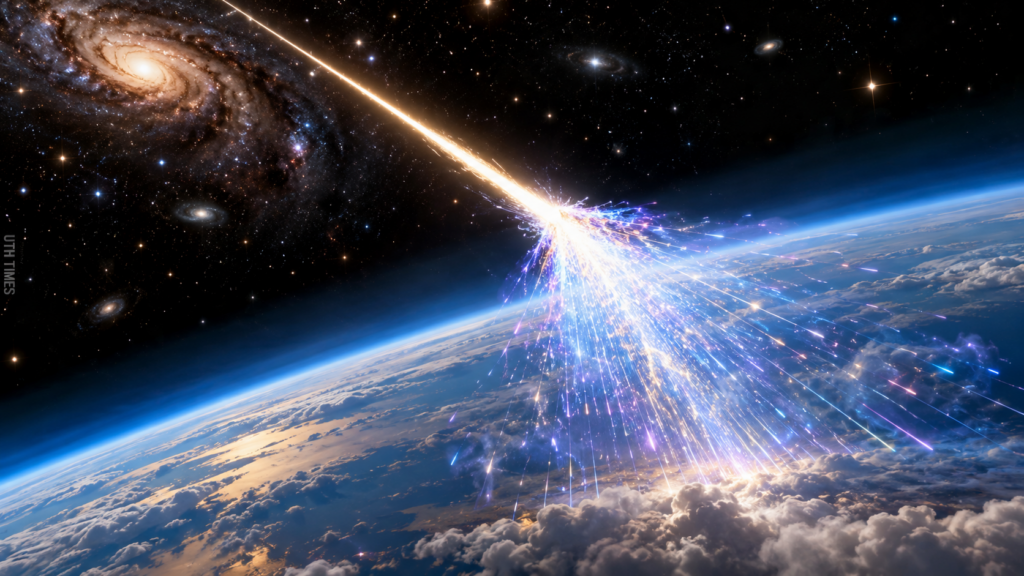
🔹 Detected on 27 May 2021 by the Telescope Array experiment in Utah, the particle was named Amaterasu, after the Japanese sun goddess. Researchers estimated its energy at approximately 244 exa-electronvolts (EeV), placing it among the most energetic cosmic rays ever recorded. Only the famous “Oh-My-God” particle, detected in 1991, ranks higher in the historical record.
🔹 To understand the scale, Amaterasu carried roughly 40 million times the energy of particles accelerated in the Large Hadron Collider, according to researchers’ comparisons. Yet the particle itself was extraordinarily tiny. Its significance lies not in its size, but in the astonishing energy concentrated within it.
⚡ How Did Scientists Detect It?
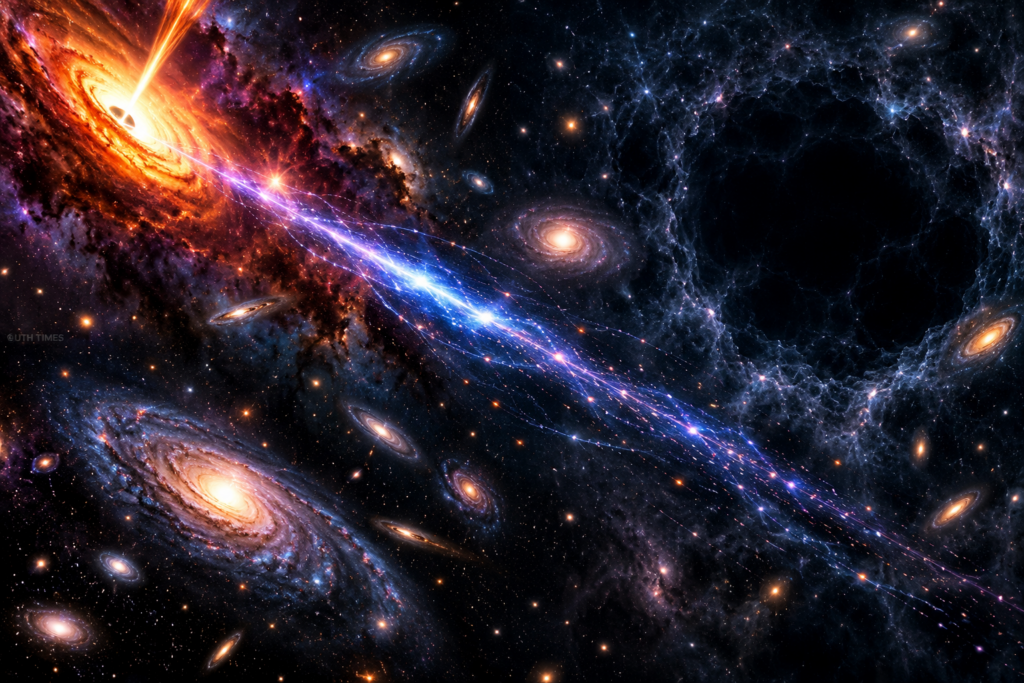
🔹 Cosmic rays are high-energy particles, often atomic nuclei, travelling through space at nearly the speed of light. When one strikes Earth’s atmosphere, it collides with atmospheric molecules and triggers a cascade of secondary particles known as an air shower.
🔹 The Telescope Array’s detectors captured the resulting shower, allowing scientists to reconstruct the original particle’s properties. The observation was so unusual that researchers carefully checked their calculations before announcing the discovery.
🕳️ The Biggest Mystery: Where Did It Come From?
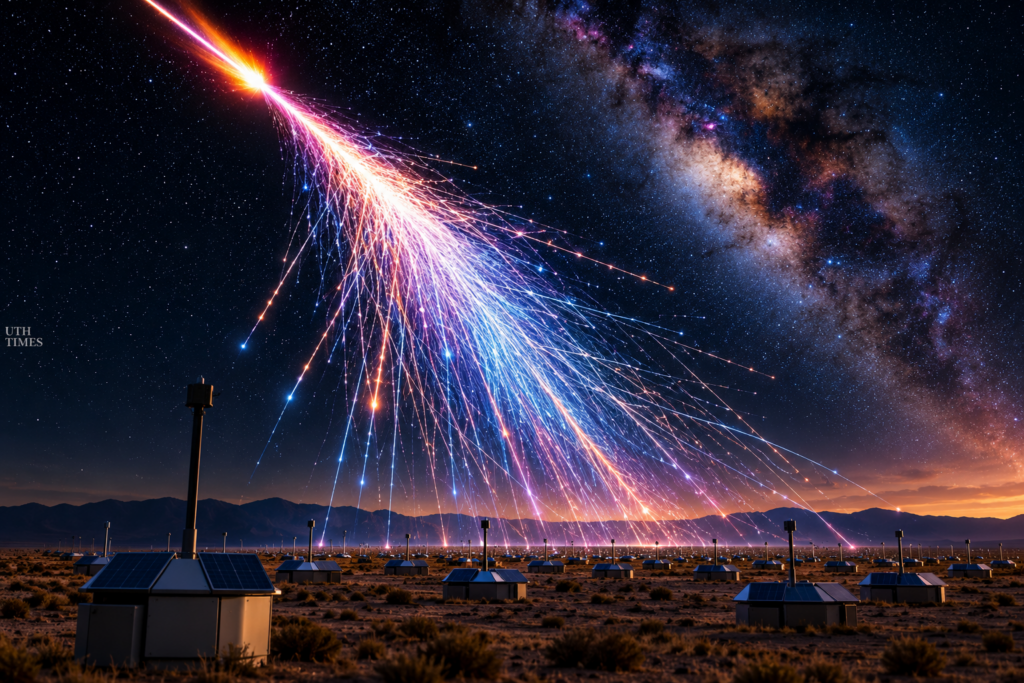
🔹 The real puzzle emerged when scientists tried to trace Amaterasu back to its source. Extremely energetic particles are expected to retain more directional information than lower-energy cosmic rays, but magnetic fields can still bend their paths. The reconstructed direction initially pointed toward a relatively empty region of space, often associated with the Local Void. No obvious source capable of producing such an energetic particle was identified.
🔹 Scientists have considered several possibilities, including powerful galaxies, extreme astrophysical events and acceleration mechanisms that are not yet fully understood. Ordinary supernova explosions, for example, may not be capable of accelerating particles to these extraordinary energies.
🔭 A New Clue Emerges in 2026
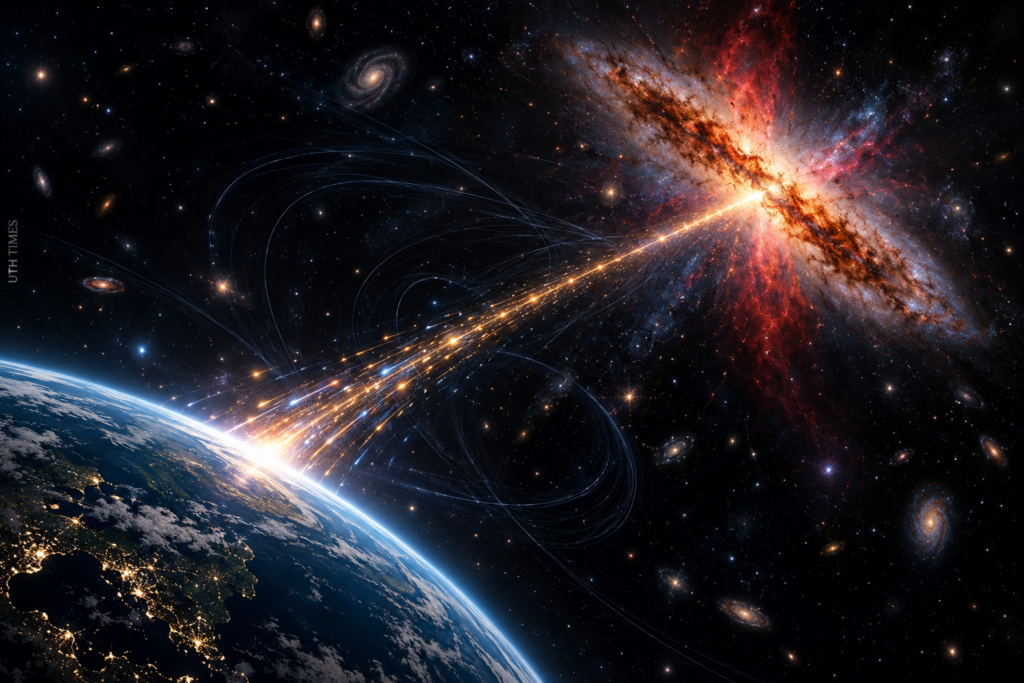
🔹 The mystery may now have a promising lead. Research published in 2026 by scientists associated with the Max Planck Institute for Physics explored possible origins using advanced simulations of particle propagation and magnetic-field deflection.
🔹 One candidate is M82, the Cigar Galaxy, a nearby starburst galaxy known for its intense star formation. Its energetic environment makes it an intriguing possibility. However, M82 has not been confirmed as Amaterasu’s birthplace; the proposed origin depends on assumptions about the particle’s composition, energy and journey through magnetic fields.
🌍 Should We Be Worried?
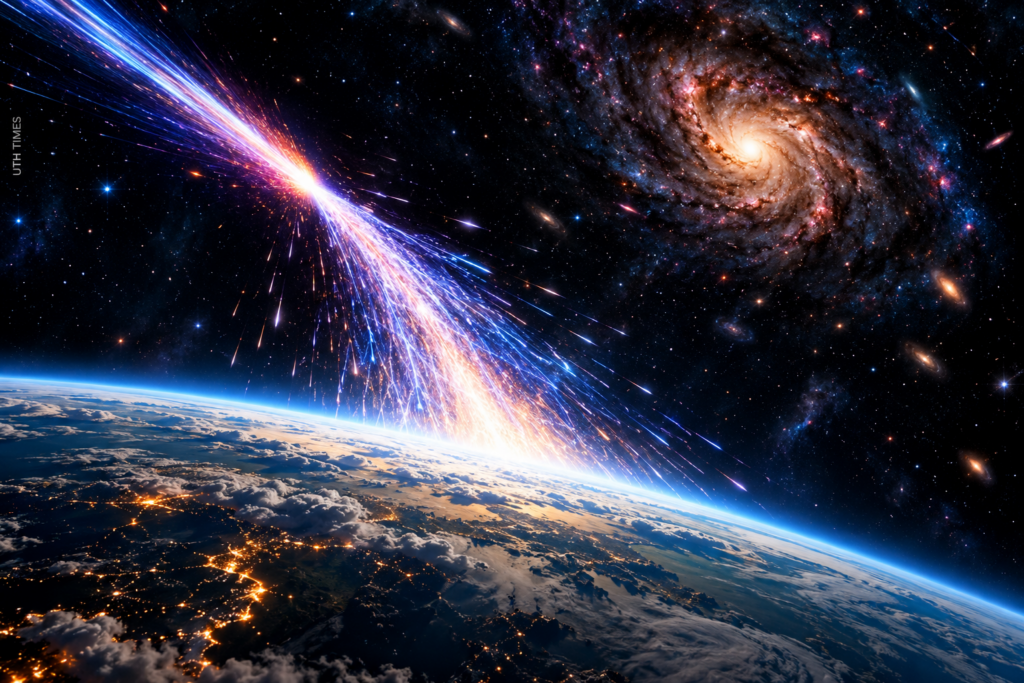
🔹 Despite its extraordinary energy, Amaterasu was not a threat to people on the ground. Earth’s atmosphere absorbs and disperses the energy of incoming cosmic rays through particle showers. Scientists study these events to understand extreme conditions across the Universe, not because they signal an impending catastrophe.
Amaterasu is more than a record-breaking particle. It is a reminder that the Universe can produce phenomena that challenge our current understanding. Finding its true origin could help scientists uncover how nature accelerates matter to energies far beyond human-made machines.
The particle has arrived. The investigation continues.

