
A new financial milestone has put India’s external economic strength firmly in the spotlight.
India’s foreign exchange reserves have climbed to an unprecedented $740.80 billion, marking the highest level ever recorded by the country. According to the Reserve Bank of India (RBI), reserves rose by $11.475 billion in the week ended August 28, 2026, extending the streak to a remarkable ninth consecutive weekly increase.
💰 A Record-Breaking Forex War Chest

The latest jump is not merely another weekly movement in India’s financial data—it represents a significantly stronger external cushion at a time when global markets remain vulnerable to geopolitical tensions, energy-price shocks and sudden capital movements.
🚀 Total reserves: $740.80 billion
🚀 Foreign Currency Assets: $600.67 billion
🚀 Gold reserves: $116.41 billion
🚀 SDRs: $18.81 billion
🚀 IMF Reserve Position: $4.91 billion
Foreign Currency Assets, the largest component of India’s reserves, alone increased by $9.337 billion during the week. Gold reserves added another $2.191 billion, demonstrating that the latest record was supported by multiple components of the reserve portfolio.
🏦 The RBI Factor Behind the Surge

One of the biggest stories behind this record is the RBI’s special foreign-currency mobilisation measures.
🔥 A special swap facility encouraged banks to attract foreign-currency deposits, particularly FCNR(B) deposits from non-resident Indians, alongside overseas foreign-currency borrowings.
🔥 Between June and August, these measures attracted more than $136 billion in foreign-currency inflows, with NRI deposits accounting for the overwhelming share.
This is crucial: the $740.80-billion reserve figure should not be interpreted as meaning the entire $136 billion of mobilised funds simply became additional reserves. The inflows interacted with the banking system and RBI operations, while the reported reserve stock also reflects asset movements and valuation changes.
🛡️ Why $740.80 Billion Matters
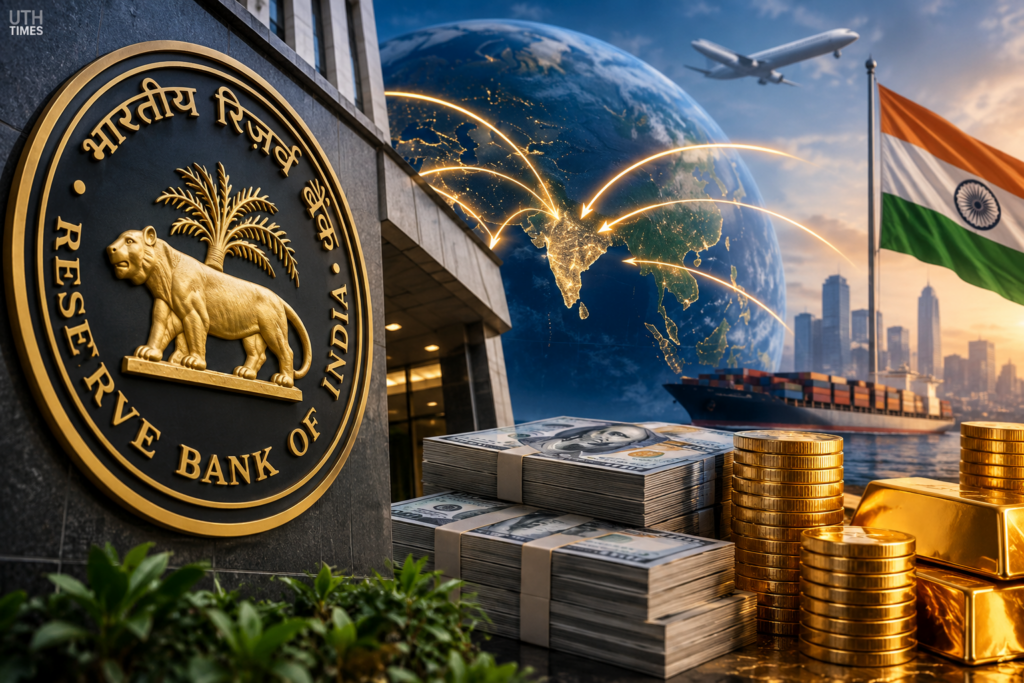
For India, massive reserves are essentially an external financial safety shield.
⚡ They give the RBI greater firepower to manage excessive volatility in the rupee.
⚡ They provide a buffer when crude-oil prices surge, particularly because India remains heavily dependent on imported energy.
⚡ They strengthen confidence among international investors, lenders and businesses dealing with India.
⚡ They improve India’s ability to withstand sudden capital outflows or global financial turbulence.
The timing is especially significant. With geopolitical conflicts disrupting energy markets and global capital flows, a large reserve cushion can provide valuable room for policymakers to respond to external shocks.
📈 From $728 Billion to $740.80 Billion

The previous record stood at around $728.49 billion, recorded for the week ended February 27, 2026. The latest figure therefore pushes India decisively beyond its earlier peak.
The bigger picture is even more striking: reserves have risen by nearly $75 billion across the nine-week run.
India’s $740.80-billion forex reserve milestone is ultimately a story about financial resilience.
It gives the country a deeper cushion against an unpredictable world—and gives the RBI more room to act when global volatility strikes.
India is not just building reserves. It is building economic shock-absorption capacity.

