
A Hyderabad defence-tech startup has pushed multirotor drone technology into a new speed bracket. Apollyon Dynamics’ electric interceptor, Ahuti Mk II, has reached a certified 498 km/h—setting a new Indian speed benchmark for multirotor UAVs.
🚀 498 km/h: A Record-Breaking Flight
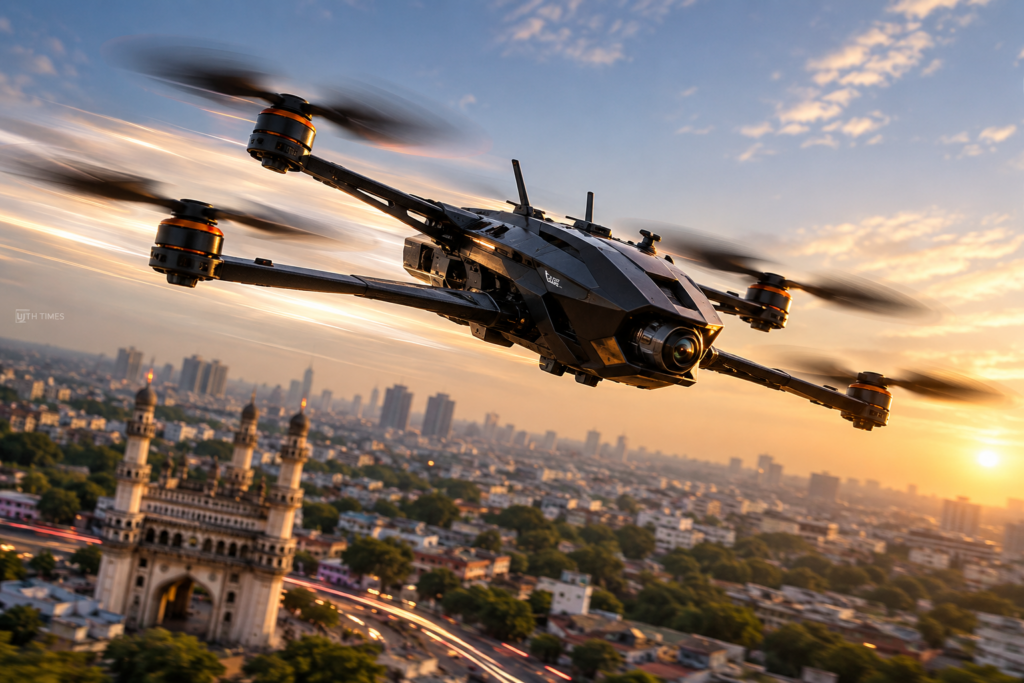
⚡ Ahuti Mk II has been recognised by the India Book of Records under the category for the Maximum Speed Achieved by a Multirotor UAV, making it the fastest multirotor UAV recorded in India.
⚡ The number is particularly striking because the company says the earlier benchmark stood at around 325 km/h. The new achievement therefore represents an increase of more than 170 km/h, underlining just how aggressively Apollyon has pushed the platform’s performance envelope.
⚡ Apollyon has also described the achievement as a benchmark for multirotor speed in South Asia based on publicly available data.
🛩️ Ahuti Mk II Was Built to Intercept—Not Hover

Most conventional multirotor drones are designed around stability, hovering, manoeuvrability or carrying payloads. Ahuti Mk II takes a fundamentally different approach.
🎯 It is an electric multirotor interceptor, designed around rapid response and the ability to close distance against aerial threats at extreme speed.
🎯 That mission changes the engineering priorities completely. Instead of simply asking how long a drone can remain airborne, the challenge becomes how quickly it can accelerate, remain controllable at high velocity and deliver the responsiveness expected from an interceptor platform.
🎯 Apollyon says the system is intended for autonomous aerial and unmanned applications for the Indian armed forces, placing the record within a much broader defence-technology effort rather than treating speed as a standalone
🔧 Ten Iterations Behind One Extraordinary Number

The 498 km/h figure did not emerge from a single prototype.
🧩 Founder Jayant Khatri said Ahuti Mk II underwent around 10 iterations involving its frame, propulsion system and motor configuration.
🧩 Each redesign was aimed at solving the engineering problems that emerge when a multirotor is pushed far beyond the speeds normally associated with this class of aircraft.
🧩 The development team included Aman Virani, Manas Vichare and Ishaan Suri, who worked through repeated design changes, testing and failures before reaching the record-setting configuration.
🇮🇳 From Startup Experiment to Defence Milestone

Apollyon Dynamics was founded in 2025 by Jayant Khatri and Sourya Choudhary and was incubated at BITS Pilani’s Hyderabad campus. The company develops autonomous aerial systems aimed at defence applications and has already fielded drone systems with the Indian Army.
What makes the story particularly compelling is the speed of that journey: a young Indian deep-tech company has moved from early-stage experimentation to developing high-performance defence platforms in a remarkably short period.
🔥 Why 498 km/h Matters

The record is bigger than a headline number.
⚙️ For an interceptor, speed can translate into shorter response times and faster engagement capability.
⚙️ For India’s defence-tech ecosystem, it demonstrates that advanced unmanned systems are increasingly being designed and developed domestically.
⚙️ And for Apollyon Dynamics, 498 km/h appears to be a milestone—not a finishing line. The company itself has signalled its ambition with a simple message: “498 km/h today. Faster tomorrow.”
Apollyon Dynamics’ Ahuti Mk II has turned a Hyderabad startup into the centre of a striking Indian aerospace story. 498 km/h is the record—but the real story is how quickly India’s young defence-tech companies are learning to build at the edge of what drones can do.

