
India is not changing its time zone. It is doing something far more strategic: making one nationally controlled time reference the backbone of the country’s critical systems.
The Legal Metrology (Indian Standard Time) Rules, 2026, notified on 27 August 2026, establish IST as the common reference for legal, administrative, commercial and official purposes. The rules will take effect 180 days after Gazette publication, giving organisations time to upgrade and synchronise their systems.
🇮🇳 One Country, One Authoritative Clock
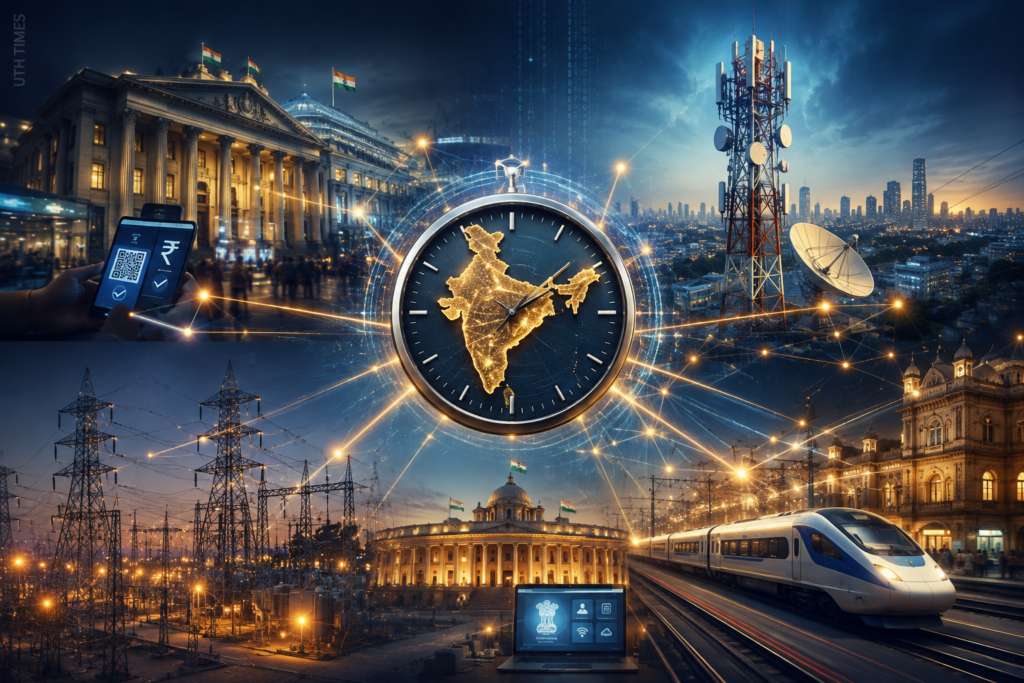
The significance of the move lies not in what people see on their watches, but in what happens inside machines.
🔹 Banking & digital payments: Financial transactions depend on accurate timestamps to establish the precise sequence of events.
🔹 Telecommunications: Network operations require highly coordinated clocks for synchronisation, data transmission and infrastructure management.
🔹 Power & transport: Electricity grids, railways and other large-scale infrastructure generate enormous volumes of time-sensitive data where even small timing discrepancies can matter.
🔹 Government & digital governance: Official records and technology-driven public services can operate against a common, traceable national reference.
In other words, India is standardising the invisible clockwork behind the visible economy.
🕰️ The Master Reference: UTC(NPLI)

At the centre of the system is CSIR-National Physical Laboratory (NPL), which maintains UTC(NPLI)—India’s realisation of Coordinated Universal Time.
IST is derived from this national reference by adding 5 hours and 30 minutes. The new framework requires time used by regulated systems to be traceable to authorised Indian timing sources.
That traceability is crucial. It means a system should not merely display “IST”; its clock must be connected through an authorised chain to India’s national time standard.
🛰️ NavIC + White Rabbit: Building India’s Time Infrastructure

India is also developing indigenous ways to distribute this precise time.
🔹 NavIC, India’s satellite-navigation system, along with other authorised Indian sources, can support secure domestic time dissemination.
🔹 White Rabbit Technology enables extremely precise synchronisation through fibre networks. A demonstration network was commissioned at the Regional Reference Standards Laboratory in Bengaluru in July 2026.
🔹 The system has already demonstrated IST dissemination for banking, telecom, power, transportation and digital governance, including a secure link between Bengaluru and NSE Chennai.
🔐 More Than Timekeeping: Digital Sovereignty

The deeper objective is resilience.
Many modern systems can obtain timing from foreign satellite-based sources. Building a robust Indian timing-distribution network gives critical infrastructure another nationally controlled option and reduces dependence on external timing infrastructure.
“One Nation, One Time” is therefore not really about clocks.
It is about control, precision and digital sovereignty—ensuring that when India’s banks, networks, power systems, transport infrastructure and government platforms record an event, they are all measuring it against the same trusted national clock.
India is not changing the time. It is taking greater control of it.

