
Home Blog Page 9

India to Match Space Superpowers by 2040: ISRO Chief’s Bold Vision

0

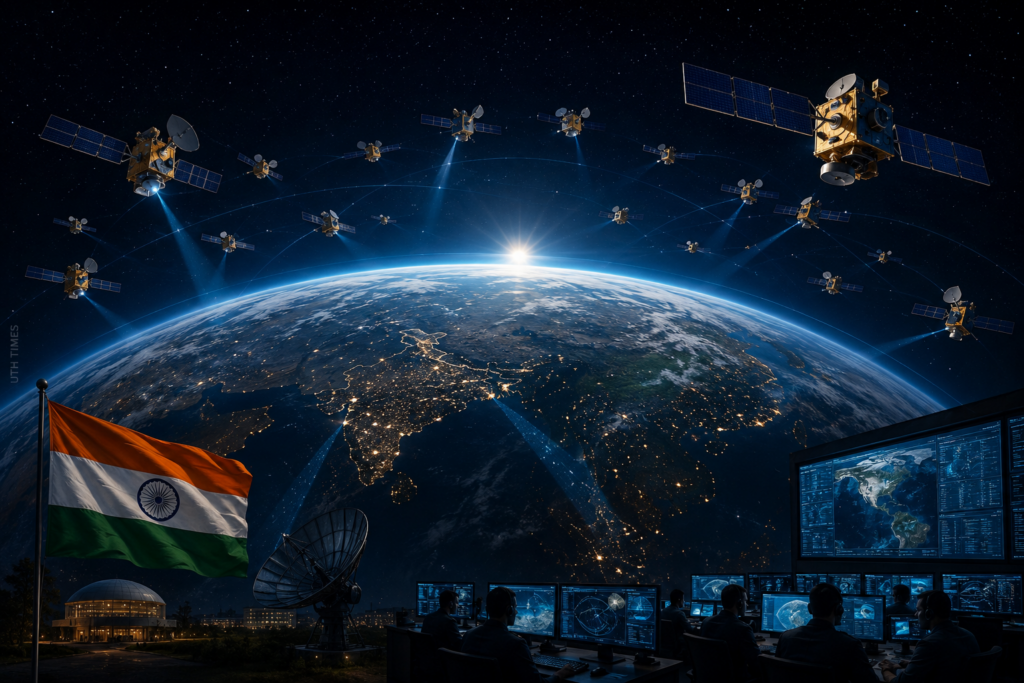
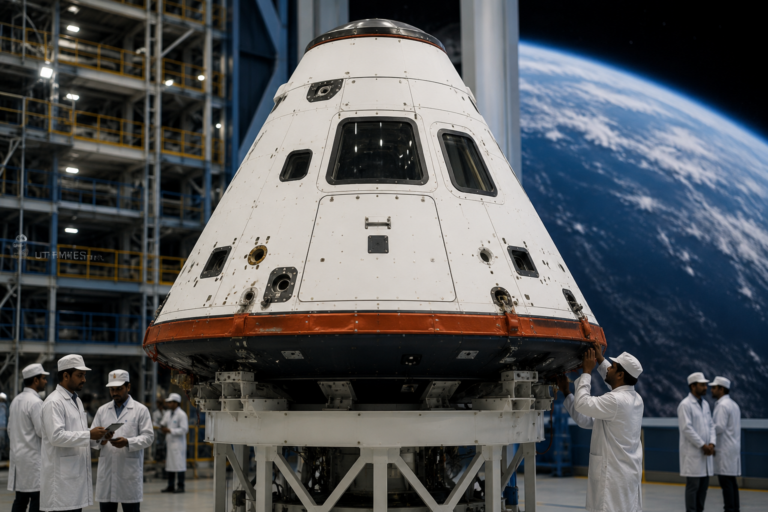
India’s space story is no longer about catching up—it is about competing at the highest level. Indian Space Research Organisation Chairman V. Narayanan has declared that India will stand shoulder-to-shoulder with the world’s leading space nations by 2040. It is a statement packed with ambition, confidence, and strategic intent. 

🚀 A New Era for India’s Space Power

For decades, global space dominance was led by nations like the United States, Russia, and China. India, once seen as a cost-efficient underdog, is now preparing for elite status.

Narayanan’s 2040 target reflects a long-term roadmap where India aims to become a full-spectrum space power with strengths in:

🔹 Human spaceflight missions

🔹 Lunar landings

🔹 Space stations

🔹 Heavy-lift rockets

🔹 Planetary exploration

🔹 Commercial satellite launches

🔹 Defence and surveillance systems 

This means India is not thinking small anymore.

🌕 Moon Missions and Human Spaceflight

One of the biggest highlights of the vision is sending an Indian astronaut to the Moon with the national flag by 2040.

Before that, India is expected to accelerate its human space programme through the Gaganyaan project, which includes multiple uncrewed missions before crewed launches.

This is critical because human spaceflight builds advanced capabilities in life-support systems, precision re-entry, astronaut training, and deep-space operations. 

🛰️ More Than Rockets: Building an Ecosystem

The future race is not only about rockets. It is about an ecosystem of innovation.

India is expected to scale rapidly in:

🔹 Private space startups

🔹 Satellite manufacturing

🔹 Space-based internet and communications

🔹 Climate-monitoring satellites

🔹 Navigation systems

🔹 Global launch services

With government reforms opening the sector to private companies, India’s space economy could become a major global business engine.

🏗️ Space Station by 2035

Another milestone is the planned Bharatiya Antariksh Station by 2035—a major stepping stone before 2040.

Having an indigenous space station would place India among a very small group of nations capable of long-duration orbital missions and advanced research in microgravity. 
This is more than a prediction—it is a declaration of intent. If India delivers on rockets, astronauts, lunar missions, and orbital infrastructure, 2040 may mark the moment the world stops calling India an emerging player and starts calling it a space superpower.
Prayer and the Brain: Ancient Wisdom, Modern Proof

0

For centuries, prayer was seen as a spiritual act—something beyond science. But modern neuroscience is revealing a stunning truth: prayer doesn’t just comfort the soul, it can transform the brain itself. Ancient traditions may have understood something humanity is only now proving in laboratories.

🧠 The Brain on Prayer: What Science Found

When a person prays regularly, brain scans show changes in key regions linked to attention, compassion, memory, and emotional regulation.

🔹 Prefrontal Cortex Activation

This is the brain’s command center for focus, decision-making, and discipline. During prayer, this region often becomes more active, meaning prayer can sharpen concentration and mental control.

🔹 Calmer Amygdala Response

The amygdala handles fear and stress reactions. Research suggests prayer may reduce overactivity here, helping lower anxiety and emotional panic.

🔹 Stronger Neural Pathways

Repeated prayer acts like mental training. Just as exercise strengthens muscles, repeated spiritual focus may strengthen neural circuits connected to peace, patience, and resilience.

🔥 Why Prayer Feels So Powerful

Prayer combines multiple brain-enhancing elements at once:

🔹 Focused Attention – directing the mind toward one intention

🔹 Emotional Release – expressing fears, gratitude, hope

🔹 Rhythm & Repetition – calming the nervous system

🔹 Meaning & Purpose – giving life deeper psychological structure

🔹 Connection – reducing feelings of loneliness

This creates a rare state where mind, emotion, and body synchronize.

🌍 Ancient Traditions Were Ahead of Their Time

Long before brain imaging existed, civilizations built prayer into daily life.

🔹 Morning prayers for mental clarity

🔹 Evening prayers for emotional release

🔹 Chanting for rhythm and calm

🔹 Silent prayer for self-reflection

🔹 Gratitude prayer for emotional balance

What looked like pure ritual may also have been advanced psychological technology.

⚡ Prayer vs Stress in the Modern World

Today’s world floods the brain with notifications, pressure, and overstimulation. Prayer offers the opposite:

🔹 Stillness in noise

🔹 Order in chaos

🔹 Calm in uncertainty

🔹 Hope in fear

Even a few minutes daily can create measurable mental shifts over time.

Prayer is not a magic cure or replacement for therapy or medical treatment. But as a regular practice, it can become a powerful tool for emotional health, mental clarity, and inner stability.

Science is catching up to something ancient cultures practiced for generations: prayer is more than belief. It may be brain training wrapped in spirituality. In a distracted world, that might be one of the most valuable discoveries of all.

Metal Power: IIT Madras Startup Reimagines Energy Storage

0

What if electricity could be packed, stored for months, shipped by truck, and used whenever needed? That sounds futuristic—but three scientists from Indian Institute of Technology Madras are working to make it real through their startup Sthyr Energy.

⚡ The Biggest Problem in Renewable Energy

India has rapidly expanded solar and wind power. On many days, the country produces enormous renewable electricity—sometimes more than immediate demand. But there’s one painful limitation:

🔹 If power isn’t used instantly, much of it goes waste

🔹 Solar generation drops after sunset

🔹 Wind output changes unpredictably

🔹 Existing batteries are expensive for long-duration storage

🔹 Grid balancing becomes harder as renewables grow

This means the world is generating clean power—but struggling to preserve it.

🔩 Turning Electricity Into Metal

Sthyr Energy’s breakthrough idea is astonishingly simple and revolutionary: convert surplus electricity into energy stored inside metal.

Instead of relying only on lithium-ion batteries, the startup is reportedly exploring metal-based energy systems where electricity is used to charge metal materials, which can later release that stored energy when required.

Think of it as solid energy packets.

🔹 Store renewable power for weeks or months

🔹 Transport it physically via trucks or rail

🔹 Use it in remote areas without large grid upgrades

🔹 Reduce dependence on costly battery minerals

🔹 Build a more flexible energy economy

This could redefine how electricity moves—not just through wires, but through materials.

🚚 Why This Could Be Massive for India

India is one of the fastest-growing clean-energy markets in the world. But renewable-rich states often generate power far from industrial demand centers.

If metal-energy transport becomes viable:

🔹 Solar energy from Rajasthan could power factories elsewhere

🔹 Remote villages could receive stored energy modules

🔹 Ports, mines, and farms could use off-grid clean power

🔹 Grid congestion and transmission pressure may reduce

🔹 Seasonal surplus power could be preserved longer

That means energy would no longer be trapped by geography.

🌍 Global Impact Beyond India

This is not just an Indian innovation story—it could become a global infrastructure shift.

Countries with abundant sun, wind, or hydro could export stored clean energy in metal form. Nations lacking strong grids could leapfrog directly into flexible power systems.

If successful, Sthyr Energy may help transform electricity from an instant-use commodity into a tradable stored resource.

Three scientists from IIT Madras are attempting something bold: changing electricity from something you consume immediately into something you can own, move, and save.

If they succeed, the future of power may not sit in batteries alone—it may sit inside metal.

India’s First Chip Fab Gets Green Signal: Tata’s ₹91,000 Crore Gujarat Mega Move

0

India has just crossed a historic milestone. In a move that could redefine the nation’s technological future, the government has officially cleared India’s first semiconductor fabrication plant under a Special Economic Zone (SEZ) in Dholera, Gujarat, with the Tata Group set to invest a massive ₹91,000 crore. This is not just a factory—it is India’s entry ticket into the elite global chip manufacturing race. 

🚀 Why This Announcement Is Monumental

Semiconductors are the invisible engines powering modern life. Smartphones, laptops, EVs, satellites, defense systems, AI servers, and even household appliances depend on chips.

Until now, India largely relied on imports. This project changes the equation dramatically.

🔹 First-ever chip fabrication plant officially notified in India

🔹 Strategic location at Dholera, Gujarat

🔹 ₹91,000 crore investment among India’s biggest tech bets

🔹 Designed as an advanced AI-enabled semiconductor facility

🔹 Expected to generate around 21,000 jobs directly and indirectly 

🏗️ Why Gujarat, Why Dholera?

Dholera is rapidly emerging as India’s futuristic industrial powerhouse. With planned smart-city infrastructure, logistics corridors, expressways, and industrial connectivity, it offers the scale and speed required for semiconductor manufacturing.

Chip fabs need uninterrupted power, ultra-clean water systems, precision logistics, and stable infrastructure. Dholera checks those boxes.

This makes Gujarat a rising semiconductor capital, already attracting other electronics and chip investments. 

💡 What Makes a Chip Fab So Powerful?

Fabrication plants are among the most sophisticated manufacturing facilities in the world. They convert silicon wafers into integrated circuits through nanometer-level precision processes.

That means India is moving beyond assembly lines and into core high-value manufacturing.

🔹 More domestic chip supply

🔹 Reduced import dependence

🔹 Stronger supply-chain security

🔹 Boost for AI, telecom, automotive & defense sectors

🔹 Massive talent demand for engineers and technicians

🌍 India’s Global Tech Moment

For years, chip dominance belonged mainly to nations like Taiwan, South Korea, United States and Japan. India is now preparing to join that conversation.

This decision signals to global investors that India is serious about becoming a semiconductor powerhouse—not just a market, but a maker.

This is bigger than a corporate investment. It is a national capability shift. If executed at scale, Tata’s Gujarat fab could become the foundation stone of a new era—where chips stamped “Made in India” power the world.

Sky Warrior: The 11-Day Flight That Shocked the World

0

At just five months old, an ordinary-looking bird achieved something many aircraft would admire. A young bar-tailed godwit flew 8,425 miles (13,560 km) from Alaska to Australia in a single nonstop journey—without food, water, or rest for 11 straight days. It wasn’t luck. It was one of nature’s greatest performances.

🌍 A Record-Breaking Migration Marvel

This young bird, still in its first year of life, crossed the vast Pacific Ocean in one uninterrupted flight. No landing on islands. No stopping to recover. No feeding break. Just wings, instinct, and endurance.

The journey began in Alaska’s summer breeding grounds, where godwits hatch and prepare for migration. As winter approached in the Northern Hemisphere, the bird launched southward toward Tasmania and Australia, following an ancient route written into its biology.

Scientists tracking migratory birds were stunned—not only because of the distance, but because this was a juvenile bird, making one of the toughest migrations on Earth so early in life.

🧬 Built Like a Biological Jet

Bar-tailed godwits are specially designed for extreme travel. Before migration, they transform their bodies into flying machines.

🔹 They dramatically increase body fat, which becomes fuel during flight.

🔹 Internal organs like the digestive system temporarily shrink to reduce weight.

🔹 Their heart and flight muscles become highly efficient.

🔹 Long pointed wings help them glide and conserve energy over oceans.

During nonstop flights, these birds burn fat reserves slowly and carefully, almost like a plane managing fuel for a long-haul route.

🧭 How Did a 5-Month-Old Know the Way?

Perhaps the most astonishing part is navigation. This young bird had never made the journey before.

Experts believe migratory birds use a mix of:

🔹 Earth’s magnetic field

🔹 Position of the sun and stars

🔹 Wind patterns

🔹 Genetic memory and instinct

That means this bird likely crossed thousands of miles of open ocean using natural guidance systems humans still study with fascination.

⚠️ Why This Matters Beyond Birds

This story is more than a wildlife headline. It highlights how migration depends on healthy ecosystems across continents.

Wetlands in Alaska, stopover zones, and Australian coastal habitats all play roles in the survival of species like the godwit. Climate change, habitat destruction, and storms can threaten these incredible journeys.

When one bird flies across the planet, it connects nations through nature.

A five-month-old bird flew farther than many people travel in years—without maps, engines, or supplies. In a world obsessed with technology, this tiny traveler reminded us that some of the greatest wonders still come with feathers.

Navgunjara: Krishna’s Mysterious Nine-Form Avatar

0

Some legends are not just stories—they are coded wisdom. Among the lesser-known yet visually stunning tales of Indian mythology is the legend of Navgunjara, a divine nine-part creature believed to be a symbolic manifestation of Lord Krishna. Strange in appearance, profound in meaning, Navgunjara remains one of the most artistic spiritual mysteries of ancient India.

When Arjun Faced the Impossible

During the exile of the Pandavas, Arjun was performing deep penance in the hills of Manipur. In the silence of meditation, an extraordinary being suddenly appeared before him.

It was unlike anything ever seen—a creature made from nine different life forms, yet standing in complete harmony.

🔹 Head of a rooster

🔹 Neck of a peacock

🔹 Hump/back of a bull

🔹 Waist of a lion

🔹 Tail of a serpent

🔹 Three legs of elephant, tiger, and horse

🔹 One human arm holding a lotus flower

At first glance, Arjun was alarmed. He immediately lifted his legendary bow, Gandiv, believing it to be a dangerous illusion or demonic beast.

The Moment of Realization

As Arjun observed carefully, fear transformed into wonder. Despite being made of conflicting forms, the creature radiated balance, grace, and divine calm.

He understood that such perfection could not belong to nature alone—it had to be a cosmic play of the Supreme. Arjun lowered his bow and bowed at its feet. In that instant, the form dissolved, and Lord Krishna appeared.

Navgunjara was not a monster. It was a message.

The Hidden Meaning of Navgunjara

This form carries layered symbolism that still fascinates scholars and devotees.

🔹 Unity in Diversity – Different species, one body. A reminder that all creation is connected.

🔹 Beyond Appearances – What seems strange may hold divine truth. Wisdom begins where judgment ends.

🔹 Ego Surrender – Even mighty Arjun had to lower his weapon before the unknown.

🔹 Cosmic Presence – God exists not only in humans, but in animals, birds, reptiles, and every force of nature.

Odisha’s Living Heritage

Navgunjara remains deeply rooted in the culture of Odisha.

🎨 Featured in traditional Pattachitra paintings

🏛️ Carved on temple walls across the region

🃏 Seen in historic Ganjifa playing cards

🙏 Connected with the spiritual traditions of Jagannath Temple

Its artistic form continues to inspire devotees, historians, and art lovers alike.

Navgunjara reminds us that truth is not always simple, and divinity is not always familiar. Sometimes, the universe appears in forms that challenge logic—only to awaken deeper vision.

India’s 6G Patent Power Move

0

India is no longer waiting for the future of connectivity—it is helping write it. With over 4,000 patents already contributed to the global 6G ecosystem, India has now set an ambitious goal: to own 10% of the world’s total 6G intellectual property (IP). This is more than a technology headline—it is a declaration of strategic power. 

🚀 Why Patents Matter More Than Towers

Many people think telecom leadership is about towers, SIM cards, and faster internet speeds. But the real battle happens behind the scenes—in patents.

Patents decide:

🔹 Who earns royalty income when technologies are used globally

🔹 Who influences global standards

🔹 Which country becomes a technology creator instead of a buyer

🔹 Who controls future innovation ecosystems

In earlier wireless generations, nations often paid foreign companies for patented technologies. With 6G, India wants to reverse that equation.

🌍 From Market to Maker

India has been one of the world’s largest telecom consumer markets. But now it is moving beyond consumption into invention.

The country’s growing patent count shows strength in:

🔹 Advanced wireless systems

🔹 AI-powered networks

🔹 Smart spectrum use

🔹 Satellite-terrestrial integration

🔹 Rural and universal connectivity solutions

India’s proposal on ubiquitous connectivity has already been accepted by global bodies such as 3GPP and the International Telecommunication Union (ITU)—a sign that Indian ideas are entering global rulebooks. 

🧠 Bharat 6G Alliance: The Brain Behind the Push

The Bharat 6G Alliance is driving this mission by bringing together industry, startups, telecom firms, research labs, and academic institutions. It has expanded from 14 institutions to 85 members, showing rapid momentum. 

Its focus areas include:

🔹 Devices and hardware

🔹 Green telecom systems

🔹 6G use cases

🔹 Global partnerships

🔹 Indigenous components and technology

This means India is not chasing trends—it is building an ecosystem.

⚡ Why 10% Ownership Is a Massive Goal

Owning 10% of global 6G IP could give India long-term strategic advantages:

🔹 Royalty revenues from worldwide deployments

🔹 Stronger domestic telecom manufacturing

🔹 Global negotiating power

🔹 Startup innovation boom

🔹 Leadership in future digital infrastructure

When billions of devices connect in the 6G era, patented technologies could generate enormous economic value.

India’s 4,000+ patents are not just numbers—they are signals. Signals that the country wants to move from user to architect, from buyer to builder, and from participant to powerhouse in the next internet revolution.

The race for 6G has begun—and India intends to own a serious share of the future.

GE-HAL Jet Engine Deal Changes India’s Defence Future

0

India has taken one of its biggest aerospace leaps yet. GE Aerospace and Hindustan Aeronautics Limited have agreed to co-produce F414 fighter jet engines in India—marking the first major transfer of advanced fighter jet engine technology from the United States to India. This is not just a defence contract. It is a strategic turning point.

✈️ What Is the F414 Engine?

The F414 is one of the world’s most trusted and powerful combat jet engines, built for next-generation fighter aircraft. It powers multiple advanced fighter platforms globally and is known for thrust, reliability, and battlefield performance.

🔹 Produces around 22,000 pounds of thrust

🔹 Designed for supersonic fighter aircraft

🔹 Proven in demanding combat environments

🔹 High durability with lower maintenance burden

🔹 Suitable for future Indian fighter programs

This engine is expected to power India’s indigenous HAL Tejas Mk2 and potentially other advanced military aircraft in the future.

🇮🇳 Why This Deal Is Historic for India

For decades, fighter jet engines remained among the most protected military technologies in the world. Nations often sold aircraft, but rarely shared core engine know-how. This agreement changes that equation.

🔥 India moves from buyer to builder

🔥 Local manufacturing strengthens self-reliance

🔥 Critical know-how enters Indian industry

🔥 Reduces long-term dependence on imports

🔥 Builds domestic aerospace supply chains

It directly supports India’s “Make in India” and defence indigenisation vision. Instead of importing complete engines, India now gains access to advanced manufacturing processes, assembly capability, and technical expertise.

🛡️ Strategic Message to the World

This partnership also reflects growing trust between India and the United States. Defence ties between both nations have rapidly expanded in recent years, but jet engine technology transfer is considered top-tier cooperation.

🌍 Shows India’s rising global strategic importance

🌍 Deepens India-US defence partnership

🌍 Strengthens Indo-Pacific security balance

🌍 Boosts India’s position in military aviation markets

🌍 Signals confidence in India’s engineering ecosystem

🚀 What It Means for Future Jets

India has ambitious fighter aircraft plans including Tejas Mk2, Advanced Medium Combat Aircraft, and future unmanned combat platforms. A strong domestic engine manufacturing base can accelerate these programs.

🔧 Faster production timelines

🔧 Better maintenance inside India

🔧 Easier upgrades and customization

🔧 Job creation in high-tech manufacturing

🔧 Growth of private and public aerospace industries

This is more than an engine deal—it is an entry ticket into the elite league of nations mastering advanced fighter propulsion. India is no longer only buying defence technology. It is beginning to build the power that flies it.

Chandrayaan-3 Reveals Hidden Layers on the Moon

0

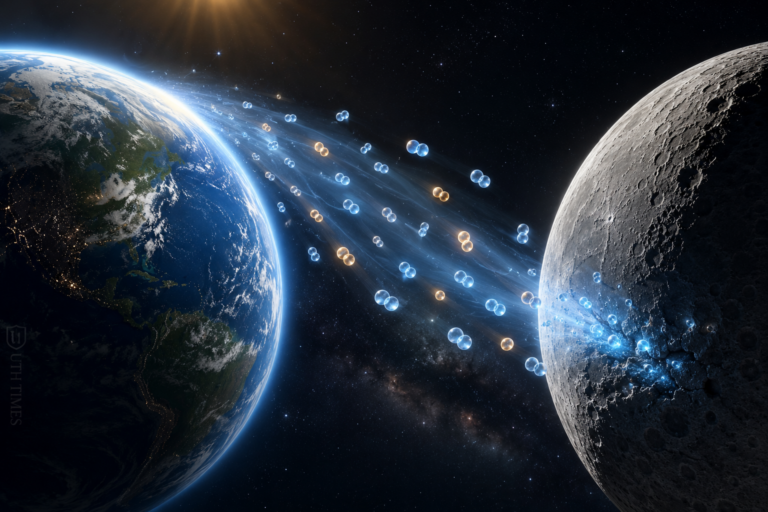
India’s lunar mission has delivered another surprise. A new scientific study using data from Chandrayaan-3 has revealed that the Moon’s surface near the south pole is not uniform. Instead, the top few centimetres contain two distinct underground layers — a finding that could reshape future searches for lunar water ice.

This is not just geology. It could influence where humans land, build bases, and extract resources in the future. 

🌕 What Exactly Did Scientists Discover?

Using data collected by the Vikram lander’s ChaSTE instrument, researchers studied the temperature and thermal behaviour of lunar soil after the lander’s famous “hop experiment.”

They found that the upper about 3 cm of soil behaves differently from the lower layer beneath it, extending to around 6.5 cm.

🔹 Top Layer: More compact and transfers heat faster

🔹 Lower Layer: Less conductive, looser, and thermally different

🔹 This suggests the Moon’s surface is layered rather than one uniform dust blanket

That may sound technical, but it is a major clue about how lunar soil evolved over time. 

💧 Why This Matters for Water Ice

The Moon’s south pole is one of the most valuable locations in space because many scientists believe water ice may exist in permanently shadowed craters there.

But ice survival depends heavily on temperature below the surface.

🔹 If heat moves differently through layers, ice may stay trapped deeper underground

🔹 Some layers may act like insulation, protecting frozen water

🔹 It helps scientists identify the best drilling zones for future missions

🔹 Better models can guide astronauts and robotic miners

This means India’s data could help future explorers locate hidden water reserves more efficiently. 

🚀 Why the Vikram “Hop” Became Historic

After landing, the Vikram lander performed a short jump or “hop” to test mobility. That small move disturbed the surface and exposed fresh soil.

Scientists then used those new readings to compare soil behaviour before and after movement — unlocking clues impossible to get from a static landing alone.

Sometimes a tiny jump creates a giant scientific leap.

🇮🇳 India’s Growing Lunar Leadership

This discovery strengthens ISRO’s role in global Moon science. Chandrayaan-3 is no longer remembered only for landing near the lunar south pole — it is now helping decode what lies beneath it.

As nations race back to the Moon, India already has something priceless: real data from the ground.

The Moon may look silent and dusty, but beneath those few centimetres lies a complex world. Thanks to Chandrayaan-3, humanity now knows the lunar surface hides more secrets than expected — and perhaps, the water needed for the next space age.

India Finds Massive Uranium Reserves: Andhra Pradesh Leads the Charge

0

India has identified more than 93,000 tonnes of in-situ uranium resources across four states, marking a major strategic breakthrough for the nation’s energy future. At a time when countries are racing toward clean power, energy security, and reduced fossil fuel dependence, this discovery places India in a stronger global position.

Leading the list is Andhra Pradesh with a massive 60,659 tonnes, making it the largest uranium-holding state in this identified reserve category.

This is not just a mining update—it is a story of power, policy, and future ambition.

⚛️ What Is In-Situ Uranium?

“In-situ” uranium means the mineral is present underground in natural deposits and can often be extracted using advanced methods without large-scale surface excavation.

🔹 Lower land disruption compared to traditional mining

🔹 More efficient long-term extraction possibilities

🔹 Important for sustainable resource planning

🔹 Valuable for future nuclear fuel supply chains

This makes the discovery even more significant from both economic and environmental perspectives.

🏆 Andhra Pradesh Emerges as India’s Uranium Capital

With 60,659 tonnes, Andhra Pradesh has become the dominant state in India’s newly identified uranium map.

Why this matters:

🔹 Can attract future investment and infrastructure development

🔹 Strengthens regional industrial importance

🔹 Creates strategic relevance in India’s energy network

🔹 Could become central to future nuclear fuel production

This gives Andhra Pradesh a powerful role in India’s long-term growth story.

🔋 Why Uranium Is a Strategic Goldmine

Uranium is the backbone of nuclear energy. Unlike coal and oil, nuclear power produces massive electricity with low carbon emissions.

For India, these reserves could mean:

🔹 Greater energy independence

🔹 Reduced dependence on imported fuel

🔹 Cleaner electricity generation

🔹 Stronger support for growing industries and cities

🔹 Boost to India’s net-zero ambitions

As electricity demand rises, domestic uranium becomes more valuable than ever.

🌍 Global Impact: India’s Energy Status Gets Stronger

The world is watching nations that can secure future energy resources. With this reserve identification, India gains stronger bargaining power in global energy and strategic discussions.

It also supports India’s expanding nuclear vision, where reliable fuel supply is essential.

This is more than a resource discovery—it is a signal that India is preparing for the future. Beneath its land lies the fuel that could power tomorrow’s cities, industries, and ambitions.

And right now, Andhra Pradesh stands at the center of that atomic rise.