Home Blog Page 19

Khavda: Powering India’s Green Leap

0

From salt deserts to superpower grids—India is rewriting the global energy story.

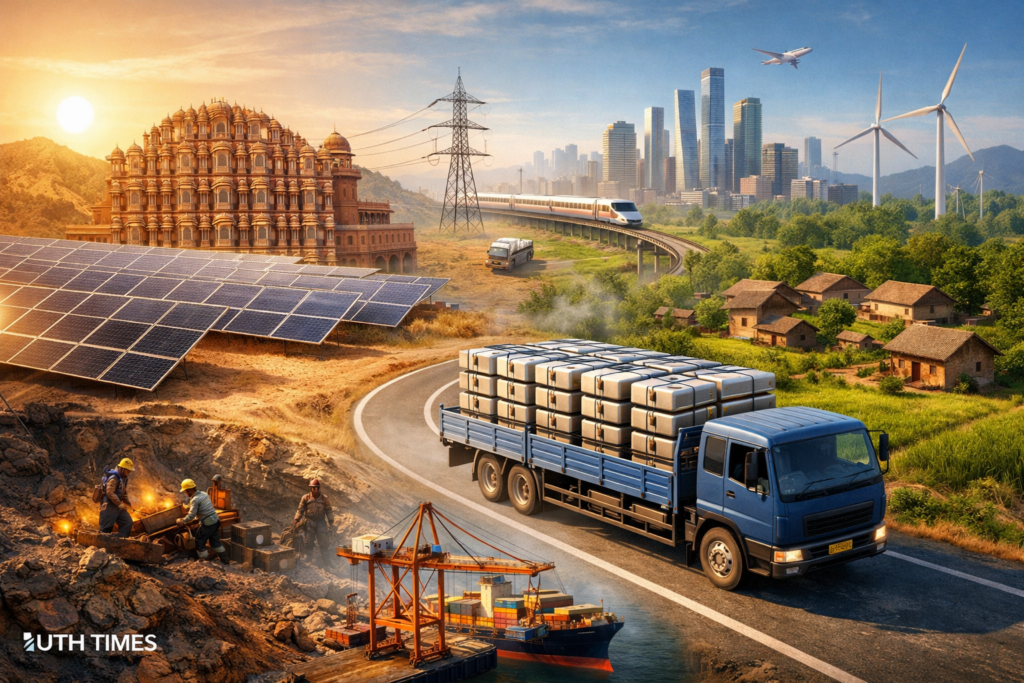
In the arid expanse of Gujarat’s Kutch region, a transformation of historic scale is underway. The Khavda Renewable Energy Park is set to become the largest renewable energy park on Earth, turning an inhospitable landscape into the engine room of India’s clean-energy future.

🌍 A Colossus in the Desert

Sprawling across 726 square kilometres—larger than many global cities—Khavda is not just a power project, it’s an energy ecosystem. Designed as a solar–wind hybrid mega park, it will deliver a staggering 30 GW of clean electricity at full capacity.

🔋 What makes it extraordinary?

  • ☀️ 60 million solar panels capturing relentless desert sunlight
  • 🌬️ Wind turbines rising up to 200 metres, harnessing high-speed coastal winds
  • ⚡ A hybrid design ensuring round-the-clock renewable power, not just daytime generation

The output will be so massive that it could power an entire country like Chile or the Netherlands—a benchmark few projects globally can even aspire to.

🇮🇳 India’s Energy Transition, Supercharged

Khavda sits at the heart of India’s ambition to become a global clean-energy leader, not just a participant.

🚀 Strategic impact:

  • 🔌 Strengthens national energy security by reducing fossil fuel dependence
  • 🌱 Cuts millions of tonnes of carbon emissions annually
  • 🌏 Positions India as a renewable infrastructure exporter, not just a consumer

This is not incremental progress—it’s a structural shift in how India powers growth.

🏗️ Investment That Signals Intent

Backed by Adani Green Energy, the project represents an investment of ₹1.5 lakh crore, one of the largest commitments ever made to clean energy anywhere in the world.

💼 Economic ripple effects:

  • 👷 15,000 direct and indirect jobs created
  • 🛠️ Massive demand for engineering, logistics, and grid infrastructure
  • 📈 A launchpad toward Adani Green’s 50 GW renewable capacity target by 2030

This is capital aligned with climate vision—rare, bold, and decisive.

🌐 Why Khavda Matters to the World

Khavda proves that scale is no longer the enemy of sustainability. It shows how emerging economies can leapfrog legacy systems and build climate-positive infrastructure at planetary scale.

🌟 In one desert, India is answering the world’s biggest question:

Can growth and green coexist?

Khavda isn’t just producing power—it’s producing confidence. Confidence that India’s energy transition is real, irreversible, and globally consequential.

Karm: Beyond Punishment and Reward

Karm is often misunderstood as a cosmic scoreboard—do good, get good; do bad, suffer. But in Sanatan thought, Karm is far more intelligent, subtle, and transformative. It is not a judge. It is a mirror.

Karm Is a Law of Conscious Consequence

Karm is not about moral policing—it is about cause and effect operating at the level of consciousness.

🔹 Every thought carries intention

🔹 Every action carries energy

🔹 Every intention shapes awareness

Karm doesn’t react to what you do—it responds to who you are while doing it. Two people can perform the same action and yet generate completely different karmic outcomes because their inner state is different.

Why Karm Is Not Immediate

If karm were instant punishment or reward, life would be mechanical, not evolutionary.

🧠 Karm works across:

  • Time
  • Memory
  • Lifetimes
  • Psychological patterns

Its purpose is not speed, but learning. Delayed karm allows human beings to mature, reflect, and awaken rather than merely fear consequences.

Karm as a Teacher, Not a Punisher

Sanatan Dharma views karm as an educational system, not a penal code.

📘 Karm teaches through:

  • Repetition of situations
  • Emotional patterns
  • Relationship cycles
  • Inner resistance

When a lesson is understood, the karm dissolves. No suffering is required once awareness arrives.

Three Dimensions of Karm

Karm operates on multiple levels simultaneously:

⚖️ Sanchit Karm – Stored karmic impressions

⚡ Prarabdha Karm – Karm currently unfolding

🔥 Kriyamana Karm – Karm being created right now

This means your present awareness has the power to rewrite future outcomes, regardless of past impressions.

Free Will Exists—Within Karm

Karm does not eliminate free will; it frames it.

🧭 You may not choose:

  • Your starting conditions
  • Your inherited circumstances

But you always choose:

  • Your response
  • Your awareness
  • Your intention

This is where liberation begins.

Karm Ends with Awareness

The ultimate teaching is radical:

🌱 Karm binds only the unconscious

🕊️ Awareness burns karm

When actions are performed without attachment, ego, or craving, they leave no karmic residue. This is not escape—it is mastery.
Karm is not a threat hanging over life. It is life’s most compassionate intelligence—guiding every soul from reaction to realization.

China Takes the Lead in Humanoid AI 🤖

0

The global race for humanoid intelligence has entered a decisive phase—and China is no longer chasing the future. It is engineering it.

A Strategic Announcement That Shook the Tech World

In a landmark disclosure, China’s Ministry of Industry and Information Technology (MIIT) revealed the scale at which the nation has advanced in artificial intelligence–driven robotics by 2025. The figures don’t suggest progress; they confirm dominance.

🚀 40+ billion yuan ($5.7B) invested in embodied intelligence

🏭 350+ companies operating across the AI-robotics value chain

🤖 140+ domestic humanoid manufacturers

🧠 330+ humanoid robot models already unveiled

This is not an innovation cluster—it’s an industrial ecosystem.

Embodied Intelligence: The Engine Behind the Rise

China’s true edge lies in embodied intelligence—the fusion of AI cognition with physical execution.

⚙️ AI models that see, decide, and move

👁️ Vision, sensors, and motion systems trained together

🔁 Continuous learning through real-world interaction

Instead of isolated lab prototypes, China is deploying robots that adapt inside factories, hospitals, warehouses, and public spaces. Intelligence is no longer confined to software—it walks, lifts, assists, and reacts.

Humanoid Robots Move From Labs to the Real Economy

What makes China’s surge historic is speed-to-market.

🏭 Manufacturing: Inspection, logistics, hazardous tasks

🏥 Healthcare: Patient assistance, monitoring, rehabilitation

🛍️ Retail & Services: Customer interaction, inventory handling

🏗️ Infrastructure: Operations in dangerous or extreme conditions

According to a separate report by Omdia, global shipments of Chinese humanoid robots have already crossed 13,000 units—a threshold signaling mass deployment, not experimentation.

At this scale, costs fall, iteration accelerates, and adoption becomes inevitable.

Why China Is Pulling Ahead

China’s humanoid leadership isn’t accidental—it’s structural.

🌍 State-backed industrial coordination

🔩 Vertical integration from chips to assembly

📉 Rapid scaling that compresses production costs

🧩 Tight coupling of AI research with manufacturing

While others debate ethics, prototypes, and funding cycles, China is building fleets.

The Bigger Picture

Humanoid AI is no longer about novelty. It’s about who controls intelligent labor in the physical world.

China’s message is unmistakable:

The era of thinking machines has begun—and China intends to lead it.

This isn’t just a technological milestone. It’s a geopolitical one.

India’s First AI-Defined Two-Wheeler Has Arrived

🚨 Gujarat-based EV innovator Matter has just redrawn the future of mobility by unveiling India’s first AI-defined two-wheeler platform—a move that pushes electric vehicles beyond batteries and motors into the realm of intelligence, adaptability, and software-driven performance.

This is not just a bike launch.

This is the reprogramming of Indian motorcycling.

What Does “AI-Defined” Really Mean?

Most EVs are hardware-first. Matter flips the equation.

🧠 AI at the Core

  • ⚙️ The platform uses artificial intelligence to continuously learn rider behavior
  • 📊 Performance, torque delivery, and efficiency adapt in real time
  • 🔁 Software updates evolve the vehicle even after purchase

In short, the motorcycle thinks, learns, and upgrades itself—much like a smartphone on wheels.

A Platform, Not Just a Product

Matter’s innovation lies in building a scalable AI-defined architecture, not a single model.

🚀 Platform Capabilities

  • 🔌 Supports multiple future two-wheelers on the same AI backbone
  • 🛠️ Enables feature upgrades via OTA (over-the-air) updates
  • 🧩 Hardware and software are modular and future-ready

This makes Matter India’s first company to treat two-wheelers as software-defined machines, not static vehicles.

Industry-First Tech Stack

Matter’s platform brings together technologies never before combined in an Indian two-wheeler.

⚡ Key Highlights

  • 🔄 4-speed manual gearbox paired with an electric motor (a global rarity)
  • 🧠 On-board AI processor for real-time decision-making
  • 📱 Smart touchscreen dashboard with deep connectivity
  • 🔐 Cyber-secure vehicle OS designed in-house

This fusion delivers control of a petrol bike with the intelligence of an EV.

Why This Changes India’s EV Game

India doesn’t just need electric vehicles—it needs emotion, performance, and trust.

🌍 Strategic Impact

  • 🏍️ Appeals to traditional riders hesitant about EVs
  • ♻️ Improves efficiency without sacrificing riding feel
  • 🇮🇳 Positions India as a global EV software innovator

Matter is not chasing trends—it’s setting standards.

The Bigger Picture

Matter’s AI-defined platform signals a shift where:

  • Vehicles are upgradable, not replaceable
  • Software becomes as important as speed
  • India moves from EV adoption to EV leadership

Matter isn’t building just motorcycles.

It’s building India’s first intelligent mobility ecosystem—one that learns, evolves, and leads.

⚡ The future of two-wheelers isn’t electric anymore.

It’s intelligent.

Drinking the Sky When Air Becomes Water

0

Water scarcity is no longer a distant crisis—it’s a daily reality for billions. From drying aquifers to collapsing pipelines, the world’s water systems are under pressure. But what if the solution isn’t underground or in rivers—but floating invisibly above us? Researchers at Massachusetts Institute of Technology may have just answered that question by teaching us how to drink the sky.

The Science That Pulls Water Out of Thin Air

At the heart of this innovation lies a futuristic material called metal-organic frameworks (MOFs)—crystalline structures engineered at the molecular level.

🔬 Why MOFs are revolutionary

  • 🌫️ Capture water molecules even at 10% humidity
  • 🧱 One shoebox-sized unit = surface area of six football fields
  • 🧲 Designed to selectively trap only water, not pollutants

Unlike conventional atmospheric water generators that fail in dry climates, MOFs thrive where humidity is scarce—making deserts, refugee zones, and arid regions suddenly viable sources of fresh water.

A Device That Runs on Sunlight and Time

What truly sets this system apart is its passive operation.

☀️ No grid. No batteries. No fuel.

  • 🌙 Night: MOFs absorb moisture from the air
  • 🌞 Day: Solar heat releases the trapped water as vapor
  • 💧 Condensation turns vapor into drinkable liquid water

This natural day–night cycle eliminates the need for electricity, cutting both costs and carbon footprint to near zero.

From Survival Tool to Infrastructure Disruptor

The current prototype produces ~10 liters per day, enough to sustain a household’s drinking needs. But the vision scales far beyond survival.

🚀 What’s coming next

  • 🏕️ Refugee camps with autonomous water systems
  • 🪖 Military bases free from supply-line dependency
  • 🏘️ Rooftop units for homes and apartments
  • 🏭 Industrial versions producing 5,000 liters daily

At a projected cost of under $500 per unit, this technology could do to water what solar panels did to electricity—decentralize it forever.

Purity Without Compromise

💎 The water produced is:

  • 🚫 Free from groundwater contaminants
  • 🧪 Naturally distilled through vaporization
  • ✅ Safe, clean, and regulation-ready

No aging pipes. No chemical runoff. Just pure H₂O—harvested from air.

If your roof could generate clean water every single day—independent of cities, pipelines, or politics—would you still stay connected to the grid?

Because once water comes from the sky, control over it may never touch the ground again.

Kubota’s Transformer Tractor: When Farming Meets Sci-Fi

0

At CES 2026, the future of agriculture didn’t just arrive — it transformed. Kubota stunned the global tech and agri-innovation community by unveiling its Transformer Robot Tractor Concept, a machine that looks straight out of a sci-fi film yet is deeply rooted in real-world farming challenges. This isn’t just machinery. It’s a vision.

🚜 A Bold Reveal at CES 2026

At the world’s biggest tech stage, Kubota redefined what “smart farming” truly means. Instead of incremental upgrades, Kubota introduced a shape-shifting robotic tractor capable of transforming its structure, mode, and function based on terrain, task, and environment.

This wasn’t about horsepower — it was about intelligence, adaptability, and survival in an unpredictable future.

🤖 What Makes It a “Transformer” Tractor?

Unlike traditional tractors locked into one rigid form, Kubota’s concept can reconfigure itself physically.

🔹 Adaptive Structure – The tractor can alter its stance, wheelbase, and height to suit crops, soil types, and slopes

🔹 Multi-Mode Mobility – From wide agricultural fields to narrow plantation rows, it reshapes itself on demand

🔹 Autonomous Intelligence – Powered by AI, sensors, and real-time data processing, it can operate with minimal human input

This is not automation. This is evolution.

🌱 Designed for a Changing Planet

Kubota’s concept directly addresses the biggest threats to agriculture:

🌍 Climate instability

🌾 Shrinking arable land

👨‍🌾 Labor shortages

📉 Rising production costs

By adapting its form and function, the tractor can maintain efficiency even in extreme or unpredictable conditions — something fixed machines simply cannot do.

The tractor integrates:

🧠 Machine learning for task optimization

🛰️ Advanced sensing for soil, crop, and terrain analysis

📡 Connectivity for fleet coordination and smart farm ecosystems

It doesn’t just follow commands — it decides.

Kubota envisions this tractor as part of a larger robotic farming ecosystem, where multiple autonomous units collaborate, share data, and evolve over time. Attachments, tools, and even movement systems could be swapped or upgraded — extending lifespan and reducing waste.

🚀 Why This Concept Matters

This reveal at Consumer Electronics Show signals a major shift:

Agriculture is no longer behind the tech curve — it’s leading it.

Kubota isn’t just building tractors anymore.

It’s engineering the future of food production.

Kali & Bhramari: Power and Nature United

In the vast spiritual architecture of Shakti, some unions are not symbolic—they are cosmic truths. The association of Maa Kali and Bhramari Devi reveals a rare synthesis where transcendence meets ecology, and cosmic intelligence breathes through living nature.

Maa Kali: The Mahavidya of Radical Truth

Maa Kali stands at the edge of time and beyond it. She is not merely destruction; she is precision.

🔱 Core Essence of Kali

  • 🖤 Embodiment of Kala (Time) — devourer of decay and illusion
  • 🔥 Fierce dissolver of ego, fear, and false identities
  • 🌌 Cosmic force that clears space for rebirth and awakening

Kali does not negotiate with darkness—she uproots it. Her terrifying form is compassionate in purpose: liberation through annihilation of ignorance. As a Mahavidya, she represents pure consciousness in motion, unbound by form yet capable of manifesting overwhelming power.

Bhramari Devi: The Prakriti That Fights Back

Where Kali transcends form, Bhramari inhabits it. She is nature’s collective intelligence—alive, responsive, and strategic.

🐝 The Power of Bhramari

  • 🎶 Manifestation of primal vibration (Nada)
  • 🌿 Guardian of ecological balance and living systems
  • 🛡️ Slayer of negativity through collective natural force

Her legend speaks of demons defeated not by weapons, but by swarms of bees—a reminder that nature, when unified, becomes invincible. Bhramari is Prakriti awakened: adaptive, protective, and deeply intelligent.

Transcendence Meets Immanence

Together, Kali and Bhramari form a complete Shakti circuit.

⚡ Their Unified Teaching

  • 🌓 Kali destroys at the root of consciousness
  • 🌍 Bhramari neutralizes threats within manifest reality
  • 🔁 One works beyond form, the other within it

This is not duality—it is coordination. Cosmic consciousness without nature is abstract; nature without consciousness is blind. Their union ensures protection, renewal, and evolution.

Why This Union Matters Today

In an age of ecological collapse and spiritual disconnection, Kali and Bhramari offer a radical message:

🌱 True renewal arises when inner awakening and environmental intelligence work together.

In Kali and Bhramari, Shakti reveals her ultimate secret: to destroy ignorance, and to protect life—simultaneously.

Alien DNA Within Humans? A Genetic Claim That Shakes Science

0

A controversial claim by Dr. Max Rempel, a molecular biologist with a PhD from the Institute of Gene Biology, has ignited intense debate across scientific and public circles.

According to Dr. Rempel, certain human families carry genetic sequences that do not match any known terrestrial life forms. These fragments, he claims, appear inserted rather than naturally evolved—raising an extraordinary possibility: non-human intervention in the human genome.

What Makes This DNA “Non-Human”?

🧬 Key genetic anomalies identified:

  • 🧩 DNA sequences that do not align with known human, animal, or microbial genomes
  • 🧪 Regions that remain inactive, yet are structurally complex
  • 🧠 Patterns inconsistent with standard evolutionary mutation processes
  • ⏳ Genetic markers appearing suddenly, without ancestral buildup

Rempel argues these traits defy classical Darwinian inheritance, suggesting an external origin rather than gradual evolution.

The “Insertion” Hypothesis Explained

🚀 How could DNA be inserted into humans?

  • 🛸 Advanced bioengineering far beyond modern human capability
  • 🧫 Targeted genetic modification at the embryonic or germline level
  • 🌍 A controlled experiment spanning generations

Rempel stops short of naming extraterrestrials directly—but implies a technologically superior non-human intelligence may have altered human DNA in the distant past.

Scientific Community: Fascinated, But Skeptical

⚠️ Mainstream scientists respond with caution:

  • 🔬 No independent peer-reviewed verification yet
  • 🧾 Unknown DNA could represent ancient viral remnants or undiscovered human variants
  • 🧠 Extraordinary claims demand extraordinary evidence

Many geneticists stress that “unknown” does not automatically mean “alien.”

Why This Claim Still Matters

🌌 Even skeptics admit the implications are enormous:

  • 👶 Rewrites human evolutionary history
  • 🧠 Raises questions about consciousness and intelligence
  • 🧬 Pushes the limits of genetic science and origin studies

Whether alien or not, these findings expose how little we truly know about our own genome.

Are we purely a product of Earth—or part of something far older, far wider, and far more mysterious?

Science hasn’t answered that yet. But the question is now impossible to ignore.

Russia’s Plasma Engine: 30 Days to Mars

0

What once belonged to science fiction is now stepping into the laboratory. Russian scientists have unveiled a prototype plasma engine that could slash the Earth–Mars journey from nearly nine months to just 30 days—a leap that could redefine the future of human spaceflight.

🚀 What Is This Plasma Engine?

At the heart of this breakthrough is a plasma-based electric propulsion system, developed by scientists associated with Rosatom research units. Unlike chemical rockets that rely on explosive thrust, this engine uses superheated plasma accelerated by electromagnetic fields.

🔹 Plasma is heated to extreme temperatures (millions of degrees)

🔹 Charged particles are expelled at ultra-high velocities

🔹 Continuous thrust is maintained for weeks, not minutes

The result? Sustained acceleration in space, something chemical rockets simply cannot achieve.

🧠 Why This Changes Everything

Traditional Mars missions follow orbital mechanics—launch, coast, and wait. Plasma engines change the rules.

🔥 Key advantages:

  • 🚀 Constant acceleration instead of short bursts
  • ⏱️ Mars transit cut to ~30 days
  • 🧑‍🚀 Reduced radiation exposure for astronauts
  • 🛰️ Greater maneuverability in deep space

This means missions could be faster, safer, and more flexible, opening doors to regular interplanetary travel rather than rare, high-risk expeditions.

⚙️ How It’s Different From Ion Engines

While ion engines already exist on satellites, this prototype operates at an entirely new scale.

🧲 What sets it apart:

  • ⚡ Power output measured in megawatts, not kilowatts
  • 🌌 Designed for crewed interplanetary spacecraft
  • 🔬 Built for long-duration, high-energy missions

The engine would likely be paired with a nuclear or advanced space-based power source, enabling uninterrupted thrust deep into space.

🌍 Strategic & Global Impact

This isn’t just a scientific achievement—it’s a geopolitical signal.

🌐 Potential implications:

  • 🚀 A new space race phase, focused on propulsion supremacy
  • 🪐 Faster missions to Mars, asteroids, and deep-space stations
  • 🔋 Spin-off technologies in energy, materials, and plasma physics

If scaled successfully, plasma propulsion could become the backbone of 21st-century space logistics.

🔮 What Comes Next

The prototype is currently ground-tested, but the roadmap includes:

  • 🧪 Space-based testing
  • 🛰️ Integration into experimental spacecraft
  • 🧑‍🚀 Long-term vision: human missions to Mars and beyond

A 30-day journey to Mars is no longer a dream—it’s a technological trajectory. Plasma engines may soon turn the Red Planet from a distant frontier into a reachable destination.

Turning Back Time: Scientists Rejuvenate Human Skin Cells Without Stem Cells

0

Aging has long been considered irreversible at the cellular level. But scientists at the Babraham Institute have just shaken that belief. In a landmark study, researchers successfully made 50-year-old human skin cells behave as if they were 30 years younger—without turning them into stem cells. This is not science fiction. This is cellular rejuvenation, real and measurable.

🔬 The Science Behind the Cellular “Reset”

At the heart of this discovery lies a carefully controlled twist on a Nobel Prize–winning technique developed by Shinya Yamanaka.

Instead of fully reprogramming adult cells into stem cells, researchers used a partial reprogramming approach:

  • 🧬 Adult skin cells (fibroblasts) were exposed to Yamanaka factors
  • ⏳ The process was deliberately stopped early—after just 13 days
  • 🔄 Cells reverted back to skin cells, but with a younger molecular identity

This precise interruption proved to be the breakthrough moment.

🧠 Molecular Age Reversal: Proof, Not Promise

Scientists didn’t rely on appearance—they relied on data.

The rejuvenated cells were analyzed using:

  • 🧪 Epigenetic clocks (chemical aging markers on DNA)
  • 📊 Transcriptome analysis (patterns of gene activity)

The results were stunning. The treated cells closely matched the biological profile of much younger cells, shedding many age-related molecular signatures—without losing their identity.

🩹 Younger Cells, Younger Behavior

What truly elevated this discovery was functionality.

The rejuvenated fibroblasts:

  • 🧴 Produced significantly more collagen, vital for firm, healthy skin
  • 🏃‍♂️ Migrated faster to close artificial wounds in lab tests
  • 🔁 Showed reversal in genes linked to Alzheimer’s disease and cataracts

This wasn’t cosmetic youth—it was functional rejuvenation.

🌍 Why This Discovery Is a Game-Changer

This technique hints at a future where aging tissues can be selectively refreshed—without the risks of uncontrolled stem cell growth.

Potential implications include:

  • 🧠 Slowing neurodegenerative diseases
  • 🦴 Improved tissue repair and wound healing
  • 🧬 Targeted anti-aging therapies at the cellular level

Importantly, cells were not fully reset, avoiding cancer-related risks often linked with stem cell conversion.

This research is still in its early stages. But it marks a powerful shift: aging may not be a one-way street after all. If refined and safely translated into humans, partial cellular reprogramming could redefine how we treat aging itself.

The clock hasn’t stopped—but science just learned how to rewind it.