
For centuries, prayer was seen as a spiritual act—something beyond science. But modern neuroscience is revealing a stunning truth: prayer doesn’t just comfort the soul, it can transform the brain itself. Ancient traditions may have understood something humanity is only now proving in laboratories.
🧠 The Brain on Prayer: What Science Found
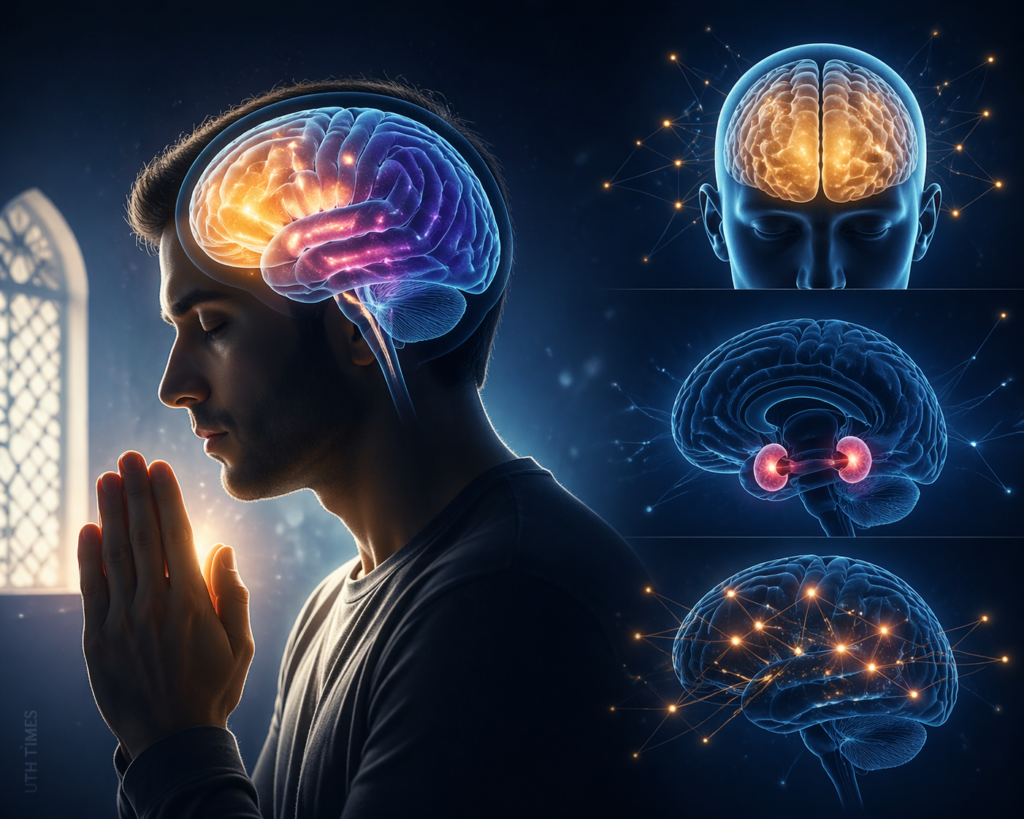
When a person prays regularly, brain scans show changes in key regions linked to attention, compassion, memory, and emotional regulation.
🔹 Prefrontal Cortex Activation
This is the brain’s command center for focus, decision-making, and discipline. During prayer, this region often becomes more active, meaning prayer can sharpen concentration and mental control.
🔹 Calmer Amygdala Response
The amygdala handles fear and stress reactions. Research suggests prayer may reduce overactivity here, helping lower anxiety and emotional panic.
🔹 Stronger Neural Pathways
Repeated prayer acts like mental training. Just as exercise strengthens muscles, repeated spiritual focus may strengthen neural circuits connected to peace, patience, and resilience.
🔥 Why Prayer Feels So Powerful

Prayer combines multiple brain-enhancing elements at once:
🔹 Focused Attention – directing the mind toward one intention
🔹 Emotional Release – expressing fears, gratitude, hope
🔹 Rhythm & Repetition – calming the nervous system
🔹 Meaning & Purpose – giving life deeper psychological structure
🔹 Connection – reducing feelings of loneliness
This creates a rare state where mind, emotion, and body synchronize.
🌍 Ancient Traditions Were Ahead of Their Time

Long before brain imaging existed, civilizations built prayer into daily life.
🔹 Morning prayers for mental clarity
🔹 Evening prayers for emotional release
🔹 Chanting for rhythm and calm
🔹 Silent prayer for self-reflection
🔹 Gratitude prayer for emotional balance
What looked like pure ritual may also have been advanced psychological technology.
⚡ Prayer vs Stress in the Modern World

Today’s world floods the brain with notifications, pressure, and overstimulation. Prayer offers the opposite:
🔹 Stillness in noise
🔹 Order in chaos
🔹 Calm in uncertainty
🔹 Hope in fear
Even a few minutes daily can create measurable mental shifts over time.
Prayer is not a magic cure or replacement for therapy or medical treatment. But as a regular practice, it can become a powerful tool for emotional health, mental clarity, and inner stability.
Science is catching up to something ancient cultures practiced for generations: prayer is more than belief. It may be brain training wrapped in spirituality. In a distracted world, that might be one of the most valuable discoveries of all.

