
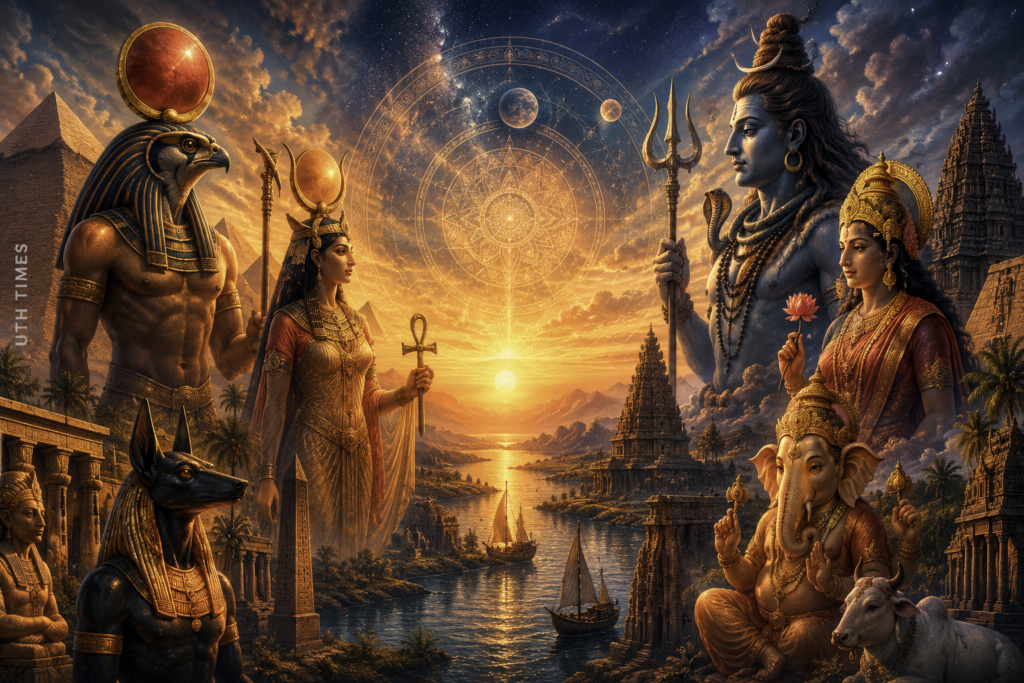
🌍 Two of the world’s oldest civilizations developed remarkably rich spiritual traditions thousands of kilometers apart. While Egyptian mythology and Sanatan Dharma emerged independently, historians have long noticed fascinating similarities in their philosophies, symbolism, and cosmic worldview. But are these similarities evidence of a shared origin—or simply parallel human thought?
🌞 A Universe Governed by Cosmic Order
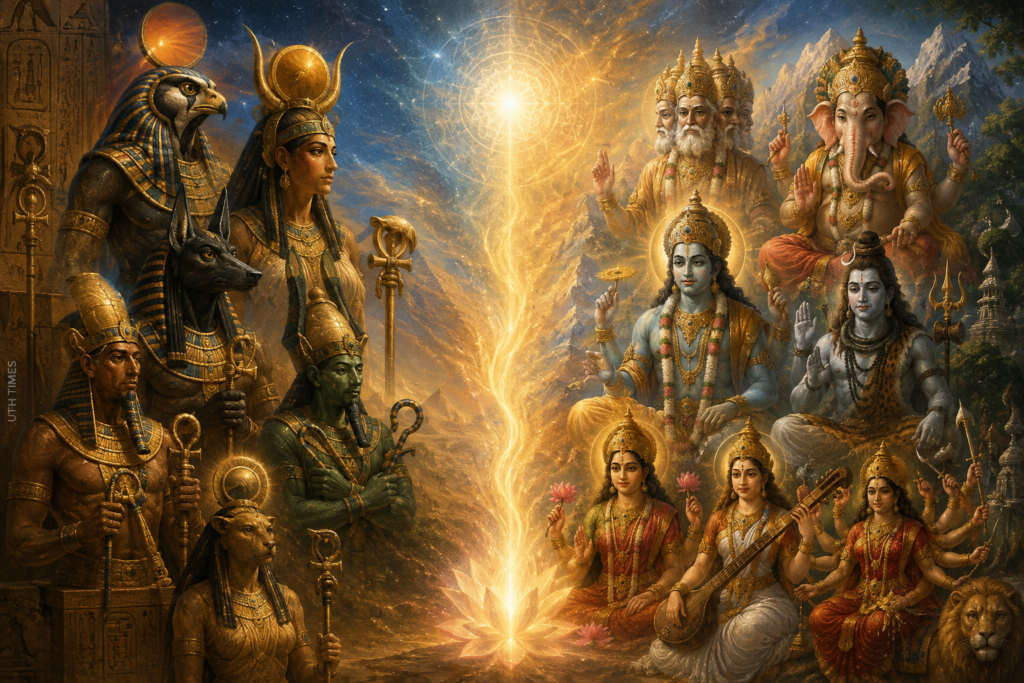
Both traditions believed that the universe was not random but operated according to an eternal cosmic law.
🔹 In ancient Egypt, this principle was known as Ma’at—representing truth, justice, balance, and harmony. Pharaohs were expected to uphold Ma’at to maintain order in both society and nature.
🔹 In Sanatan Dharma, a comparable concept is Dharma, the universal order governing morality, duty, righteousness, and the balance of existence.
Although Ma’at and Dharma are not identical, both describe a universe sustained by ethical and cosmic balance rather than chaos, making them among the earliest philosophical concepts of universal law.
🕉️ Multiple Deities, One Supreme Reality
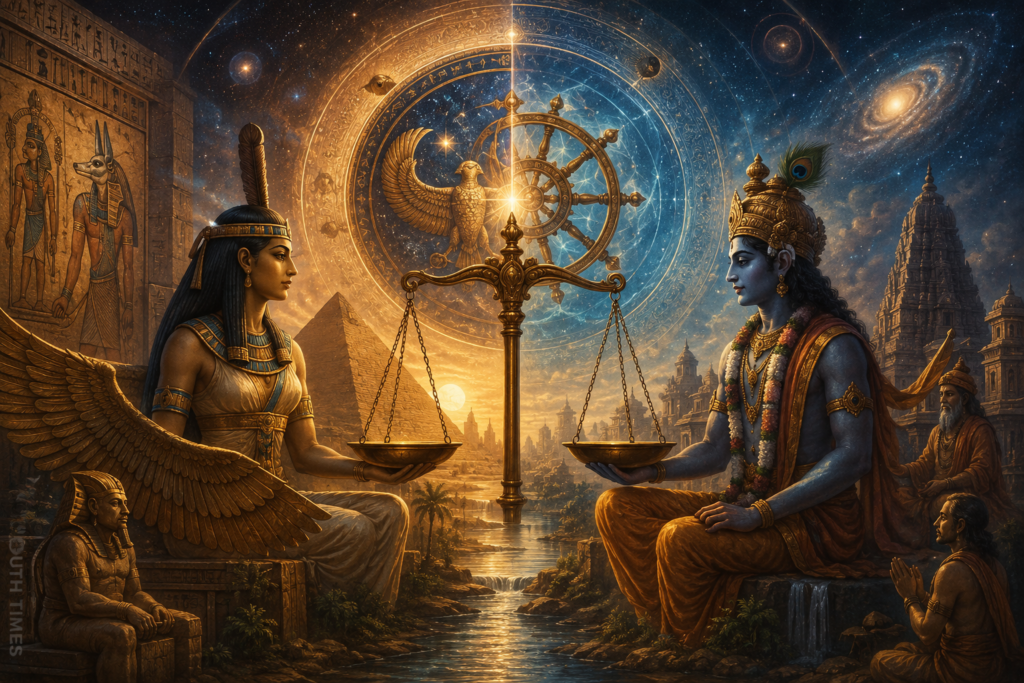
One of the strongest similarities lies in their understanding of divinity.
✨ Egyptian civilization worshipped gods such as Ra, Isis, Osiris, Horus, Anubis, and Hathor, each representing different natural forces, virtues, and cosmic responsibilities.
✨ Sanatan Dharma reveres deities including Brahma, Vishnu, Shiva, Lakshmi, Saraswati, Durga, and Ganesha, each embodying distinct aspects of the Supreme Reality.
Rather than believing in many completely separate gods, both traditions often viewed these divine forms as expressions of a deeper cosmic principle. In Hindu philosophy, this is Brahman, while many Egyptologists argue that Egyptian theology also hinted at an underlying divine unity beyond individual gods.
⚖️ The Soul’s Journey Beyond Death
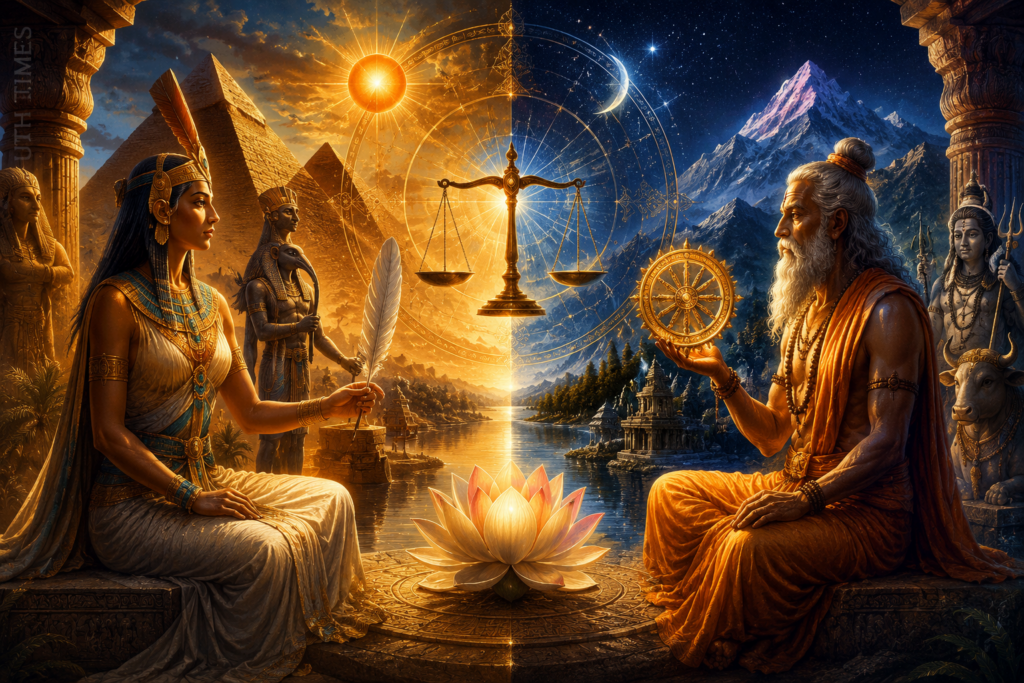
The afterlife occupied a central place in both traditions.
🔸 Egyptians believed the soul faced judgment before Osiris, where the heart was weighed against the Feather of Ma’at. A pure heart earned eternal life, while an impure one faced destruction.
🔸 Sanatan Dharma teaches that every action (Karma) shapes the soul’s future, leading to rebirth until Moksha—liberation from the cycle of birth and death—is attained.
Although the mechanisms differ, both civilizations emphasized moral accountability beyond physical life.
🌌 Sacred Symbols and Divine Nature
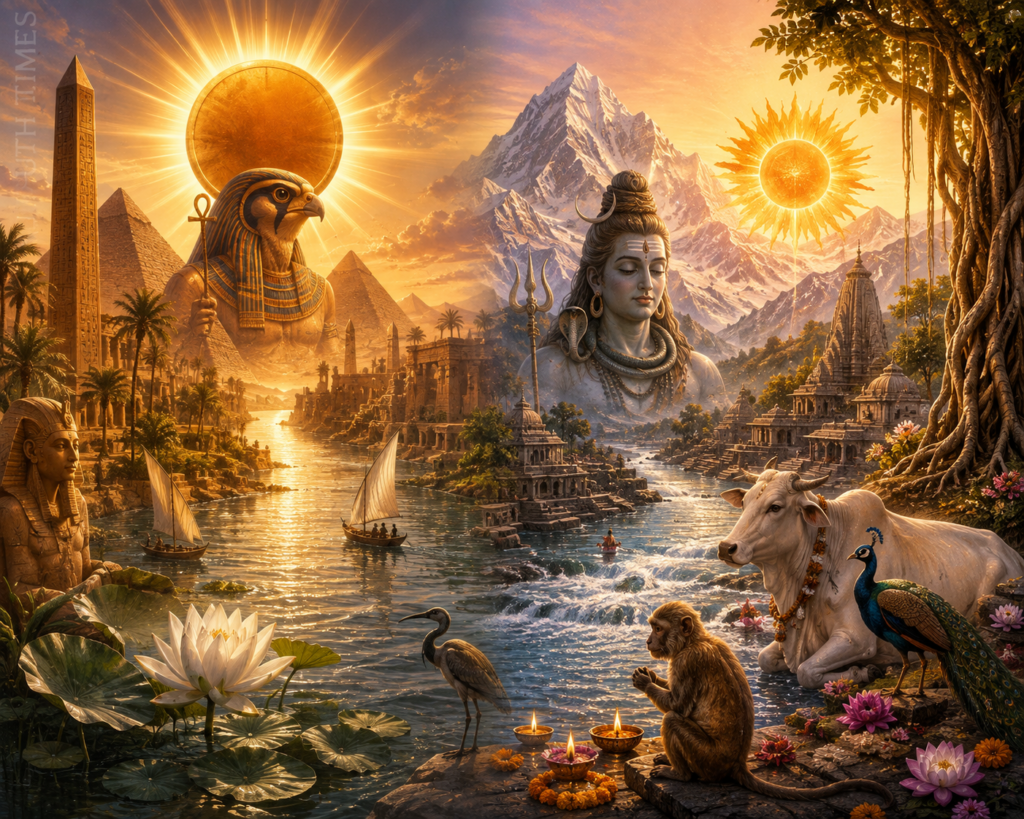
Nature itself was considered sacred.
🌿 The Egyptian sun represented Ra’s life-giving power, while the Nile symbolized renewal and fertility.
🌿 In Sanatan Dharma, rivers like the Ganga, mountains such as Kailash, sacred trees, animals, and the Sun (Surya) are revered as manifestations of divine energy.
Both traditions saw nature not merely as matter, but as a living expression of cosmic consciousness.
🏛️ Were They Actually Connected?
This question continues to intrigue historians.
📜 Ancient trade routes linked Egypt with Mesopotamia and regions further east, making cultural exchanges possible. However, there is currently no conclusive archaeological or historical evidence proving that Egyptian mythology directly originated from, or influenced, Sanatan Dharma—or vice versa.
Most scholars believe these similarities arose because both civilizations independently explored universal questions about creation, morality, life, death, and humanity’s place in the cosmos.
✨ Whether viewed as coincidence, parallel evolution, or distant cultural inspiration, the similarities between Egyptian mythology and Sanatan Dharma reveal humanity’s timeless search for truth. Across deserts and rivers, both civilizations remind us that the greatest spiritual questions have always transcended geography.

