
India has approved a massive ₹13,000-crore greenfield airport project on Great Nicobar Island, marking one of the most ambitious infrastructure developments in the country’s maritime frontier. Positioned at the southern edge of the Andaman and Nicobar archipelago, the airport is expected to serve both civilian and military purposes, strengthening India’s strategic presence in the Indian Ocean while opening new avenues for economic growth.
✈️ More Than Just an Airport

The proposed airport is a key component of the larger Great Nicobar development plan. Unlike conventional airports, this facility is being designed to handle commercial passenger traffic as well as military aircraft operations.
🔹 It will improve connectivity between mainland India and the remote island territory.
🔹 The airport is expected to support international flights in the future, making Great Nicobar a potential aviation hub.
🔹 Advanced infrastructure will allow the facility to operate as a dual-use airport, serving both civilian travelers and defence forces.
This makes the project not only a transportation asset but also a strategic national investment.
🌏 Why Great Nicobar Matters
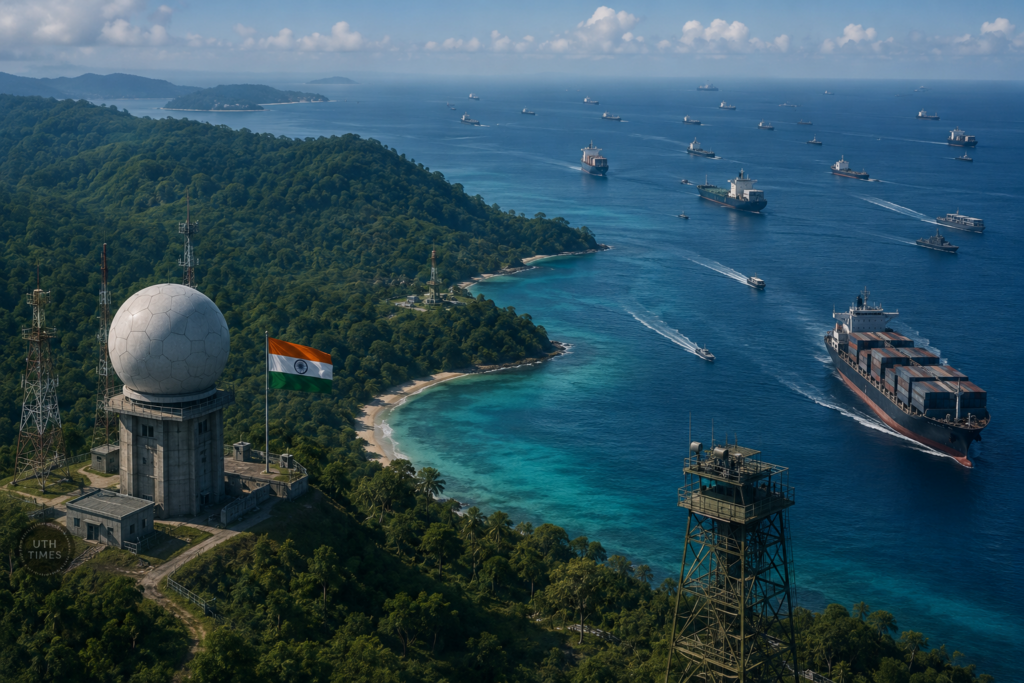
Great Nicobar occupies a highly significant location near the Malacca Strait, one of the world’s busiest maritime trade routes.
🔹 Nearly one-third of global shipping traffic passes through this region.
🔹 The island provides India with a valuable vantage point to monitor activities in the eastern Indian Ocean.
🔹 Enhanced infrastructure could strengthen India’s maritime security capabilities and improve surveillance over critical sea lanes.
For strategic planners, Great Nicobar is increasingly viewed as one of India’s most important frontier locations.
🛡️ A Boost for National Security

One of the most notable aspects of the project is its military utility.
🔹 The airport will be capable of supporting rapid deployment of personnel and equipment.
🔹 Defence aircraft can use the facility during emergencies, humanitarian missions, and surveillance operations.
🔹 The project complements India’s broader efforts to enhance security and preparedness in the Indo-Pacific region.
In an era of growing geopolitical competition, such infrastructure plays a crucial role in safeguarding national interests.
📈 Economic Opportunities and Regional Growth

Beyond defence considerations, the airport is expected to stimulate economic development.
🔹 Improved connectivity could encourage tourism in the Andaman and Nicobar Islands.
🔹 New employment opportunities may emerge through construction, aviation services, logistics, and hospitality sectors.
🔹 Better transportation links can support trade and investment in the region.
The project has the potential to transform Great Nicobar from a remote island into a significant economic gateway.
🚀 A Runway Into India’s Future

The ₹13,000-crore Great Nicobar Airport represents far more than a new aviation facility. It is a symbol of India’s growing ambitions in the Indian Ocean, combining strategic security, economic development, and global connectivity. As construction moves forward, this runway on the nation’s southern frontier could become one of the most important pieces of infrastructure shaping India’s future in the Indo-Pacific century

