
Imagine two particles separated by an unimaginable distance—potentially even across vast regions of the universe—yet measurements on them reveal correlations that cannot be explained by ordinary classical physics.
It sounds like science fiction. It is actually one of quantum physics’ most extraordinary realities.
🌌 The Phenomenon Is Called Quantum Entanglement
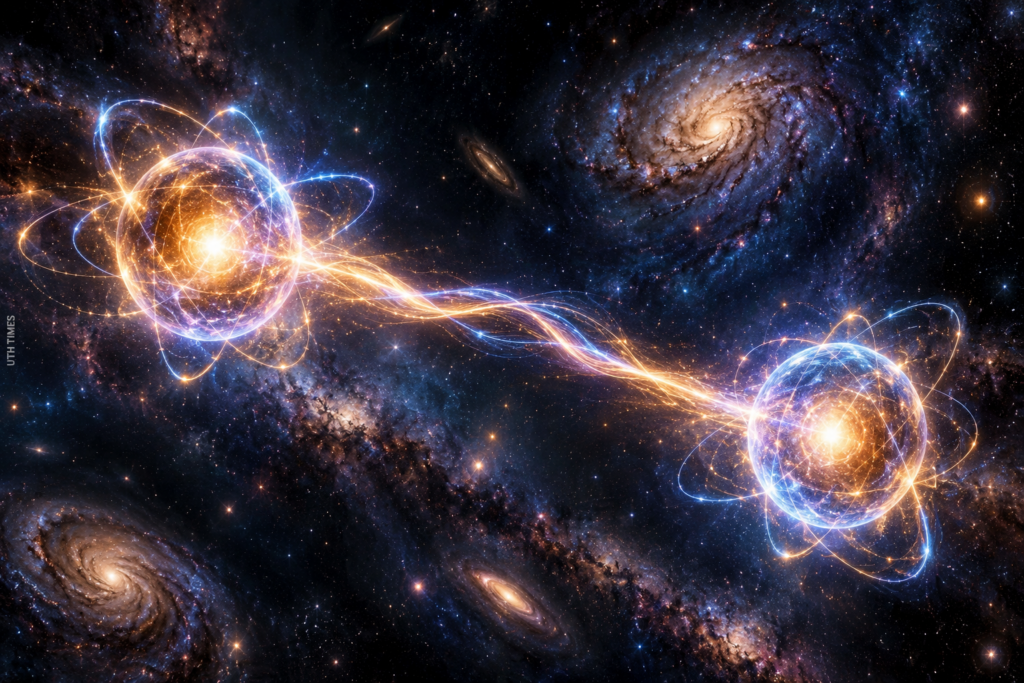
When two particles become quantum entangled, they are described by a shared quantum state. Even after being separated, measurements of one particle can be strongly correlated with measurements of the other.
This is not simply a case of two particles carrying matching instructions from the moment they were created. Experiments testing Bell inequalities have shown correlations stronger than those allowed by theories based on predetermined hidden variables. This experimental breakthrough earned Alain Aspect, John Clauser and Anton Zeilinger the 2022 Nobel Prize in Physics.
The truly startling part is distance.
⚛️ Distance Does Not Simply Break the Connection
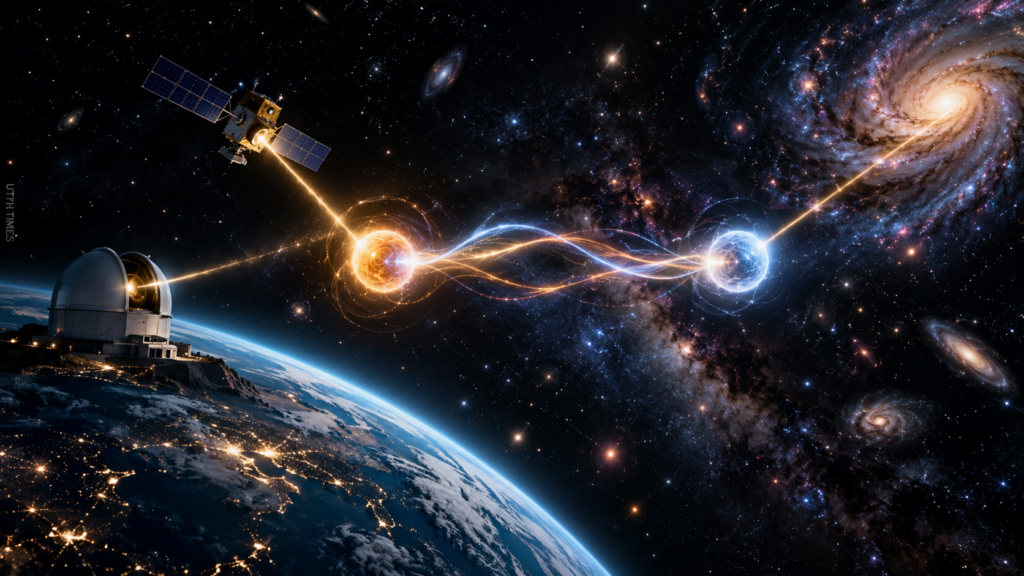
Quantum theory allows entanglement to persist even when entangled particles are separated by enormous distances. Researchers have demonstrated entanglement over long distances, including between ground stations and satellites, while experiments have even used light from distant galaxies to help choose measurement settings.
But there is an important scientific distinction: this does not mean scientists have shown two particles sitting in different galaxies exchanging usable messages instantaneously.
The popular phrase “changing instantly” describes the striking correlation observed when the particles are measured—not a controllable signal travelling faster than light.
🕳️ Einstein Called It “Spooky”
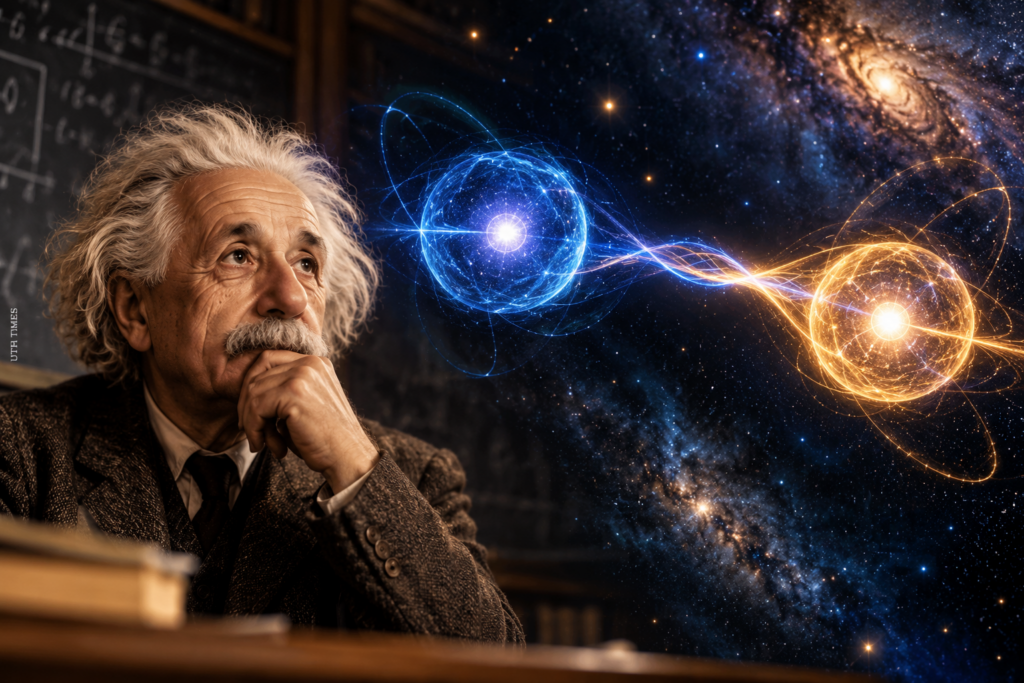
The phenomenon famously troubled Albert Einstein and his colleagues, who questioned whether quantum mechanics provided a complete description of reality. Einstein referred to the apparent effect as “spooky action at a distance.”
Yet modern Bell-test experiments have repeatedly supported quantum mechanics. The particles behave as though their properties are connected in a way that classical intuition struggles to explain.
🚀 Why This Could Change Technology
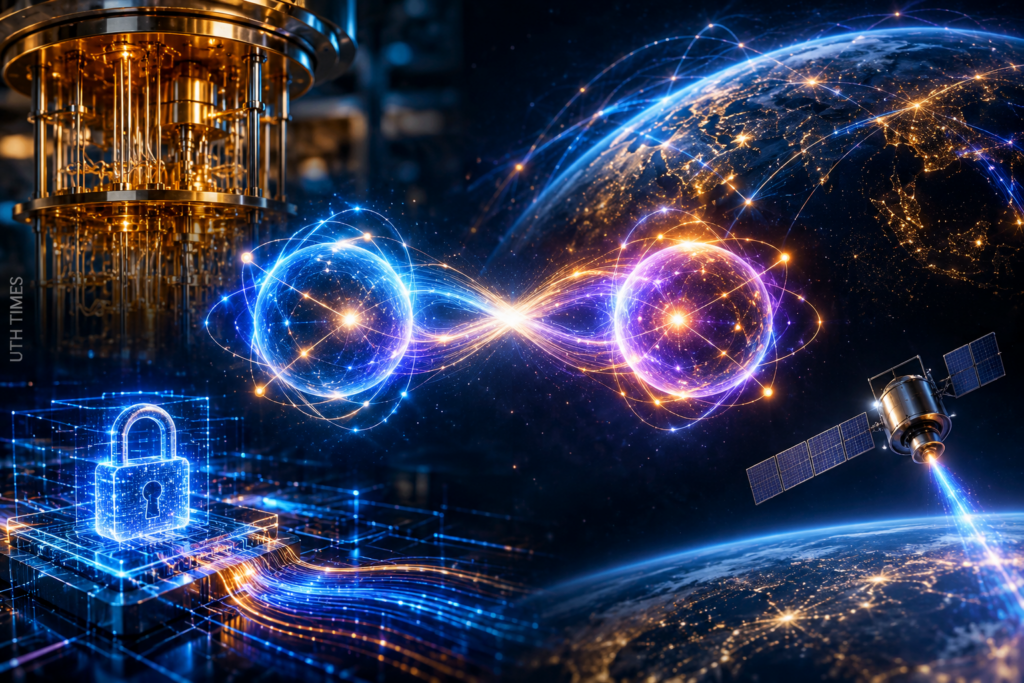
Entanglement is not merely a philosophical mystery. It is becoming a foundation for emerging quantum technologies.
🔹 Quantum computers can exploit entangled states as part of powerful computational architectures.
🔹 Quantum networks could eventually connect quantum devices across large distances.
🔹 Quantum cryptography uses quantum properties to develop new approaches to secure communication.
🔹 Quantum teleportation can transfer a quantum state from one location to another, although it does not teleport matter or allow faster-than-light messaging.
🌠 The Bigger Mystery
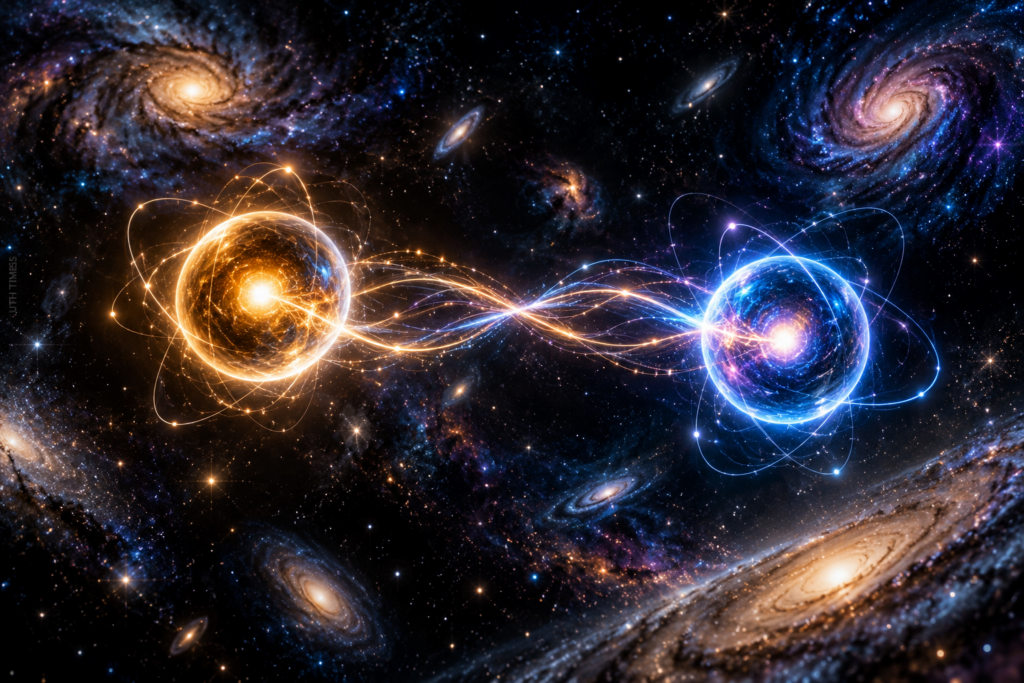
Perhaps the most fascinating lesson is not that particles can “talk” across galaxies. It is that nature does not always behave according to our everyday ideas of distance, separation and independent objects.
Quantum entanglement suggests that two particles can remain part of one mathematical quantum description even after they are separated by enormous distances.
And that leaves physics with a spectacular question: how deeply connected is the universe beneath everything we can see?

