
India wants a bigger place in global manufacturing. But according to TVS Motor Chairman Emeritus and Indian Foundation for Quality Management (IFQM) Chairman Venu Srinivasan, competing on cost alone will not be enough. India must match—and eventually surpass—the quality benchmarks set by Japan, South Korea and China.
🌏 From “Made in India” to “Trusted from India”
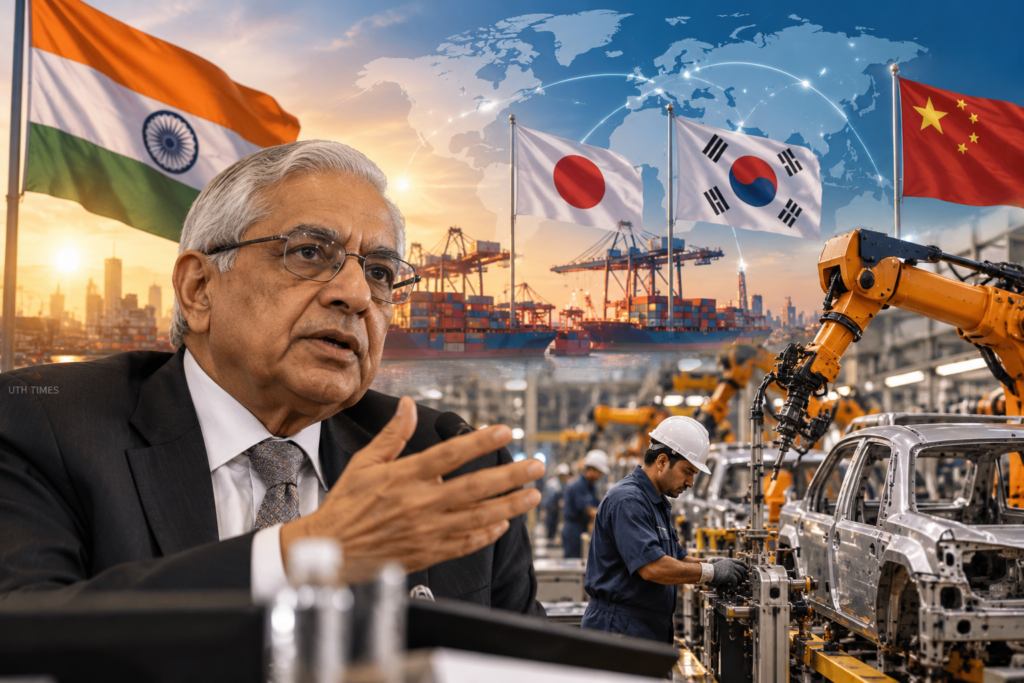
Speaking at the IFQM Symposium 2026, Srinivasan acknowledged that India has strong reasons to be confident. Several Indian companies are already producing goods that meet international standards of quality and productivity.
But he warned that the country still has a significant distance to cover if it wants a larger share of global manufacturing and services.
🔹 The real competition is quality: India needs to meet and exceed the standards established by manufacturing powerhouses such as Japan, South Korea and China.
🔹 Cost is no longer enough: Competitive pricing can attract global business, but consistent quality, reliability and innovation are what can retain it.
🔹 Trust is the bigger prize: Srinivasan argued that India must reach a stage where an international buyer chooses an Indian product because they automatically associate it with quality and reliability.
🚀 Viksit Bharat Needs More Than Low-Cost Manufacturing
Srinivasan linked the challenge directly to India’s Viksit Bharat 2047 ambition. A developed India cannot simply become the world’s low-cost factory. It needs to become a country capable of designing, innovating and manufacturing globally competitive products.
🔹 Innovation must move to the centre of industrial strategy.
🔹 Product design needs to become a major Indian strength rather than relying primarily on manufacturing products designed elsewhere.
🔹 Indian companies need their own global identity, creating products that are not merely manufactured in India but conceived and developed by Indian capabilities.
That shift—from “Made in India” to products that are designed, developed and trusted from India—could fundamentally change India’s position in global markets.
🏭 Quality Is a Continuous Race
Perhaps the most important message is that quality cannot be treated as a one-time achievement.
Countries and companies that dominate one generation can eventually be overtaken by the next wave of technology, products and processes. Therefore, Indian manufacturers will need continuous improvement rather than a temporary push for better standards.
For India, the opportunity is enormous—but so is the challenge. If the country can combine quality, innovation, design, productivity and trust, its manufacturing ambitions could extend far beyond being an alternative production base.
🇮🇳 The Bigger Goal
The ultimate target is simple: when the world sees an Indian product, quality should be the first association—not the question mark.
Srinivasan’s message is therefore less about catching Japan, Korea or China and more about building an Indian manufacturing identity strong enough to compete with—and eventually outperform—the best in the world.

