
What if our planet has a rhythm we cannot hear—but scientists can detect?
For more than six decades, sensitive seismometers have been recording an extraordinarily regular seismic signal: a faint pulse that repeats roughly every 26 seconds. It is far too weak for humans to feel, yet instruments around the world can detect it. The phenomenon is real—but its precise cause remains unsettled.
🔴 A “Heartbeat” Hidden Beneath the Noise
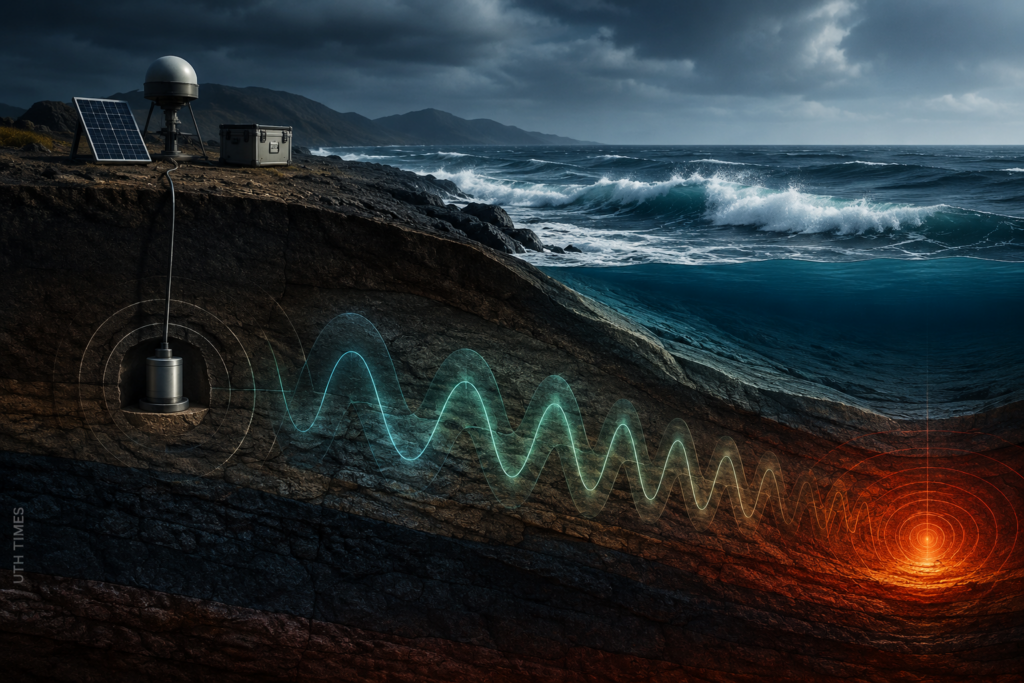
Scientists classify the signal as a microseism—a tiny, continuous vibration that forms part of Earth’s background seismic activity. Unlike an earthquake, it does not represent a sudden rupture of the crust, and it poses no known danger to people or buildings.
What makes this particular microseism extraordinary is its remarkably narrow, persistent rhythm. The signal has a period of about 26 seconds, equivalent to a frequency of roughly 0.038 Hz—far below the range of human hearing. Yet seismic instruments are sensitive enough to capture its faint vibrations travelling across enormous distances as surface waves.
🌊 The Clue Pointing Toward the Ocean
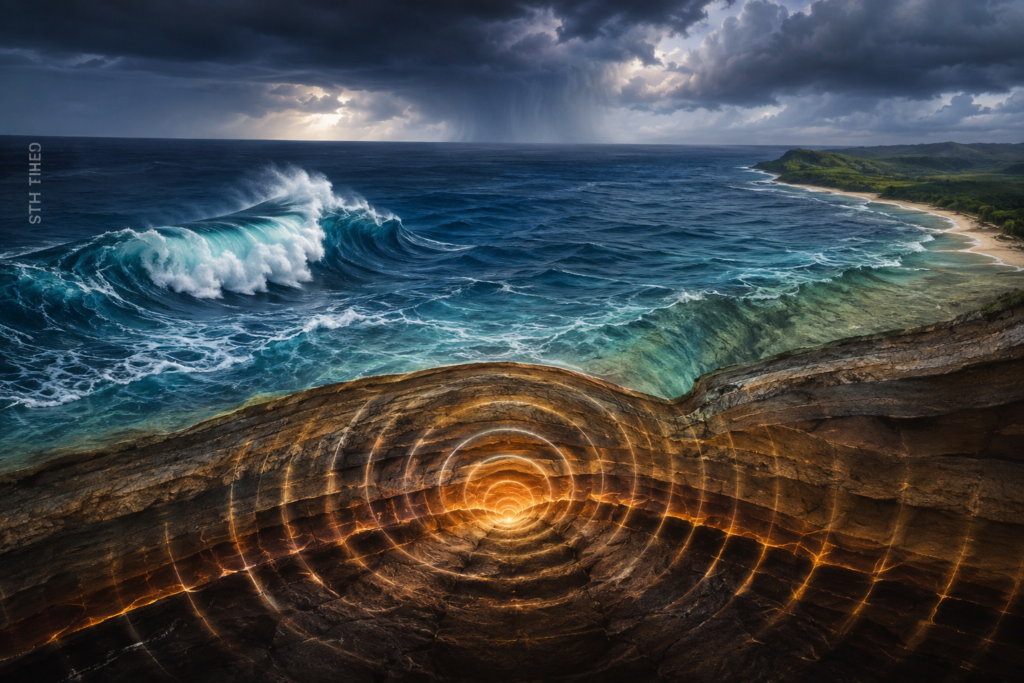
The mystery became more intriguing when researchers traced the signal to the Gulf of Guinea, off the western coast of Africa, with later studies narrowing the source toward the Bight of Bonny.
One leading explanation involves the ocean itself.
🌊 Powerful ocean swells can interact with the continental shelf and seafloor, transferring energy into the solid Earth.
🌍 That interaction may create a repeating vibration that travels outward through the crust—almost like tapping a gigantic drum.
⛈️ Researchers have also found links between the pulse’s strength and storm activity, supporting the possibility that ocean conditions influence the signal.
🌋 But There’s Another Suspect: Volcanoes

The ocean theory is not the only contender.
🌋 Some researchers have proposed that volcanic activity near São Tomé could generate the remarkably regular vibrations. Underground movement of fluids through cracks or volcanic conduits can produce persistent seismic signals, and research has specifically explored fluid-filled underground structures as a possible mechanism for the 26- and 28-second tremors.
Researchers at the University of Hamburg have also highlighted the continuing debate between ocean-wave activity and volcanic processes.
🧠 Did Scientists Really “Discover” It Recently?
Not exactly.
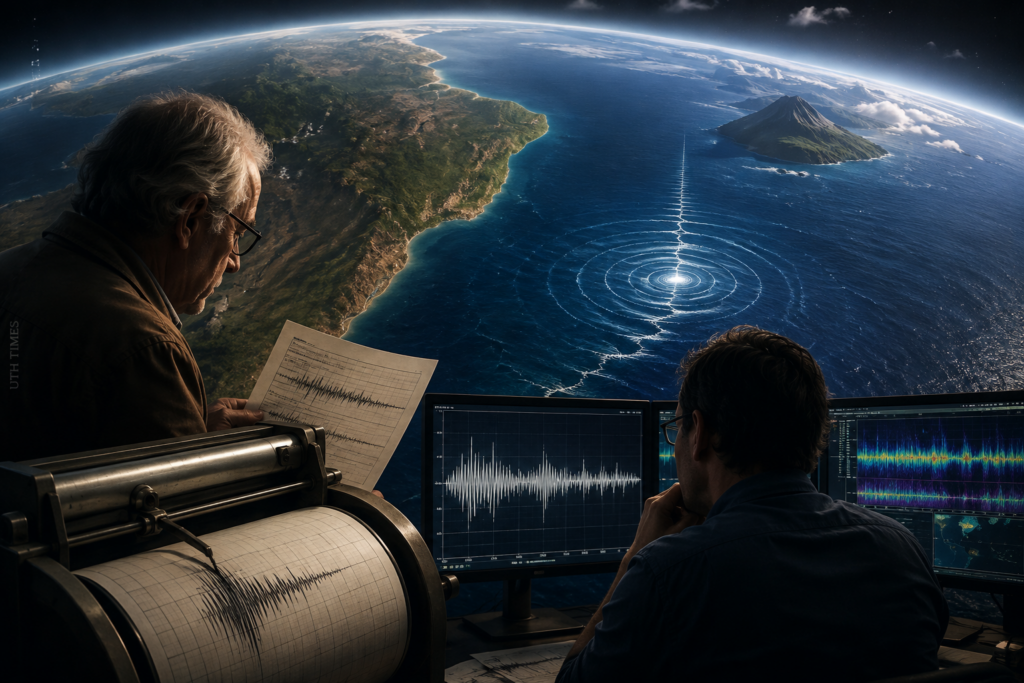
The pulse was first documented in the early 1960s, when geophysicist Jack Oliver identified a persistent seismic signal associated with the southern Atlantic. Decades later, improved digital seismic networks allowed researchers to revisit the phenomenon and pinpoint its source much more precisely.
That is what makes the story remarkable: Earth has apparently been “ticking” for decades, while scientists are still debating what mechanism keeps the rhythm going.
🧬 Is Earth Actually Alive?

Here the science needs a clear boundary.
The 26-second pulse does not prove that Earth is a living organism. “Heartbeat” is an evocative metaphor, not a biological diagnosis. There is currently no evidence that the planet possesses consciousness, a biological circulatory system, or a literal heartbeat.
But the phenomenon does reveal something fascinating: Earth is never completely still.
Oceans, atmosphere, volcanoes, tectonic processes and the crust constantly exchange energy. Even when our planet appears silent and motionless, sensitive instruments reveal a world in continuous vibration.
After more than 60 years, scientists know where the signal is coming from—but not conclusively why it keeps beating so precisely. And perhaps that is the most fascinating part.
Earth isn’t necessarily alive. But it is undeniably active—and somewhere beneath the Atlantic, its quiet 26-second rhythm continues.

