
For decades, NASA’s Voyager spacecraft have traveled farther than any human-made object in history. But one of their most astonishing discoveries wasn’t another planet—it was a mysterious 90,000°F “Wall of Fire” marking the boundary between our Solar System and the vast interstellar universe. Despite its terrifying name, this isn’t a literal wall or blazing flames. It’s a strange cosmic frontier that is rewriting our understanding of space.
🌌 What Is the “Wall of Fire”?
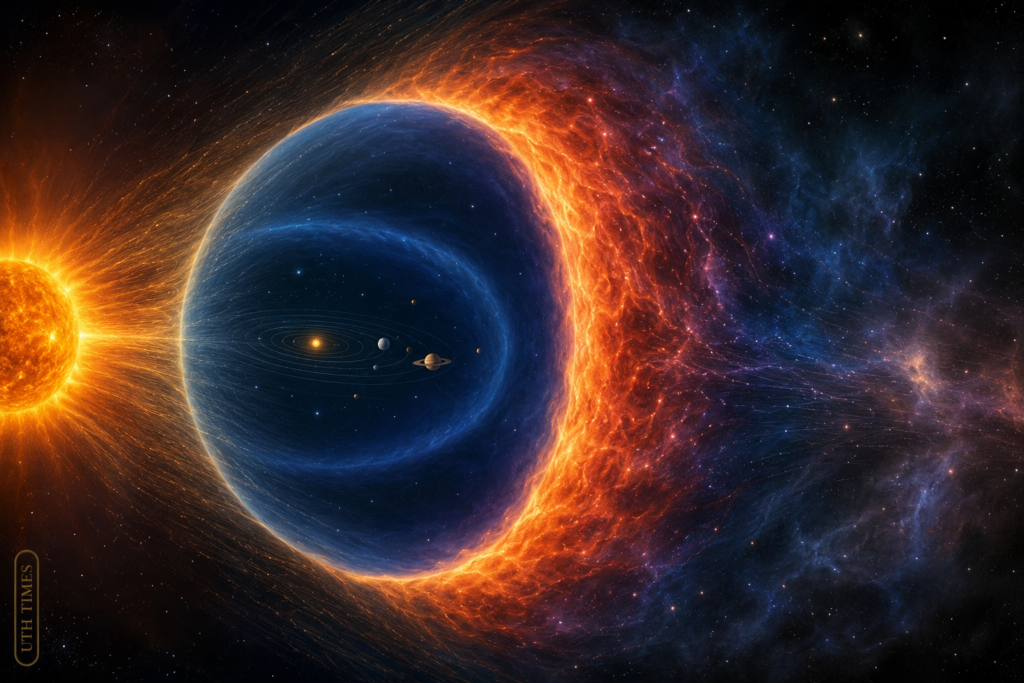
The so-called “Wall of Fire” is the heliopause—the invisible boundary where the Sun’s powerful solar wind collides with the interstellar medium, the gas and particles that exist between stars. As Voyager 1 crossed this region in 2012, followed by Voyager 2 in 2018, both spacecraft detected an unexpectedly hot layer of plasma reaching temperatures between 54,000°F and 90,000°F (30,000–50,000 Kelvin).
🔹 It is not made of flames.
🔹 It is an extremely thin cloud of electrically charged particles (plasma).
🔹 It forms the outer shield of our Sun’s protective bubble, known as the heliosphere.
🚀 Why Didn’t Voyager Burn Up?
This is the biggest mystery for many people.
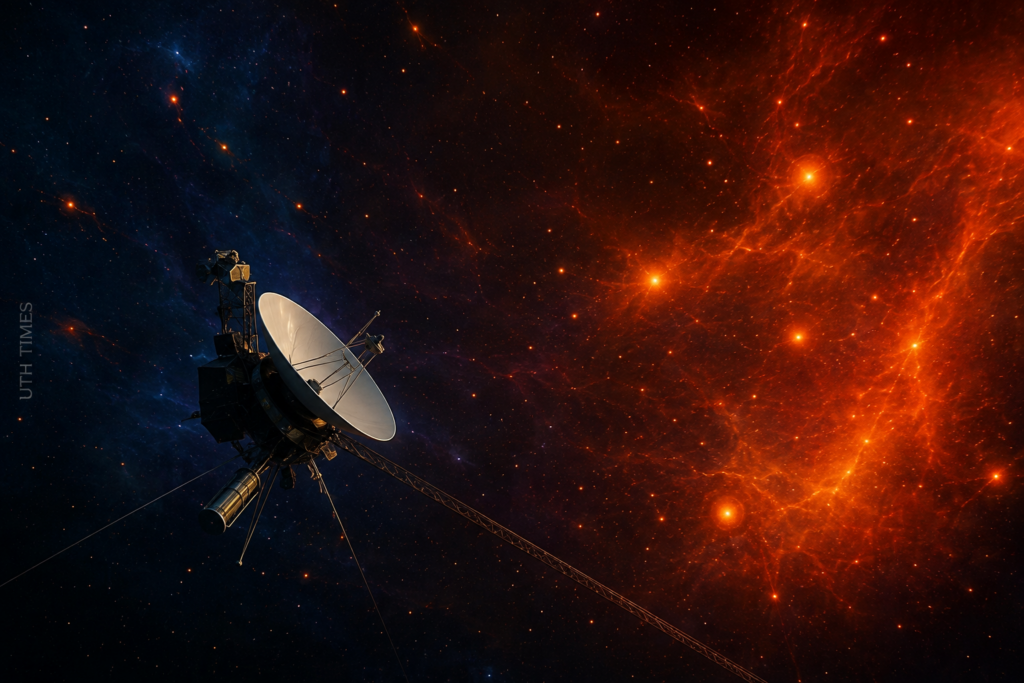
Although the plasma measures an astonishing 90,000°F, space in this region is almost completely empty. There are incredibly few particles, meaning there isn’t enough matter to transfer significant heat to the spacecraft.
Think of it like a few glowing sparks floating in a gigantic stadium—they’re individually very hot, but far too sparse to heat everything around them. That’s why Voyager safely crossed the region while continuing to transmit scientific data back to Earth.
🔭 Why Is This Discovery So Important?
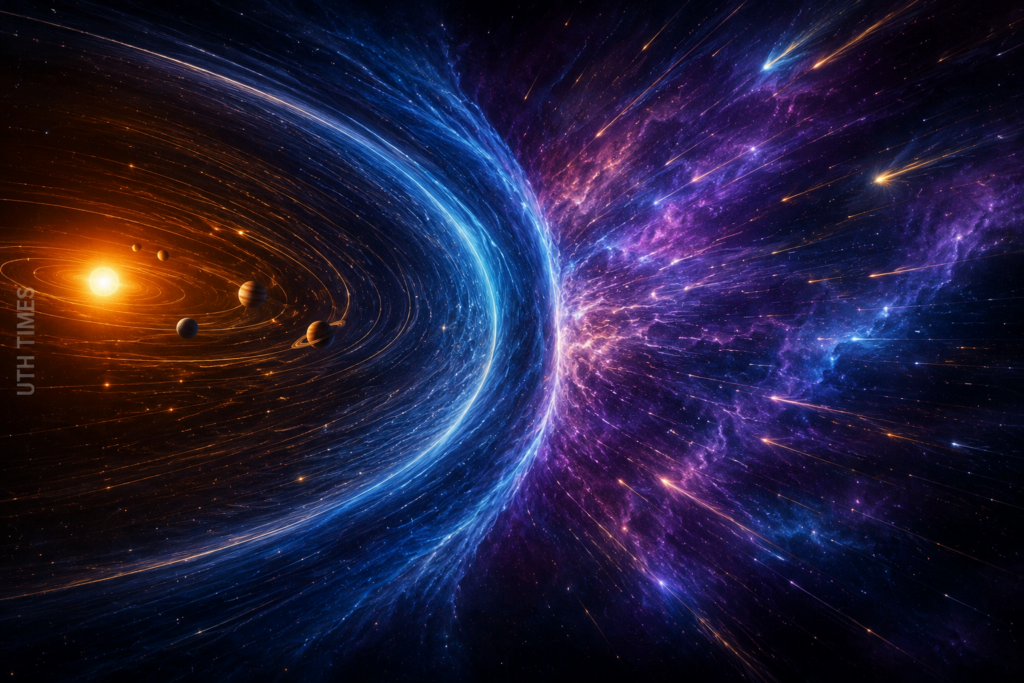
The heliopause acts as Earth’s first line of defense against much of the galaxy’s high-energy cosmic radiation.
Scientists believe the intense heating occurs because:
🔹 The outward-flowing solar wind slams into incoming interstellar particles.
🔹 Magnetic fields from the Sun and the galaxy interact, compressing plasma and releasing enormous amounts of energy.
🔹 The boundary controls how cosmic rays enter our Solar System, influencing the radiation environment experienced by planets and spacecraft.
This discovery has helped researchers refine models of how our Solar System interacts with the Milky Way and has revealed that the heliosphere is far more dynamic than previously believed.
⭐ A Journey That Changed Space Science Forever
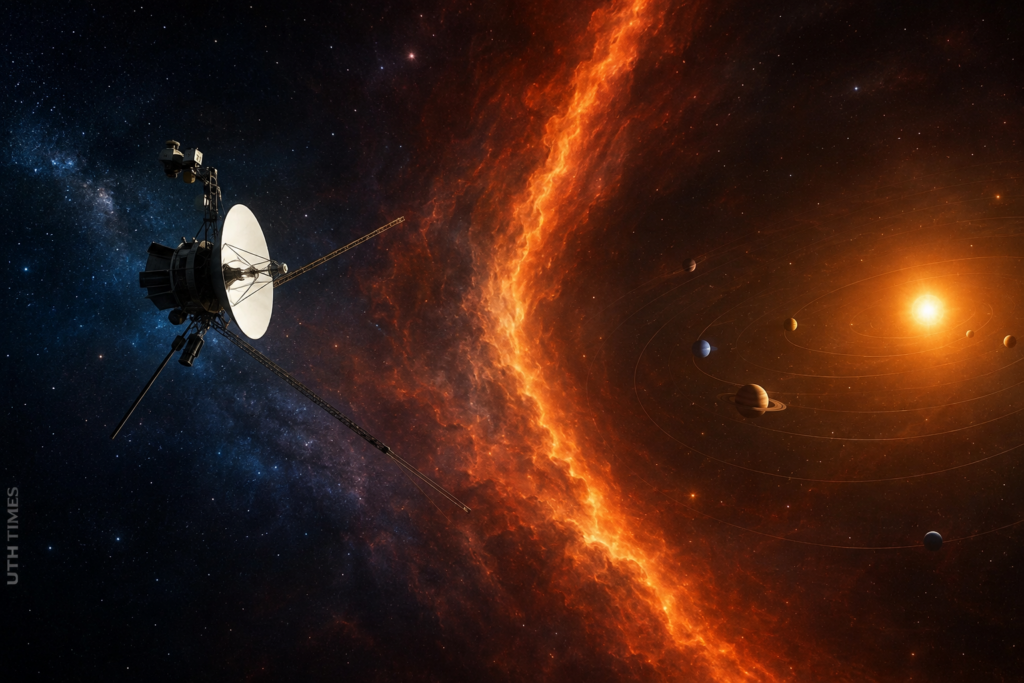
Launched in 1977, the Voyager probes were originally built to explore the outer planets. Nearly five decades later, they continue making discoveries billions of miles from Earth.
Voyager 1 became the first human-made object to enter interstellar space, while Voyager 2 confirmed that the Solar System’s outer boundary is irregular rather than perfectly shaped. Together, they have transformed our understanding of the cosmic neighborhood surrounding our Sun.
The “Wall of Fire” isn’t a barrier of flames—it’s the invisible frontier where our Sun’s influence ends and the galaxy begins. Thanks to the Voyager missions, humanity has crossed that frontier for the very first time, proving that even after nearly 50 years, these legendary spacecraft continue to reveal some of the universe’s greatest secrets.

