
For decades, physicists believed that quantum interference and many forms of entanglement were fundamentally linked to particles being identical. A groundbreaking study published in Nature Physics has now challenged that belief, revealing that completely distinguishable particles can also interfere and become entangled under the right quantum conditions.
This unexpected breakthrough is more than a theoretical curiosity—it could reshape the future of quantum technology and deepen humanity’s understanding of how the universe truly works.
🔬 Breaking a Rule That Seemed Untouchable

In conventional quantum mechanics, interference occurs when particles such as photons or electrons are indistinguishable, making it impossible to tell which particle followed which path. This indistinguishability was considered essential for generating many quantum effects.
The new research overturns that assumption.
✨ Scientists demonstrated that particles with different identities—which can be distinguished by their physical properties—can still display quantum interference and develop entangled relationships. Instead of relying solely on identical particles, the researchers showed that the overall quantum state of a system can create interference even when the particles themselves remain different.
This subtle but profound shift changes one of the foundational ideas of quantum physics.
⚛️ What Exactly Is Quantum Entanglement?
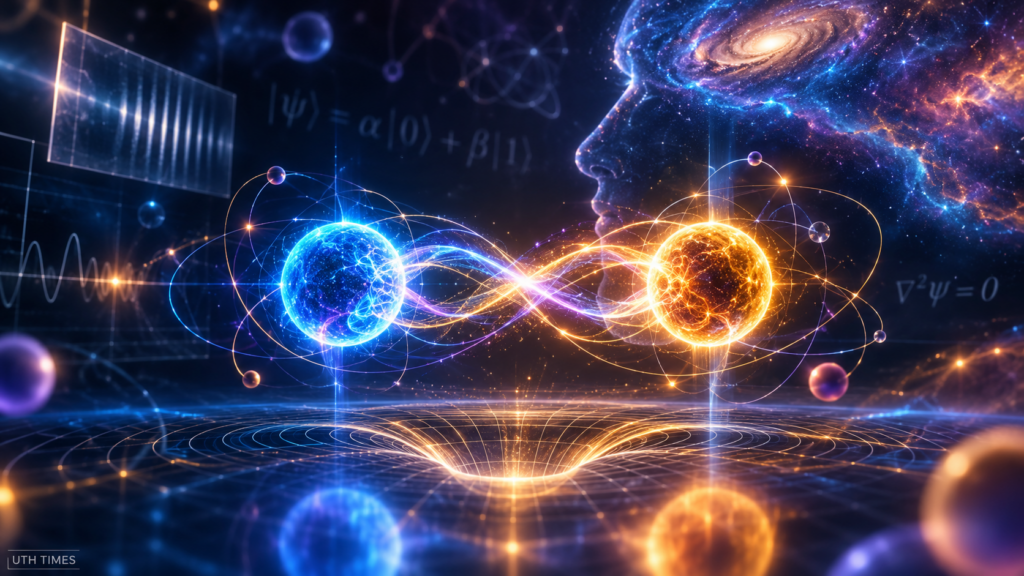
Quantum entanglement is often described as one of nature’s strangest phenomena.
🔹 Two or more particles become connected through a shared quantum state.
🔹 Measuring one particle immediately determines the correlated state of its partner, regardless of the physical distance separating them.
🔹 Albert Einstein famously referred to this phenomenon as “spooky action at a distance,” reflecting how deeply it challenged classical intuition.
The new discovery expands this concept by showing that identity itself is not the limiting factor for creating these quantum connections.
💻 Why This Could Transform Future Technology
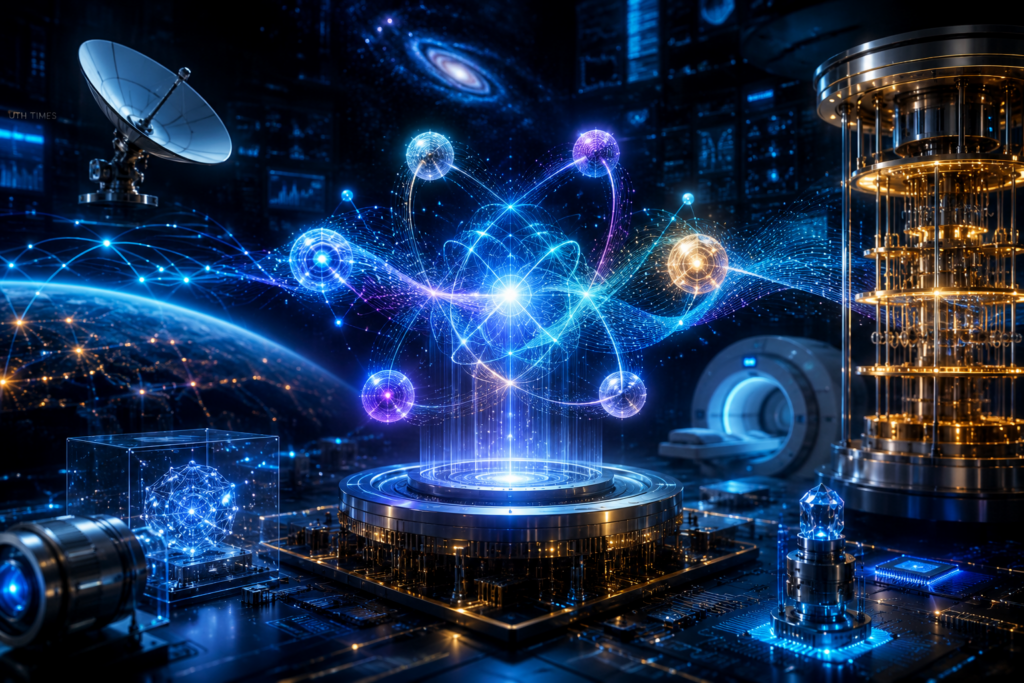
The implications extend far beyond laboratory physics.
✨ Potential breakthroughs include:
🔹 More flexible quantum computers capable of processing information using a wider variety of quantum systems.
🔹 Highly secure quantum communication networks, where information remains protected through fundamentally unbreakable quantum encryption.
🔹 Advanced quantum sensors with improved precision for medicine, navigation and scientific research.
🔹 Hybrid quantum devices that combine different types of particles, potentially overcoming engineering limitations faced by today’s quantum hardware.
By removing a major restriction, scientists may gain far greater freedom in designing next-generation quantum technologies.
🌌 A New Window Into the Nature of Reality
Perhaps the greatest significance of this research lies not in technology—but in philosophy.
For nearly a century, physicists viewed particle identity as a fundamental ingredient of quantum interference. This study suggests that quantum relationships are governed more by the structure of the entire quantum system than by whether individual particles are identical.
If confirmed and expanded through future experiments, this discovery could influence everything from quantum information science to our deepest theories describing space, matter and reality itself.
Science occasionally advances through discoveries that improve existing knowledge—but sometimes it rewrites the rules entirely. By proving that distinguishable particles can interfere and become entangled, researchers have opened an entirely new chapter in quantum physics. The quantum world has once again reminded us that reality is stranger, richer and far more surprising than human intuition ever imagined.

