
India’s next telecom battleground may not be on the ground at all—it could be thousands of kilometres above it. As satellite broadband moves closer to commercial reality, Airtel and Jio are positioning themselves for a new space-powered connectivity race.
🚀 From Mobile Towers to Satellites

Traditional telecom networks depend heavily on fibre, towers and terrestrial infrastructure. Satellite broadband changes that equation by using satellites to beam internet connectivity directly to users, particularly in remote or difficult-to-reach locations.
India’s Department of Telecommunications has already granted GMPCS authorisations to Jio Satellite Communications, OneWeb India and Starlink, although authorisation alone does not automatically provide spectrum rights; separate spectrum assignment and other regulatory requirements remain necessary.
That makes India one of the most interesting emerging markets in the global satellite-internet race.
🛰️ Airtel’s OneWeb Advantage

Bharti Airtel has a major head start through its association with Eutelsat OneWeb, whose LEO constellation is designed to provide high-speed, low-latency connectivity.
🔹 Airtel’s satellite strategy is expected to initially have a strong enterprise, institutional and hard-to-reach connectivity focus.
🔹 Potential applications include remote offices, critical infrastructure, backhaul, maritime connectivity and areas where conventional broadband infrastructure is difficult to deploy.
🔹 OneWeb India already holds a GMPCS authorisation and is identified by the government as using the OneWeb LEO constellation.
So Airtel is not starting from zero—it is building on an existing satellite ecosystem while navigating India’s remaining regulatory and spectrum requirements.
🌐 Jio Wants a Bigger Satellite Play

Jio, meanwhile, is building its own satellite communications strategy.
The company’s satellite arm has a GMPCS authorisation, while government documents have identified Jio Satellite Communications as planning to use SES’s O3b mPOWER MEO constellation for satellite broadband.
Jio’s advantage is its enormous existing telecom ecosystem. If satellite connectivity becomes integrated with its broader network, the company could potentially combine terrestrial and satellite infrastructure into a single connectivity platform.
That could be particularly powerful for areas where fibre and mobile towers cannot economically reach.
⚔️ And Then There’s Starlink
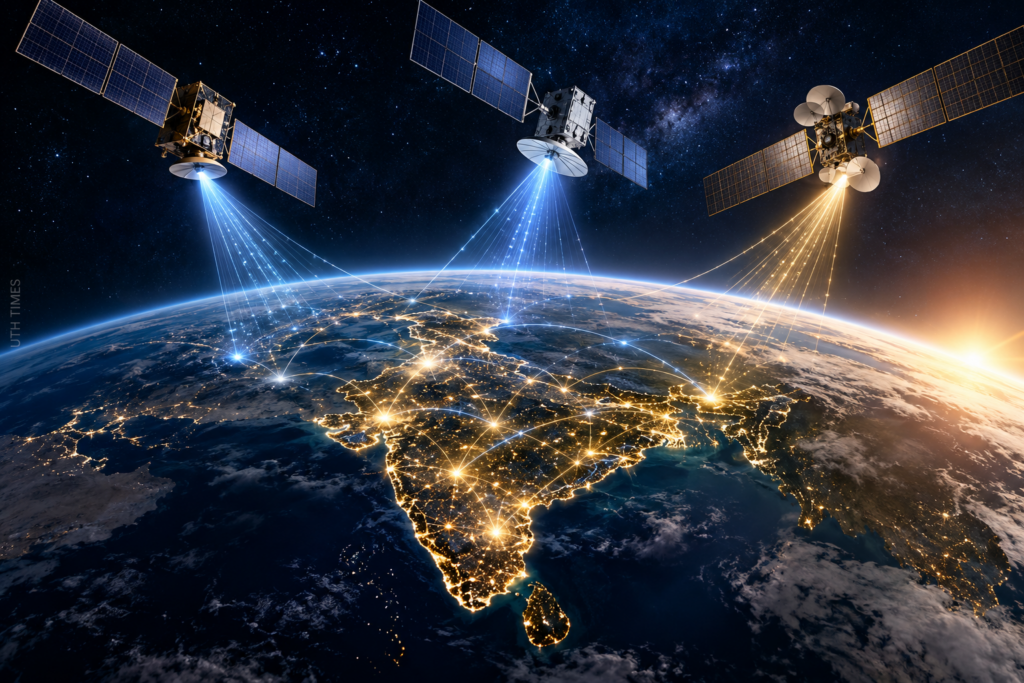
The global name everyone associates with satellite broadband is SpaceX’s Starlink.
But India’s market is more complicated than simply switching on a satellite network. Starlink, Jio and Airtel have all reached important approval stages, yet spectrum allocation and security-related requirements remain critical steps before full commercial deployment.
This means India’s satellite broadband story is no longer simply “Starlink versus everyone.”
It is becoming a three-way contest involving global satellite technology and India’s two telecom giants.
🔮 The Real Battle: Who Connects the Unconnected?

The biggest opportunity may not be replacing your home fibre connection.
It could be connecting the places traditional telecom cannot easily reach—remote villages, mountains, islands, ships, disaster zones, infrastructure projects and businesses operating far from major cities.
📡 The winning company may ultimately be the one that makes satellite connectivity affordable, reliable and seamlessly integrated with India’s existing digital infrastructure.
India’s telecom revolution began with towers. The next chapter could begin in orbit.
Airtel has OneWeb. Jio has its satellite ambitions. Starlink is pushing for entry. The race for India’s sky is officially taking shape.

