
India is preparing for a major shift in its telecom rules. The government is set to double the permitted electromagnetic-field (EMF) power-density limit for 5G base stations from 5 W/m² to 10 W/m², with the revised rules expected to take effect next month.
The move is designed to make 5G deployment more efficient—but it also puts the spotlight firmly back on radiation standards and public safety.
⚡ What Exactly Is Changing?
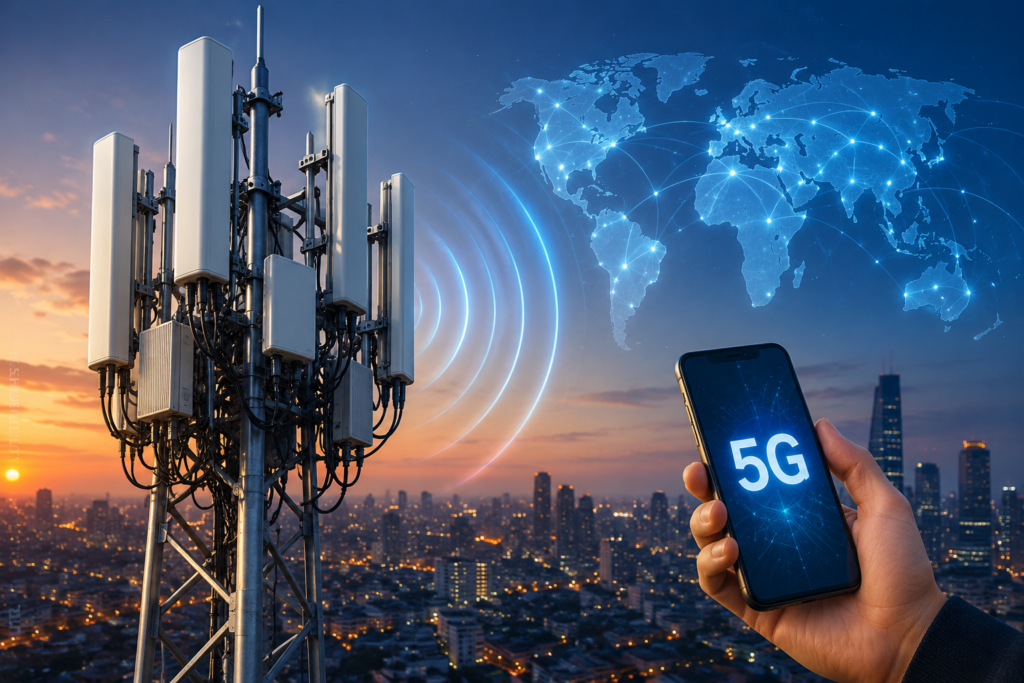
📡 The new rules would allow a 5G base transceiver station (BTS) to operate up to 10 watts per square metre, compared with the current 5 W/m² ceiling.
🔎 Importantly, this is a limit on radio-frequency electromagnetic-field exposure from base stations, not a statement that mobile phones themselves will suddenly emit twice as much radiation.
🌍 The government is positioning the change as an alignment with international norms. Reports say the revised ceiling corresponds with the level recommended by the International Commission on Non-Ionizing Radiation Protection (ICNIRP) and is used in numerous countries.
🗼 Why Telecom Companies Wanted This

5G networks depend on dense infrastructure, particularly in busy urban areas. More capacity and coverage can require additional sites, creating higher deployment and capital costs.
🚀 A higher permitted power density could allow signals to cover a larger area from an individual site.
🏗️ That could reduce the number of additional towers or small-cell sites needed in some locations.
💰 Fewer new sites can potentially translate into lower network-expansion costs for operators.
📶 For consumers, the intended payoff is better coverage and more consistent network performance as mobile-data demand continues climbing.
🧬 Does “Double the Limit” Mean Double the Health Risk?
Not necessarily—and this distinction is crucial.
The 10 W/m² figure is a regulatory exposure ceiling, not the amount every person will experience. Actual exposure depends on factors such as distance from antennas, antenna direction, equipment power, surrounding structures and network traffic.
🇮🇳 India’s telecom authorities also maintain compliance mechanisms. The Department of Telecommunications says BTS sites must meet prescribed EMF limits, submit self-certification and remain subject to compliance audits by its field units.
🧪 DoT states that EMF exposure from mobile towers below prescribed ICNIRP/WHO-recommended limits has no convincing scientific evidence of causing adverse health effects.
📈 The Bigger 5G Picture

This is ultimately about network economics as much as radiation policy.
India’s 5G usage is expanding rapidly, while operators are under pressure to deliver greater capacity without endlessly multiplying infrastructure.
🔹 Jio and Airtel could potentially improve coverage efficiency across their existing networks.
🔹 Vodafone Idea, which is expanding its 5G footprint, could also benefit from greater flexibility in network planning.
🔹 For the industry, the change could mean more coverage per site, lower incremental infrastructure requirements and potentially faster expansion.
⚠️ What Should People Watch Next?

The real test begins when the revised rules take effect.
👀 Regulators will need to ensure operators remain within the new limits.
📊 Independent monitoring and transparent exposure measurements will remain important for public confidence.
📡 And as India moves toward increasingly advanced mobile technologies, the debate will continue: How much infrastructure does a connected nation need—and how should exposure be regulated?
India is not simply “turning up 5G.” It is redrawing the regulatory boundary around telecom infrastructure to make nationwide connectivity more efficient. The challenge now is to deliver that bigger network while keeping compliance, monitoring and public trust equally strong.

