
History often remembers the loudest voices, not the most effective hands. While global narratives are dominated by Western breakthroughs and institutions, some of the world’s most pressing crises were quietly addressed by India—without applause, awards, or sustained recognition.
From hunger and healthcare to climate action and digital inclusion, India has repeatedly stepped in when the world needed solutions—not slogans.
🌾 Hunger: Turning a Food-Deficit Nation into a Global Model
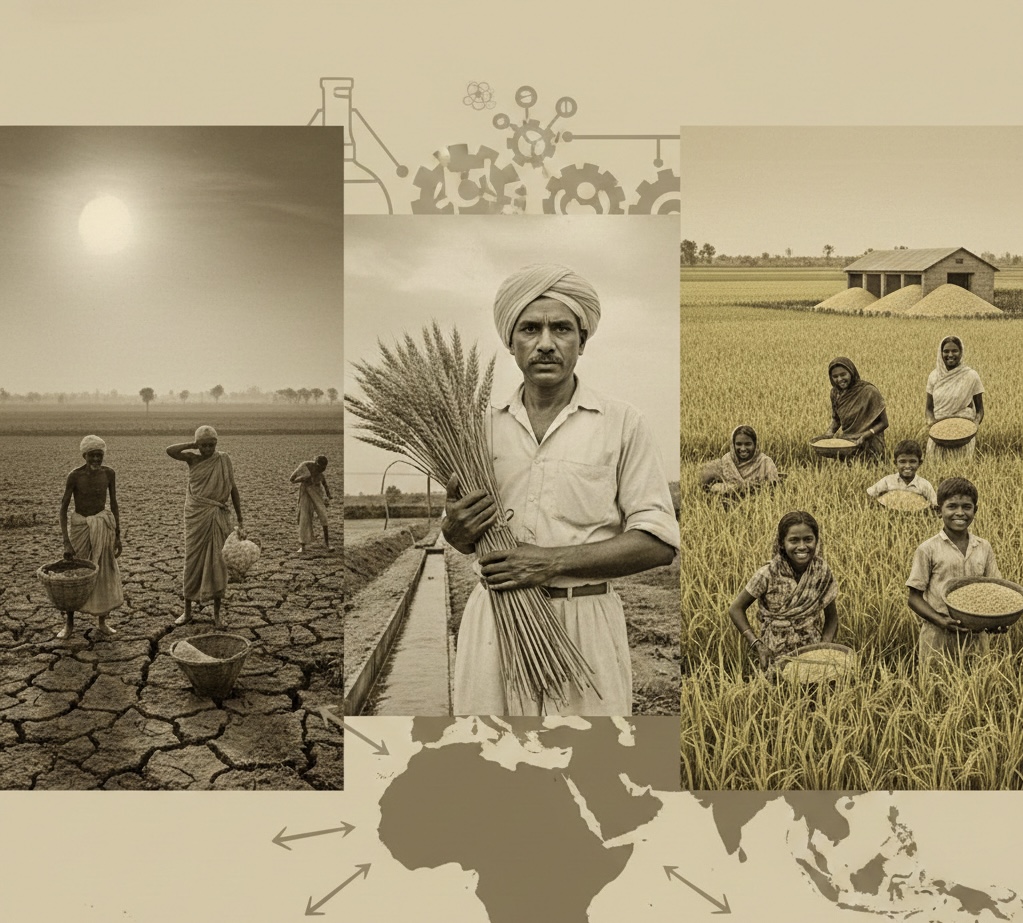
In the mid-20th century, global famine was a real and immediate threat. India itself stood on the brink of mass starvation.
🔹 India’s intervention
- Revolutionised agriculture through improved crop varieties, irrigation, and research
- Built self-sufficiency in food grains within a decade
- Shifted from dependency on food aid to surplus production
India’s agricultural transformation became a template for food security in Asia and parts of Africa. Millions avoided starvation—not through charity, but through a scalable model. Yet the global narrative rarely credits India for reshaping how developing nations fight hunger.
💊 Healthcare: Making Survival Affordable for the Global South

Healthcare inequality remains one of the world’s deadliest problems—where treatment exists, but access doesn’t.
🔹 India’s intervention
- Emerged as the world’s largest supplier of generic medicines
- Reduced costs of HIV/AIDS, TB, cancer, and vaccine treatments dramatically
- Supplied affordable drugs to over 150 countries
Entire public health programs in Africa and Latin America depend on Indian pharmaceuticals. Millions are alive today only because India made treatment affordable, even when it challenged powerful global drug monopolies.
🧪 Pandemics: Acting When Vaccine Nationalism Took Over

During the COVID-19 crisis, the world fractured along supply lines. Vaccines became strategic assets.
🔹 India’s intervention
- Manufactured vaccines at scale when global supply chains failed
- Exported doses to dozens of nations despite domestic pressure
- Treated vaccines as humanitarian tools, not leverage
For many developing countries, India was the first responder in a global health emergency. Yet once wealthy nations secured their stockpiles, India’s role faded from headlines.
🌱 Climate Change: Growth Without Hypocrisy

Climate responsibility has often been framed as a luxury of the developed world.
🔹 India’s intervention
- Met climate targets ahead of schedule
- Built one of the world’s fastest-growing renewable energy programs
- Founded the International Solar Alliance to help developing nations transition
India proved that development and climate action are not mutually exclusive. While others debated responsibility, India demonstrated feasibility—without preaching or posturing.
📲 Digital Divide: Governance at Population Scale

Digital exclusion threatens economic mobility worldwide.
🔹 India’s intervention
- Built public digital infrastructure for over a billion people
- Enabled financial inclusion, direct welfare transfers, and digital identity
- Open-sourced its model for other nations to replicate
India showed that digital governance can be inclusive, affordable, and scalable—a solution many countries now study, though few acknowledge its origin.
🚢 Humanitarian Aid: Help Without Conditions

In global crises, aid often comes with strategic strings attached.
🔹 India’s intervention
- Conducted rapid disaster relief across Asia, Africa, and island nations
- Provided food, medicine, evacuation, and rebuilding support
- Avoided political conditionality or resource demands
India emerged as a trusted first responder, especially for nations ignored by larger powers. Yet its humanitarian diplomacy remains underreported.
🔚 Conclusion: Quiet Impact, Lasting Legacy
India doesn’t brand its generosity.
It doesn’t monetize its morality.
And it doesn’t wait for permission to help.
While recognition may be uneven, outcomes are undeniable. The world eats, heals, connects, and recovers—often because India stepped in when it mattered most.
Sometimes, the most powerful global leadership is the kind that doesn’t ask to be noticed.

