
🚀 A Precious Metal Breaks Its Silence

For centuries, gold has symbolised permanence, beauty, and chemical stubbornness — the ultimate noble metal that refuses to react with anything. But a groundbreaking lab experiment has just shattered that belief, revealing that under extreme pressure and heat, gold can indeed react. And the result? A completely new material: gold hydride.
🔬 💥 The Accidental Breakthrough — How Gold Finally Reacted

In a high-pressure experiment originally designed to study how hydrocarbons turn into diamond, scientists embedded a thin gold foil into a sample and subjected it to pressures greater than those deep within Earth’s mantle, combined with intense heat from X-ray lasers.
✨ Gold wasn’t supposed to do anything. It’s been used for decades as an inert reference material — something that does not react. Yet in these extreme conditions, hydrogen from the hydrocarbons fused with the gold atoms, forming gold hydride for the very first time.
What’s especially fascinating is that this compound only exists under such extreme pressure and temperature. Once the environment cools or pressure eases, the gold and hydrogen separate again.
🧪 🧊 Superionic Secrets — A Metallic Dance of Atoms

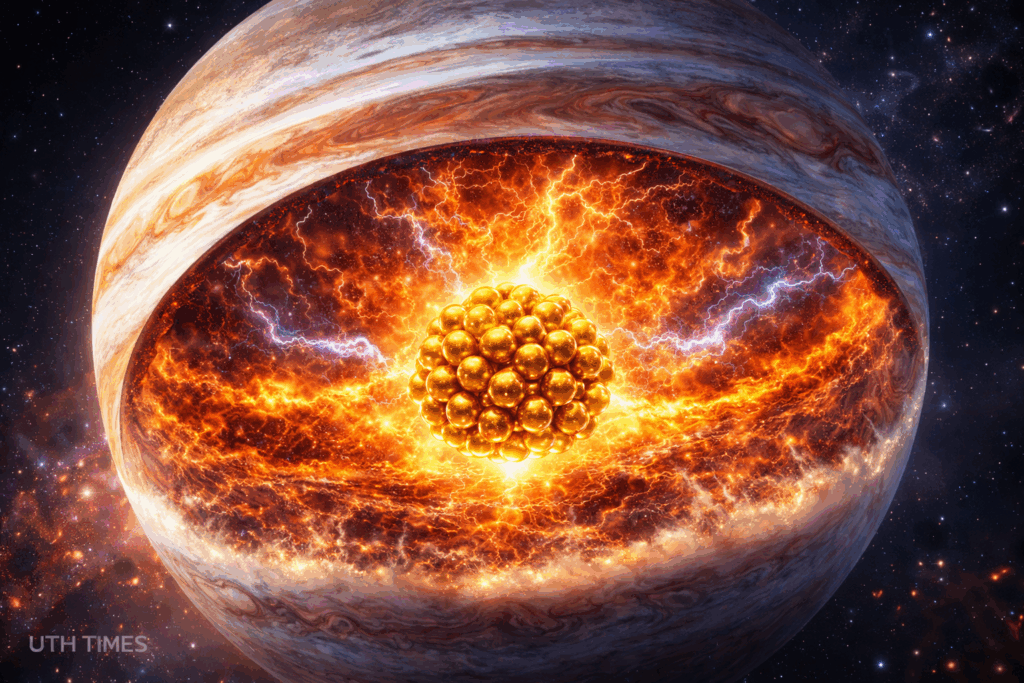
The structure scientists observed was unlike anything seen before: a hexagonal close-packed lattice of gold atoms through which hydrogen moves freely in what’s called a superionic state.
💡 In this superionic state, hydrogen isn’t static — it flows through the gold lattice like a liquid inside a solid. This gives gold hydride unusual electrical properties, including increased conductivity.
The behaviour is so unexpected that it literally rewrites part of the textbook definition of gold as “unreactive.” Scientists now say gold’s chemical personality can change dramatically when pushed into extreme environments.
🌍 Beyond the Lab Bench

This discovery isn’t just a curious novelty — it has major implications across science:
✨ Planetary Science: The experiment simulates conditions found inside giant planets like Jupiter, where hydrogen exists in dense, exotic states. Gold hydride offers a way to study dense hydrogen’s behaviour in such environments.
✨ Fusion Research: Understanding how hydrogen behaves under pressure and heat is crucial for mastering nuclear fusion, the power source of stars. Gold hydride provides new experimental data to refine fusion models here on Earth.
✨ Exotic Materials: High-pressure hydrides — especially ones with superionic hydrogen — are being explored for energy storage, superconductivity, and advanced electronics.
🧠 A New Chapter in Chemistry
Gold hydride stands as a striking example of how extreme conditions can unlock entirely new forms of chemistry. A metal long thought too inert to bond has been coaxed into reacting — and in doing so, has rewritten part of what scientists thought they knew about elemental behaviour.
🏁 Gold’s Unexpected Second Act
Gold hydride teaches us something profound: even the most familiar elements still hold surprises. When pushed far beyond everyday conditions, gold reveals a hidden reactive side, forcing scientists to rethink chemistry at its most fundamental level — a reminder that nature’s secrets often lie just beyond the boundaries of the known.

