
🕰️ A Brief History
The idea of socialism—where wealth and production are shared for the common good—emerged during Europe’s Industrial Revolution. Thinkers like Karl Marx and Friedrich Engels imagined a society free from capitalist exploitation.
Yet, whenever it was implemented—from the USSR and Mao’s China to Cuba, North Korea, and Venezuela—the dream repeatedly collapsed under its own weight.
🔟 10 Simplified Reasons
1️⃣ No Real Incentives

When everyone earns the same, motivation disappears. Productivity and innovation decline.
2️⃣ No Price Signals
Without market prices, governments can’t gauge what people truly need—leading to either shortages or useless oversupply.
3️⃣ Centralized Power

When a few “planners” control decisions, it breeds corruption, inefficiency, and fear—not equality.
4️⃣ Economic Misallocation
State-run systems often overinvest in heavy industry while ignoring consumer needs. People queue for bread while factories overproduce steel.
5️⃣ Suppressed Freedom

To maintain control, socialist regimes frequently silence dissent, killing both creativity and trust.
6️⃣ Human Cost of Utopian Experiments
From the USSR’s famines to Cambodia’s genocide, forced equality has too often turned deadly.
7️⃣ Stagnation After Early Growth
Socialist economies may grow quickly at first through mobilization, but soon hit a wall as inefficiency and rigidity take over.
8️⃣ Dependency on the State

Citizens begin to rely on the government for everything, weakening personal responsibility and entrepreneurship.
9️⃣ Corruption and Cronyism
Without competition or accountability, party elites replace private billionaires—just under a different name.
🔟 Ignoring Human Nature
Socialism assumes humans are selfless, but ambition, creativity, and competition are what truly drive progress.
⚖️ The Bottom Line
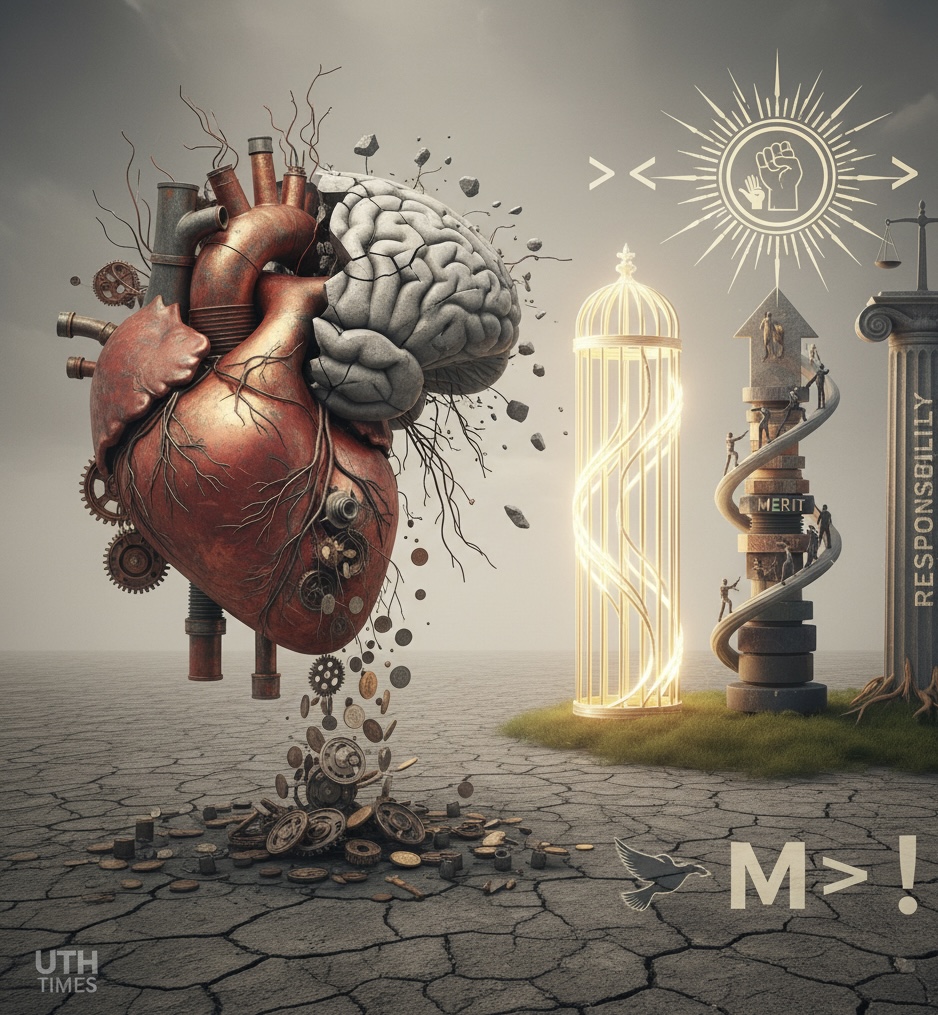
Socialism’s heart may be noble, but its brain fails to understand human behavior and economic reality.
Societies prosper when freedom, merit, and responsibility work together.
Merit > Mandate.
Freedom > Force.

