
Long before telescopes pierced the skies and equations defined reality, Sanatan Dharma envisioned a universe vast, cyclical, and profoundly alive. Today, modern cosmology seems to be catching up.
🌊 Ksheer Sagar: The Ocean Beyond Space
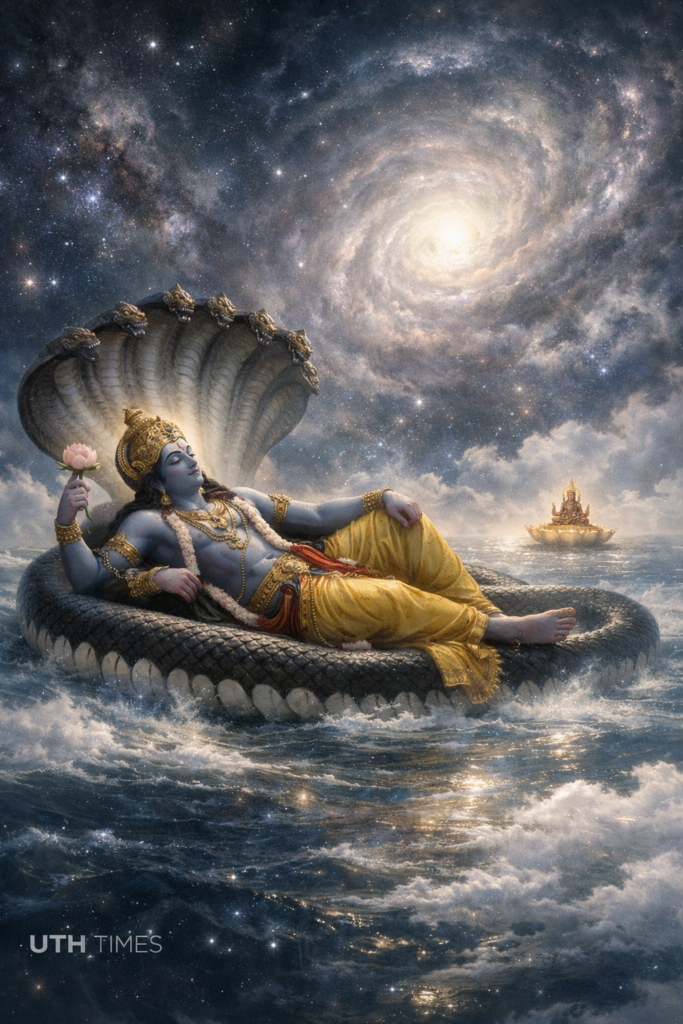
At the heart of Vedic cosmology lies Ksheer Sagar—the “Ocean of Milk,” where Lord Vishnu rests upon the infinite serpent Anant Shesha. This is not merely a religious image but a deeply layered cosmic metaphor.
✨ What it represents:
- 🌌 Cosmic Substratum: A boundless field from which all creation emerges
- 🐍 Infinity (Anant): The endless nature of space-time
- 💤 Yoga Nidra: A state of dormant creation—energy at rest before manifestation
This imagery aligns intriguingly with modern physics’ concept of a quantum vacuum, where the universe exists as potential before becoming reality.
🔁 A Universe That Never Ends
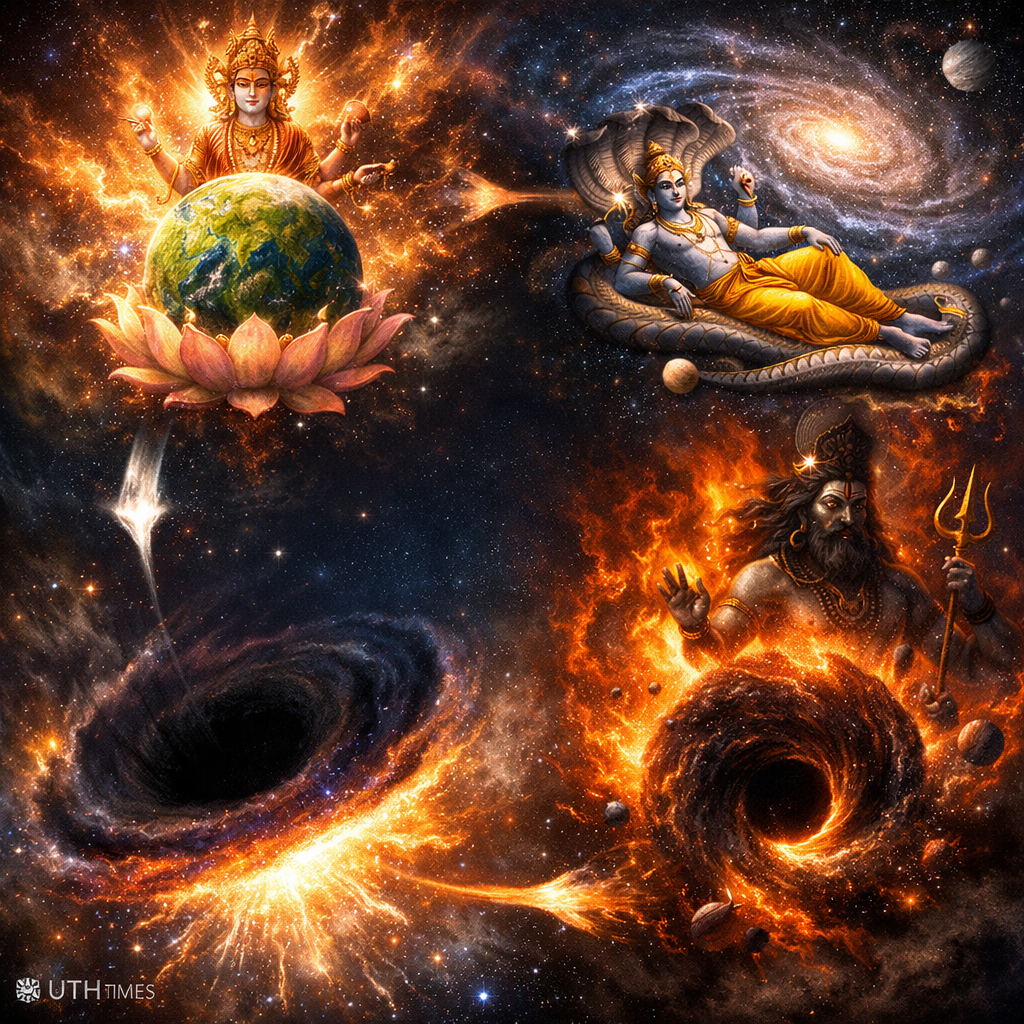
Unlike linear creation theories, Sanatan Dharma describes the universe as eternal and cyclical.
🕉️ Core Cycle:
- 🌱 Srishti (Creation)
- ⚖️ Sthiti (Preservation)
- 🔥 Pralaya (Dissolution)
This continuous loop suggests that the universe is not a one-time event but an infinite process of birth, death, and rebirth.
Modern science reflects similar ideas:
- 🌠 Big Bang Theory (creation)
- 🌌 Cosmic Expansion (existence)
- 🔄 Big Crunch / Big Bounce theories (possible rebirth)
The parallels are not exact—but they are undeniably thought-provoking.
⏳ The Astonishing Time Scale of Brahm
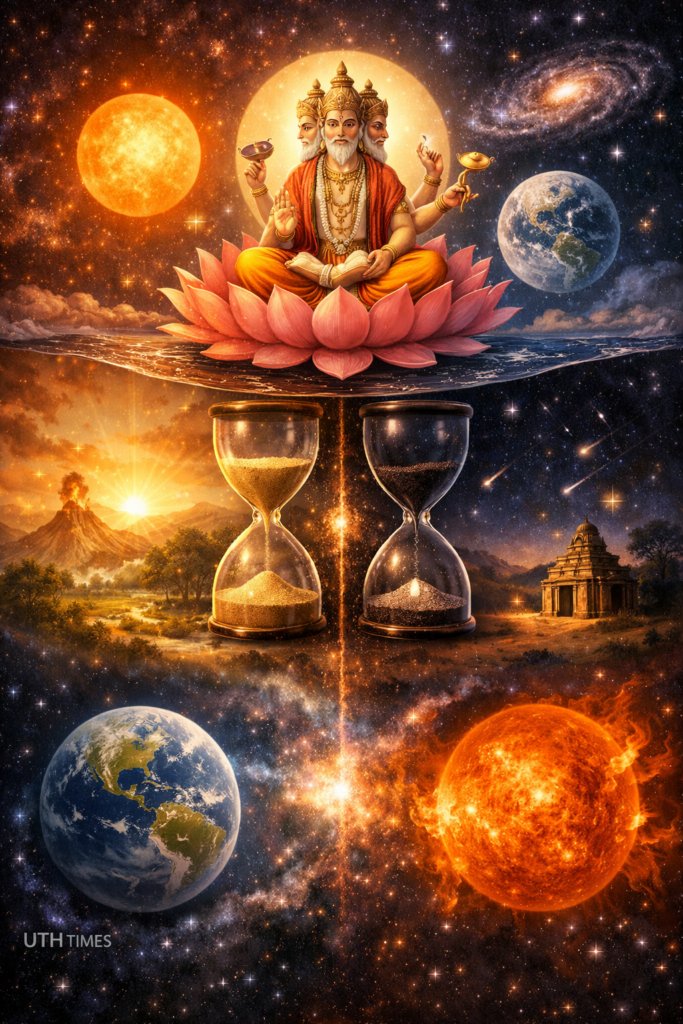
Sanatan Dharma doesn’t just imagine cycles—it quantifies them on a cosmic scale.
📜 According to Vedic texts:
- 🕰️ 1 Day of Brahma = 4.32 billion years (day) + 4.32 billion years (night)
- 🌍 Total = 8.64 billion years
These numbers are strikingly close to scientific estimates:
- 🌍 Age of Earth ≈ 4.5 billion years
- 🌞 Age of Sun ≈ 4.6 billion years
This alignment fascinated Carl Sagan, who admired how Hindu cosmology uniquely mirrors modern scientific time scales—far beyond human imagination.
🚀 Ancient Wisdom vs Modern Discovery
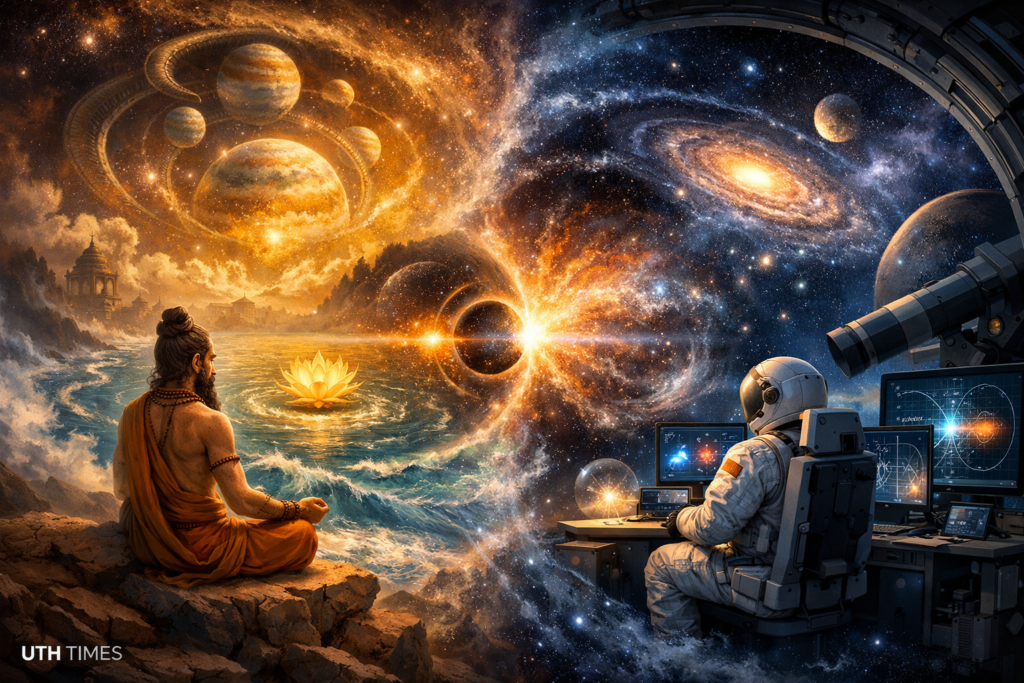
Modern institutions like NASA explore the universe through instruments, data, and mathematical models. In contrast, Vedic sages approached the cosmos through introspection, meditation, and philosophical depth.
🔍 What science is discovering:
- 🌠 The universe is expanding
- ⚛️ Reality emerges from energy fields
- 🔄 Cyclic models of the universe are possible
📖 What Vedic philosophy described:
- 🌊 A cosmic ocean as the source of creation
- 🔁 Endless cycles of universes
- ⏳ Time scales spanning billions of years
Rather than conflicting, these perspectives may be two different lenses observing the same cosmic truth.
🌌 More Than Myth: A Philosophical Cosmos
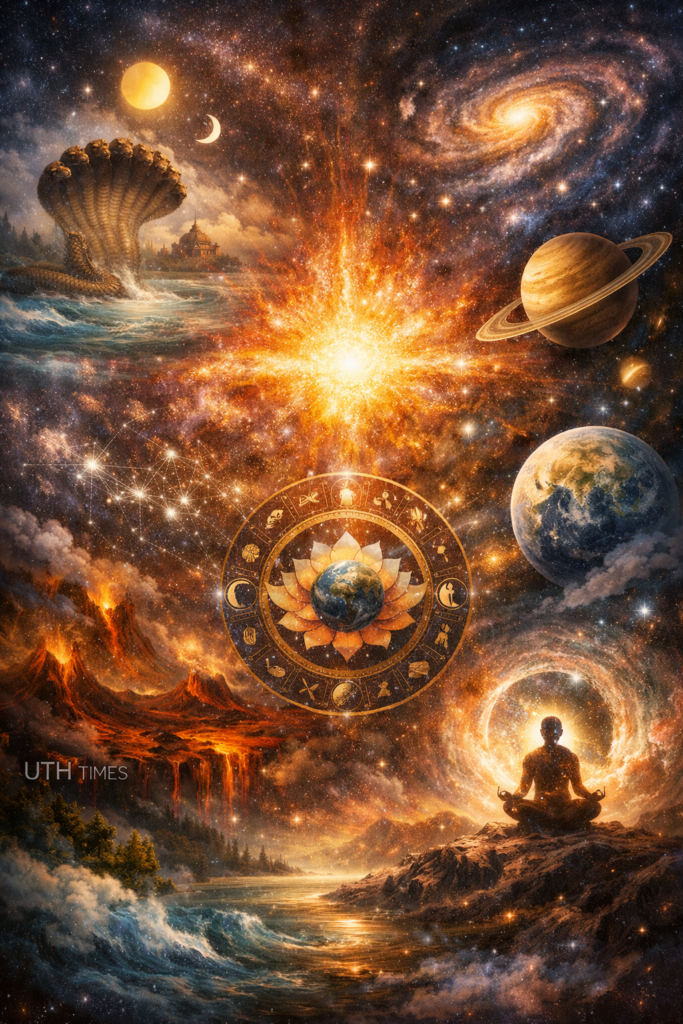
Sanatan Dharma does not separate science, philosophy, and spirituality—it merges them. The universe is not just a physical structure but a living, breathing rhythm of existence.
✨ It suggests:
- The cosmos is infinite and conscious
- Time is cyclical, not linear
- Creation is continuous, not singular
From the serene stillness of Ksheer Sagar to the explosive birth of the Big Bang, the universe tells a story—one that Sanatan Dharma may have begun narrating long before science found its voice.

