
History occasionally reveals discoveries that challenge our understanding of ancient civilizations. Recently in Mumbai, researcher Syed Shamir Hussain presented a remarkable set of documents and artefacts that he claims are connected to two powerful symbols of Sanatan Dharma — Lord Shiva’s Trishul and Lord Indra’s Vajra. According to the research he presented, these symbols may date back nearly 10,000 years and were reportedly discovered in the Philippines, opening a fascinating discussion about the ancient spread of Indic culture across Southeast Asia.
The Presentation in Mumbai
The artefacts and historical documents were showcased during a research presentation where Syed Shamir Hussain detailed his findings and interpretations.
🔹 The presentation included photographs, sketches, and research documentation related to the objects.
🔹 The artefacts reportedly resemble Trishul (trident) and Vajra (thunderbolt weapon) symbols commonly associated with Hindu deities.
🔹 Hussain claims these symbols indicate ancient Sanatan cultural influence far beyond the Indian subcontinent.
Researchers attending the discussion noted that the shapes, engravings, and symbolic patterns bear similarities to traditional Hindu iconography, which has been historically present in many parts of Southeast Asia.
Symbolism of Trishul and Vajra

The two artefacts presented carry deep spiritual and mythological meaning in Sanatan philosophy.
🔱 Trishul – Weapon of Lord Shiva
The Trishul, the sacred trident of Lord Shiva, represents cosmic balance.
🔹 Creation, preservation, and destruction
🔹 Past, present, and future
🔹 Mind, body, and consciousness
In Hindu philosophy, the Trishul symbolizes ultimate spiritual authority and universal order.
⚡ Vajra – Weapon of Lord Indra
The Vajra, the thunderbolt weapon of Lord Indra, symbolizes divine power and indestructibility.
🔹 Represents lightning and energy of the heavens
🔹 Symbol of strength and righteousness
🔹 Associated with victory over chaos and evil
The presence of these symbols outside India could potentially indicate ancient cultural exchanges or migration routes.
Possible Historical Connections

Historians have long acknowledged the influence of Indian culture across Southeast Asia, including regions like Indonesia, Cambodia, Thailand, and Vietnam. However, findings in the Philippines could push this cultural timeline even further back.
Some scholars believe that:
🌏 Ancient maritime trade routes may have carried religious ideas, art, and symbols across oceans.
🌏 Early civilizations in Southeast Asia might have adopted Indic philosophical concepts.
🌏 Cultural exchange between India and island nations may have existed thousands of years earlier than previously assumed.
However, researchers emphasize that further archaeological verification and scientific dating will be required to confirm these claims.
Why This Discovery Matters
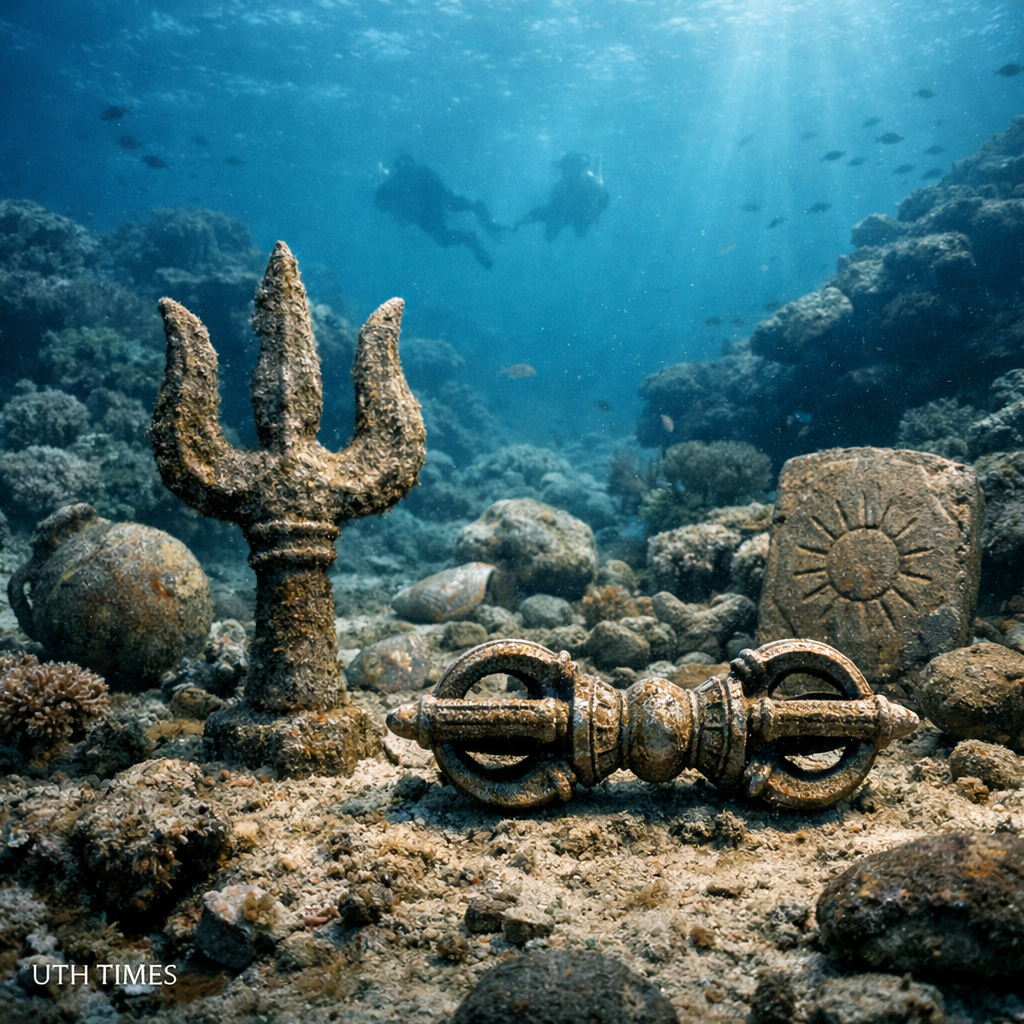
If authenticated, these artefacts could significantly reshape the historical understanding of early cultural diffusion.
🔹 It could demonstrate the global reach of ancient Indian philosophy.
🔹 It may reveal unknown maritime networks of ancient civilizations.
🔹 It could highlight the deep-rooted influence of Sanatan traditions across Asia.
Such discoveries often spark deeper exploration into how ancient societies interacted and shared knowledge across continents.
While further verification is necessary, the presentation by Syed Shamir Hussain has sparked curiosity among historians and cultural researchers alike. If these symbols truly date back 10,000 years, they could offer a powerful glimpse into the ancient spiritual and cultural connections linking India with Southeast Asia.
The discovery reminds us that history is still full of mysteries waiting to be uncovered.

