
Across India’s ancient temples, sculptures silently narrate spiritual philosophies that are thousands of years old. Recently, historians studying an 11th-century sculpture of Panchamukhi Ganesha were reminded once again that Sanatan Dharma encodes deep wisdom through symbolism rather than simple imagery.
Why does Ganesha appear with five faces in this rare form? The answer reveals a powerful philosophical framework about consciousness, protection, and cosmic balance.
🔱 The Symbolism of Panchamukhi Ganesha
Unlike the commonly seen single-faced Ganesha, Panchamukhi (five-faced) Ganesha represents a multidimensional form of divine awareness.
Each face is believed to face a different direction, symbolizing the deity’s ability to observe, protect, and guide the universe from all sides simultaneously.
In Sanatan philosophy, the five faces represent the five cosmic elements (Pancha Mahabhutas) that constitute the universe.
🔹 Earth (Prithvi) – Stability, grounding, and physical existence.
🔹 Water (Jal) – Flow, adaptability, and emotional balance.
🔹 Fire (Agni) – Transformation, energy, and purification.
🔹 Air (Vayu) – Movement, intellect, and life force.
🔹 Space (Akasha) – Infinite consciousness and cosmic awareness.
Together, these elements illustrate that Ganesha governs not just obstacles in life but the very structure of existence itself.
🐘 The Five Faces and Their Spiritual Meaning
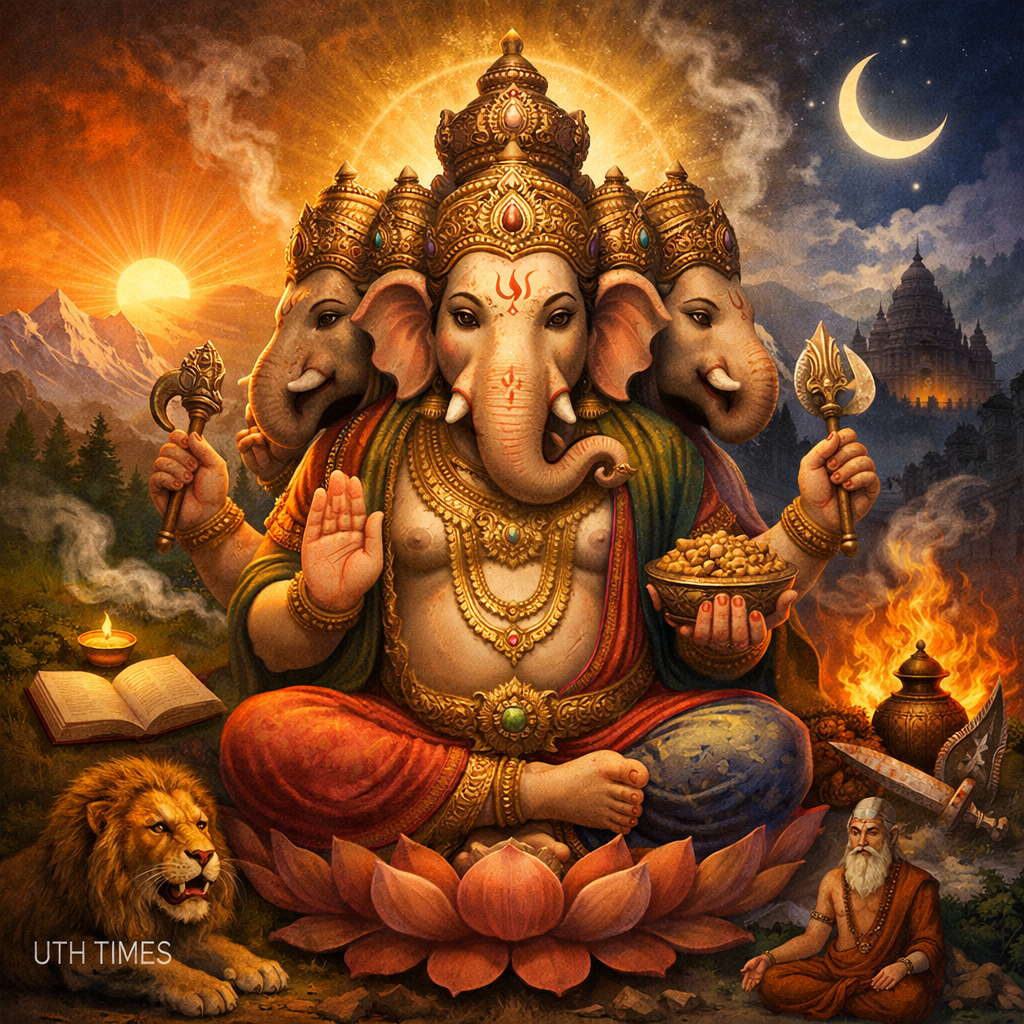
Each face of Panchamukhi Ganesha also carries a specific spiritual role, making this form deeply symbolic in Tantric and yogic traditions.
🔸 East-Facing Face – Represents wisdom and new beginnings, reminding devotees that knowledge is the first step to removing obstacles.
🔸 West-Facing Face – Symbolizes protection and the destruction of negativity.
🔸 North-Facing Face – Associated with prosperity, growth, and spiritual progress.
🔸 South-Facing Face – Represents courage and the ability to overcome fear.
🔸 Upward-Facing Face – Symbolizes enlightenment and connection with the divine consciousness.
This configuration reflects the belief that true wisdom requires awareness in every direction — physical, mental, and spiritual.
🏛️ Why the 11th-Century Sculpture Matters
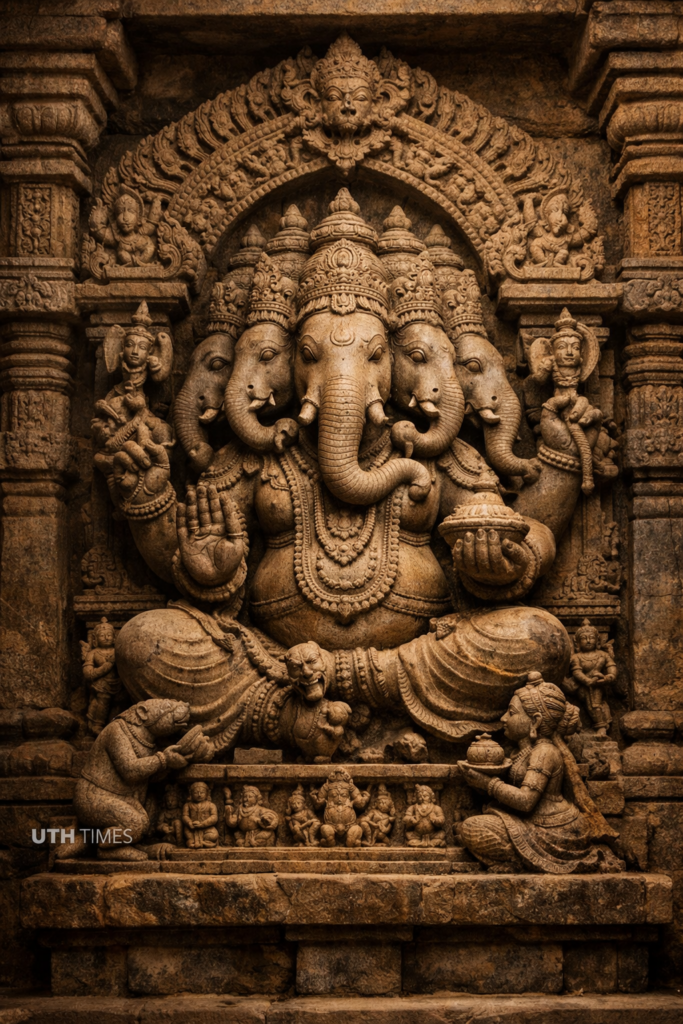
The discovery of such sculptures from the 11th century highlights how sophisticated Sanatan philosophical thought was even a thousand years ago.
Ancient sculptors were not merely artists; they were philosophers and spiritual interpreters translating complex metaphysical ideas into stone.
The Panchamukhi Ganesha sculpture demonstrates:
🔹 Advanced symbolic understanding of the cosmos
🔹 Integration of spirituality, art, and philosophy
🔹 The deep cultural continuity of Sanatan traditions
It also proves that temple architecture was designed as a form of visual scripture, where every carving carried layers of meaning.
🌺 A Divine Reminder of Universal Balance
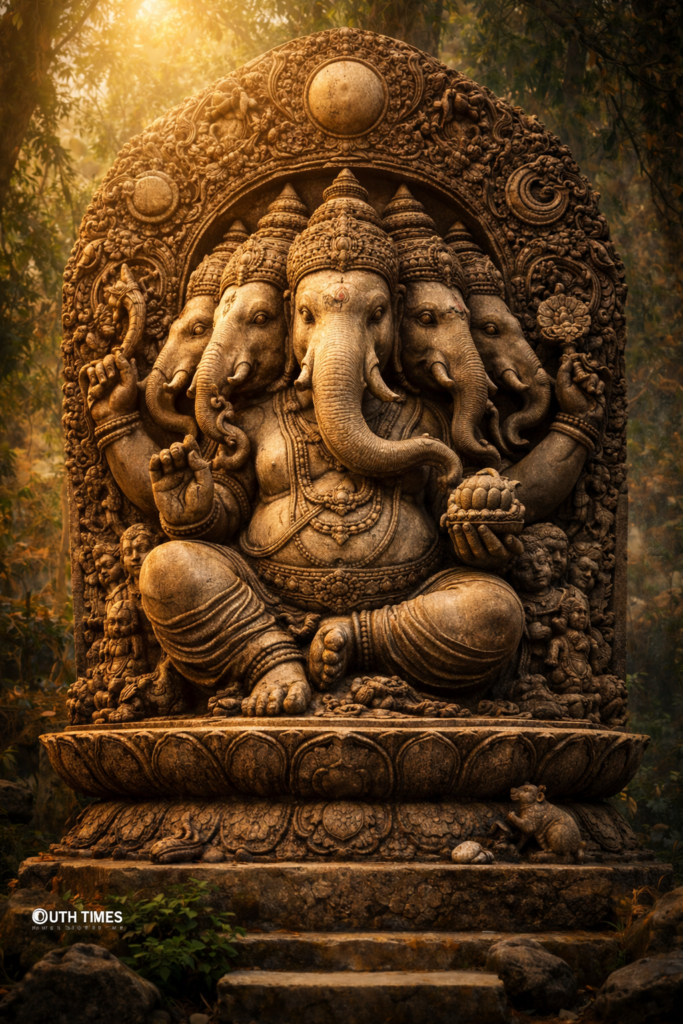
Panchamukhi Ganesha is more than an artistic representation — it is a philosophical message carved into history.
It teaches that wisdom requires balance of the five elements, awareness in all directions, and harmony between the physical and spiritual worlds.
Even after a thousand years, this ancient sculpture continues to remind us that Sanatan Dharma was never just religion — it was a profound science of existence.

