
Silent, rooted, and seemingly passive — trees are often thought of as lifeless observers of the wild. Yet African acacia trees possess a remarkable survival strategy: they communicate danger through airborne chemical signals, warning nearby trees of hungry herbivores. What appears to be a quiet savannah is actually a network of botanical intelligence, where trees prepare for attack before the first bite is taken.
🌿 The Chemical Alarm System
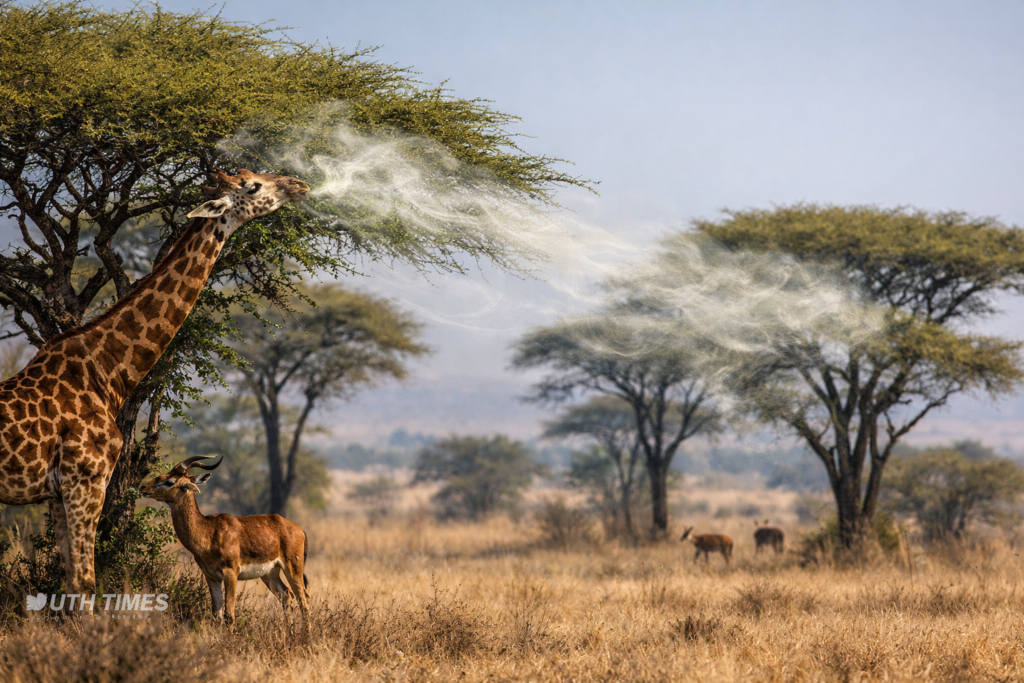
When giraffes or antelopes begin feeding on African acacia leaves, the tree does not remain defenseless. Instead, it rapidly releases volatile organic compounds (VOCs) into the air — microscopic chemical messages carried by the wind.
These chemical signals act like biological alarm calls, reaching neighboring acacia trees within minutes.
🔬 Key processes involved:
🌱 Damage Detection
The acacia senses physical injury caused by chewing insects or mammals. Specialized plant cells detect tissue damage and activate defensive pathways.
🌱 Ethylene Gas Release
The injured tree emits ethylene and tannin-triggering chemicals, a gaseous hormone that spreads through the air as a warning signal.
🌱 Wind-Based Messaging
Downwind acacia trees receive the signal and interpret it as a threat alert, preparing themselves even before animals reach them.
This airborne communication can extend up to 50 meters or more, creating a defensive perimeter across the savannah.
🌿 The Defensive Transformation
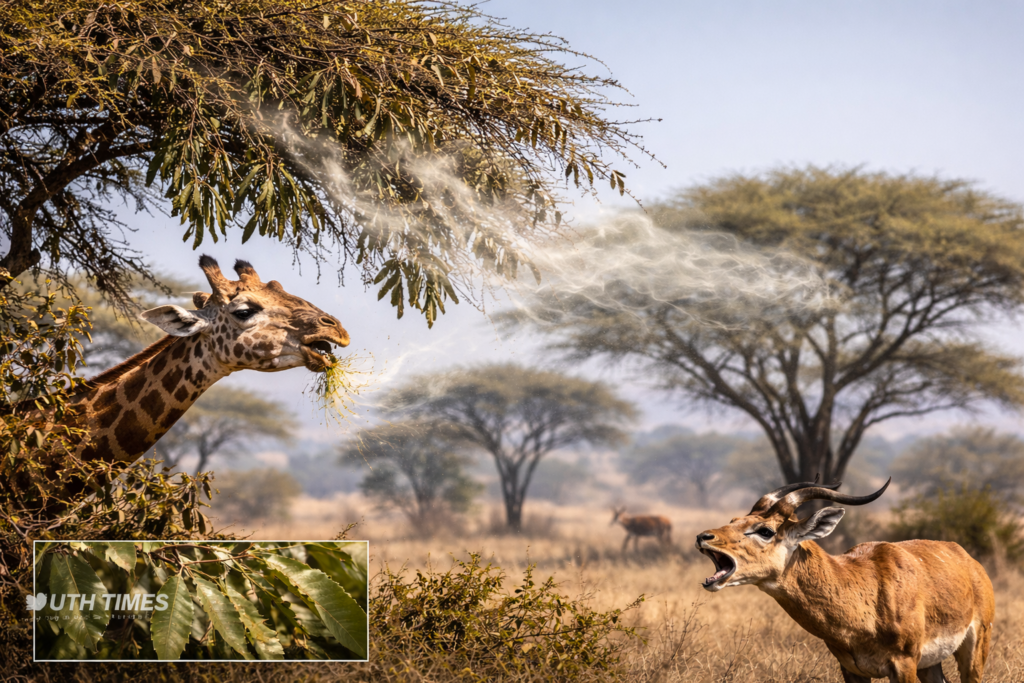
Once alerted, nearby acacias rapidly change their internal chemistry, turning from nutritious food into toxic or bitter foliage.
⚠️ Defensive responses include:
🍃 Tannin Production Surge
Neighboring trees increase tannin concentrations — natural compounds that make leaves bitter and difficult to digest.
🍃 Protein Blocking Mechanism
High tannin levels bind to proteins in herbivore digestive systems, reducing nutrient absorption and discouraging further feeding.
🍃 Toxic Threshold Levels
In extreme cases, tannin concentrations become high enough to be harmful, forcing animals to move elsewhere.
This transformation can occur within hours, demonstrating a level of responsiveness once thought impossible in plants.
🌿 A Living Intelligence Network

Scientists studying African savannah ecosystems discovered that giraffes instinctively move upwind while feeding. By doing so, they avoid trees that have already received chemical warnings.
🌍 This reveals a deeper ecological intelligence:
🌳 Trees operate as cooperative defense networks, not isolated organisms.
🌳 Chemical signaling shows plants possess memory-like biochemical responses.
🌳 Entire groves can synchronize defense strategies.
This phenomenon challenges the idea that intelligence requires a brain — acacia forests behave more like interconnected communities than individual plants.
The acacia warning system represents one of nature’s most sophisticated communication strategies. In a world without voices or movement, trees have evolved a language written in chemistry, proving that even the quietest organisms can share information and protect one another.
The next time you see a tree standing still, remember — it might be listening.

