
What if “nothing” was never empty? In a landmark experimental breakthrough, scientists using the world’s most powerful particle collider have shown that matter can literally emerge from the quantum vacuum—a state once thought to be absolute emptiness. This discovery doesn’t just tweak physics textbooks; it rewrites the definition of reality itself.
The Experiment That Shook the Void
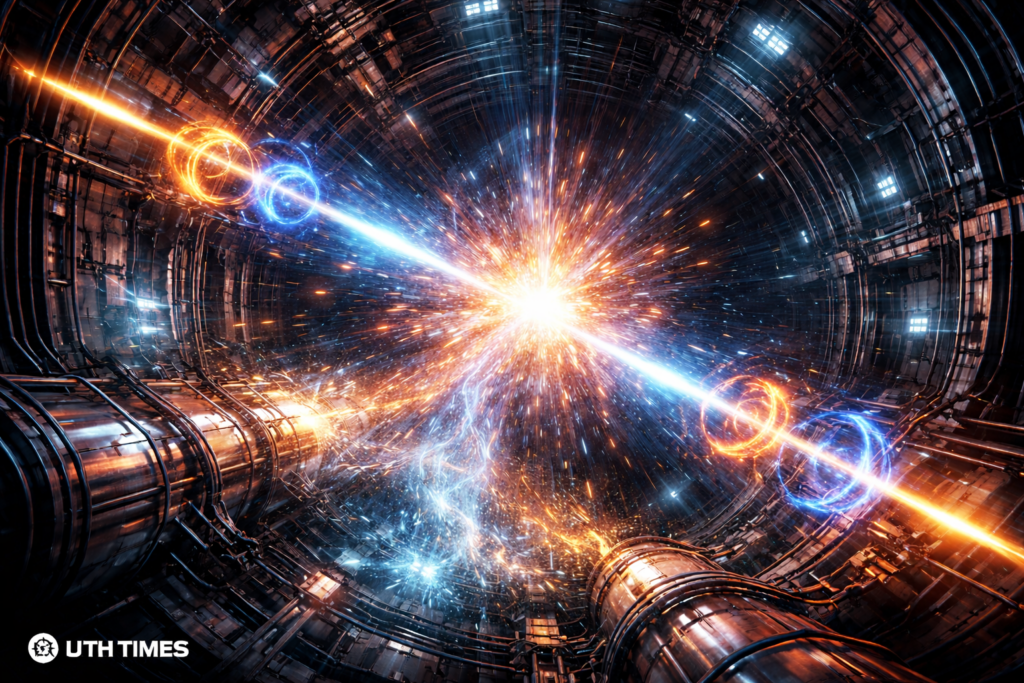
At the heart of this revelation lies ultra-high-energy experimentation at the Large Hadron Collider. By smashing particles together at near-light speeds, physicists recreated electromagnetic conditions so extreme that the vacuum itself began to respond.
What they observed was astonishing:
- ⚡ The vacuum behaved like an active medium, not empty space
- ⚡ Energy fluctuations condensed into real, detectable particles
- ⚡ Matter–antimatter pairs briefly flickered into existence
This confirms a long-theorized quantum idea: the vacuum is restless, boiling with invisible energy.
What Is the Quantum Vacuum, Really?
Forget the idea of space as a quiet, empty backdrop. Quantum physics tells a very different story:
- 🌀 Even in “nothingness,” quantum fields are always active
- 🌀 Virtual particles constantly appear and disappear
- 🌀 Extreme energy can stabilize these fluctuations into real matter
In simple terms: space itself has structure, tension, and creative power.
From Theory to Reality
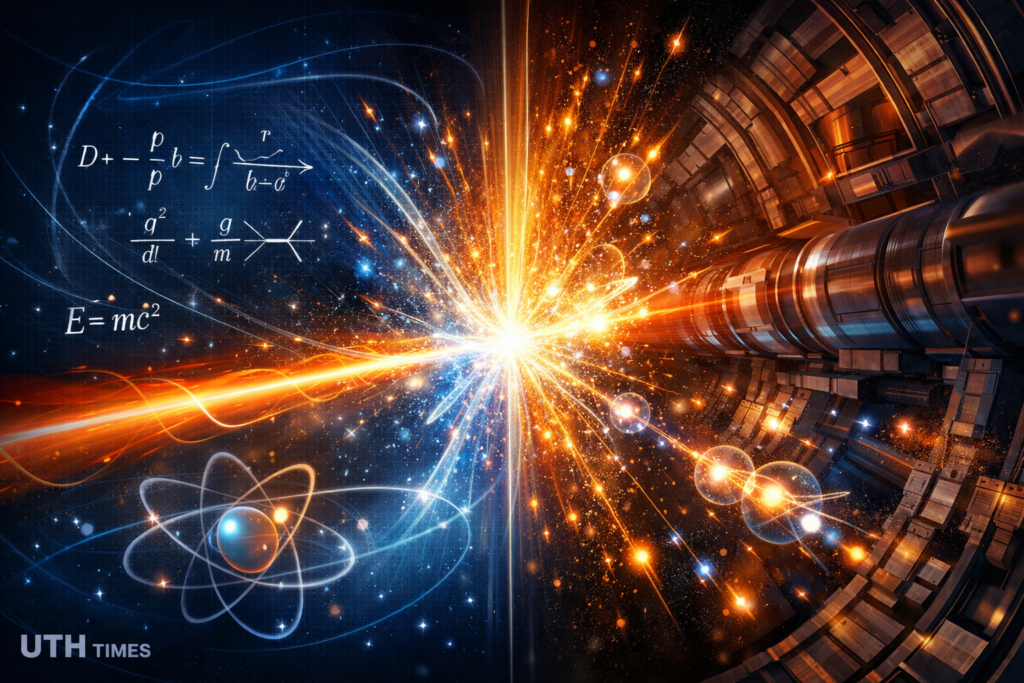
For decades, this phenomenon existed only in equations—especially in quantum electrodynamics. The collider results now show:
- 🔬 Mathematical predictions match physical observation
- 🔬 Energy alone can generate mass (Einstein was right—again)
- 🔬 The universe doesn’t need matter to create matter
This bridges theory and experiment in one of the boldest confirmations in modern physics.
Why This Changes Everything
This isn’t just about particles. It reshapes how we understand existence:
- 🌌 Explains how matter could emerge after the Big Bang
- 🌌 Offers clues about dark energy and vacuum energy
- 🌌 Suggests “nothing” may be the most powerful state of all
The universe may not have been born from something—but from unstable nothingness.
If matter can arise from the vacuum, then creation isn’t a moment—it’s a process that never stops.The void is not empty. It is waiting.

