
DRDO is reportedly pushing the boundaries of electronic warfare by exploring Photonics-based RF Memory (PRFM) — a radical evolution of classical Digital RF Memory (DRFM). Instead of using purely electronic circuits, PRFM uses light — photons — to capture, store, and replay radar signals. This could transform how jammers deceive modern radars.
📡 What Is PRFM — And Why It Matters

- ✨ Massive Bandwidth: Using photonic circuits means PRFM can operate over enormously wide frequency ranges, far beyond the constraints of conventional electronics.
- ⚡ Ultra-Low Latency: Light-based memory lets incoming radar signals be stored and retransmitted with minimal delay — critical for real-time deception.
- 🎯 High-Fidelity Replay: Since the system works coherently with the incoming signal, PRFM can offer extremely accurate copies, preserving phase, amplitude, and timing — enabling precise spoofing or mirroring of an enemy’s radar waveform.
- 🔄 Adaptive Signal Manipulation: The memory can tweak stored waveforms — altering range, Doppler, angle, or signature — to create believable false targets or confuse the adversary’s radar tracker.
🛡️ Military Impact: Smarter, Sharper Jamming

- 💣 Sharper Deception: PRFM enables creation of very realistic echoes. Enemy radars could be tricked into seeing phantom aircraft or decoys, undermining range and velocity tracking.
- 🧠 Smarter Countermeasures: With such high fidelity and bandwidth, jammers become more than noise makers — they act like intelligent adversaries, mimicking genuine emissions.
- 🛡️ Stronger Protection: Against AESA (Active Electronically Scanned Array) and LPI (Low Probability of Intercept) radars, which use agile, complex waveforms, photonic memory’s speed and fidelity offer robust defense.
- 🌐 Networked EW: PRFM-equipped jammers could feed back into real-time EW networks, sharing stored signatures and threat libraries across platforms.
⚙️ Why Photonics — And Why Now

- 🚀 Photonics Advantage: Optical components, like modulators and fiber optics, handle GHz-to-tens-of-GHz signals with lower noise and broader linearity than purely electronic circuits.
- 🧪 Convergence with Radar R&D: DRDO’s own work on photonic radar (as covered by defense analysts) shows it already has experience with photonic integrated circuits and light-generation for radar systems.
- 🏭 Strategic Self-Reliance: Developing PRFM indigenously would align with DRDO’s push for advanced electronic warfare capabilities, complementing its Digital Radio Frequency Memory (DRFM) systems.
⚠️ Challenges on the Horizon

- 🔧 Complex Engineering: Building a stable, high-speed photonic memory system that reliably captures and replays RF waveforms is nontrivial — optics + electronics integration is hard.
- 🔋 Size, Weight, Power (SWaP): Photonic systems may involve lasers, modulators, and fiber — managing them in airborne jammers or compact pods will be a design challenge.
- 🧊 Thermal Management: High-speed photonic circuits generate heat — cooling will be vital for real-world deployment.
- 🧭 Security & Robustness: Optical systems must be made rugged enough for battlefield conditions (vibration, shock, temperature).
🧭 Strategic Implications for India
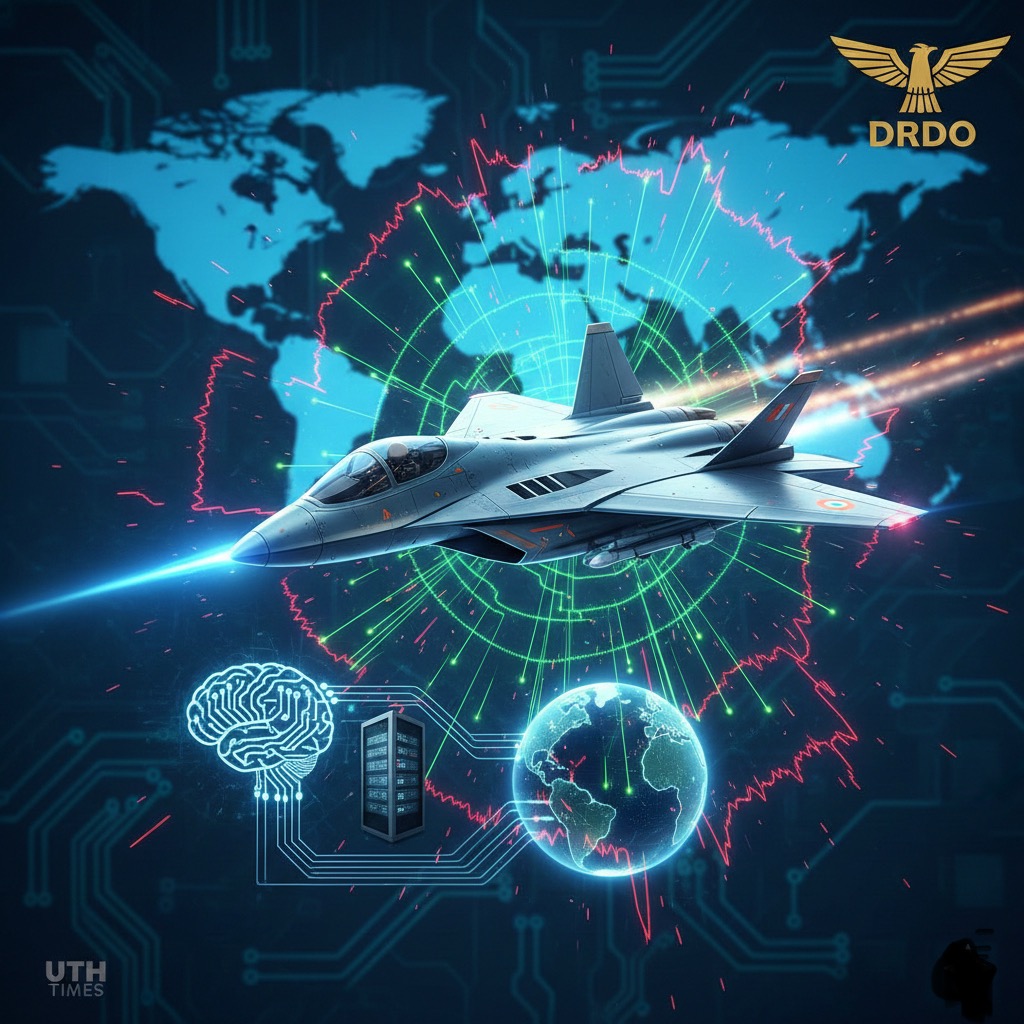
If DRDO succeeds, PRFM could position India among a very select few nations possessing light-based deception jammers. It could dramatically elevate the sophistication of Indian EW — protecting aircraft, disrupting advanced radars, and reshaping deterrence. Beyond defense, it could also spin off into high-speed photonic memory research with dual-use potential.

, enabling ultra-low latency, gigahertz-bandwidth radar deception for smarter, sharper electronic warfare.)