
India has taken a giant leap into the future of cosmic science. Engineering giant Larsen & Toubro (L&T) has secured a major contract to construct India’s Laser Interferometer Gravitational Wave Observatory (LIGO) in Maharashtra — a project that will allow India to “listen” to ripples in space-time created by black holes and neutron stars.
This observatory will place India among the world’s most advanced gravitational-wave research nations.
A Mega Science Facility Rising in Maharashtra
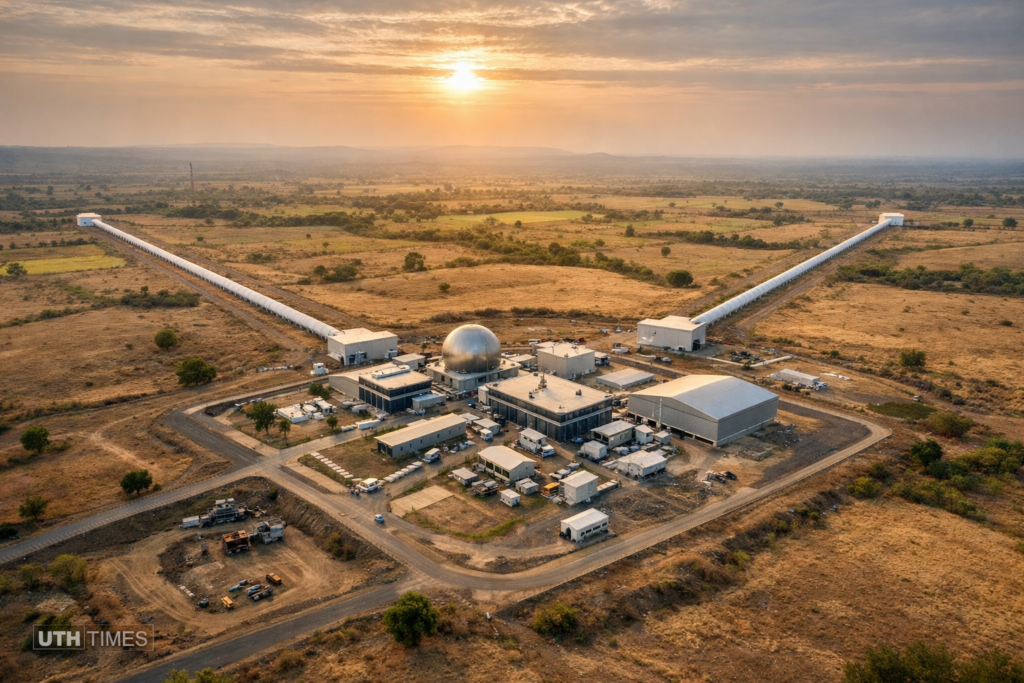
LIGO-India will be constructed at Aundha in Hingoli district under the supervision of the Department of Atomic Energy.
The project is part of a global scientific network studying gravitational waves — tiny distortions in space-time predicted by Einstein’s theory of relativity.
Key Highlights
🔭 Estimated project cost: ₹2,600 crore
🔭 Expected completion: Around 2030
🔭 Land area: About 300 acres
🔭 India will host one of the few LIGO detectors globally
Once operational, the facility will function as a national research center for astrophysics and advanced physics.
L&T’s Role: Building One of the Most Precise Machines Ever

L&T’s Heavy Civil Infrastructure and Heavy Engineering divisions will jointly construct the observatory.
Engineering Responsibilities
⚙️ Construction of ultra-precision infrastructure
⚙️ Installation of high-vacuum systems
⚙️ Manufacturing specialized beam tubes
⚙️ High-stability foundations for vibration control
The observatory will include an 8-kilometre ultra-high vacuum beam tube system, one of the most technically demanding components.
These tubes allow laser beams to travel uninterrupted, enabling detection of cosmic signals smaller than a proton.
How India’s LIGO Will Detect the Universe
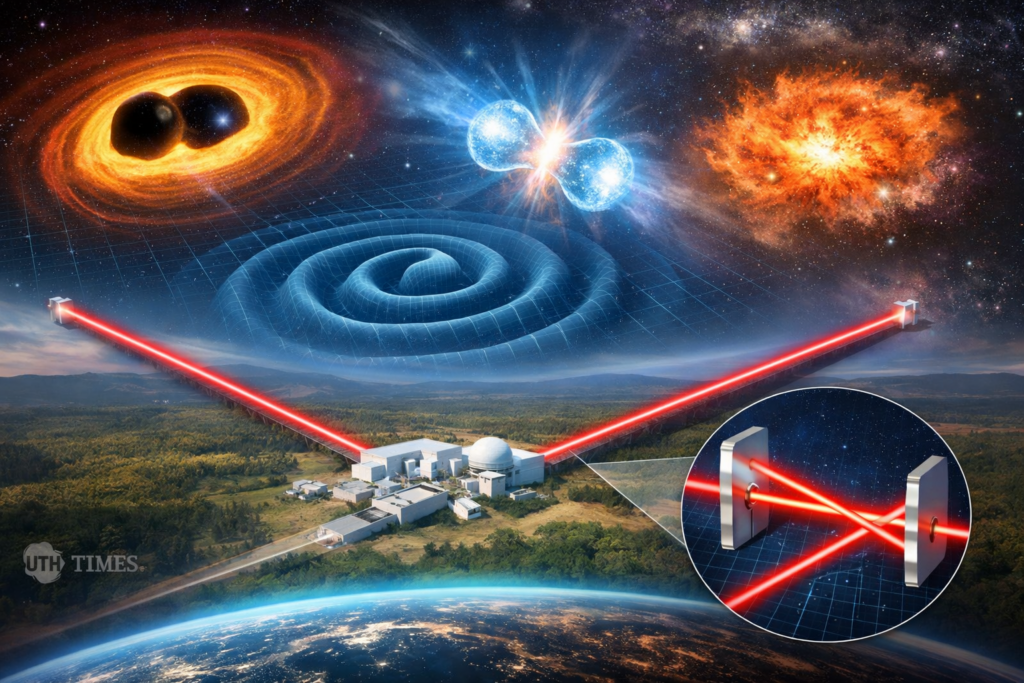
LIGO uses laser interferometers with two perpendicular arms, each about 4 km long.
How It Works
🌌 Laser beams travel through vacuum tunnels
🌌 Mirrors reflect light back and forth
🌌 Gravitational waves stretch space itself
🌌 Tiny changes in distance are recorded
These measurements reveal violent cosmic events such as:
⭐ Black hole collisions
⭐ Neutron star mergers
⭐ Supernova explosions
Gravitational waves were first detected in 2015, revolutionizing astronomy.
Why LIGO-India Matters Globally

India’s detector will strengthen the global gravitational-wave network and improve the accuracy of cosmic event detection.
Scientific Impact
🚀 Better mapping of cosmic events
🚀 Improved source localization
🚀 Breakthroughs in astrophysics
🚀 New frontiers in fundamental physics
The observatory will also boost India’s reputation in frontier scientific research.
India’s Gateway to Cosmic Discovery
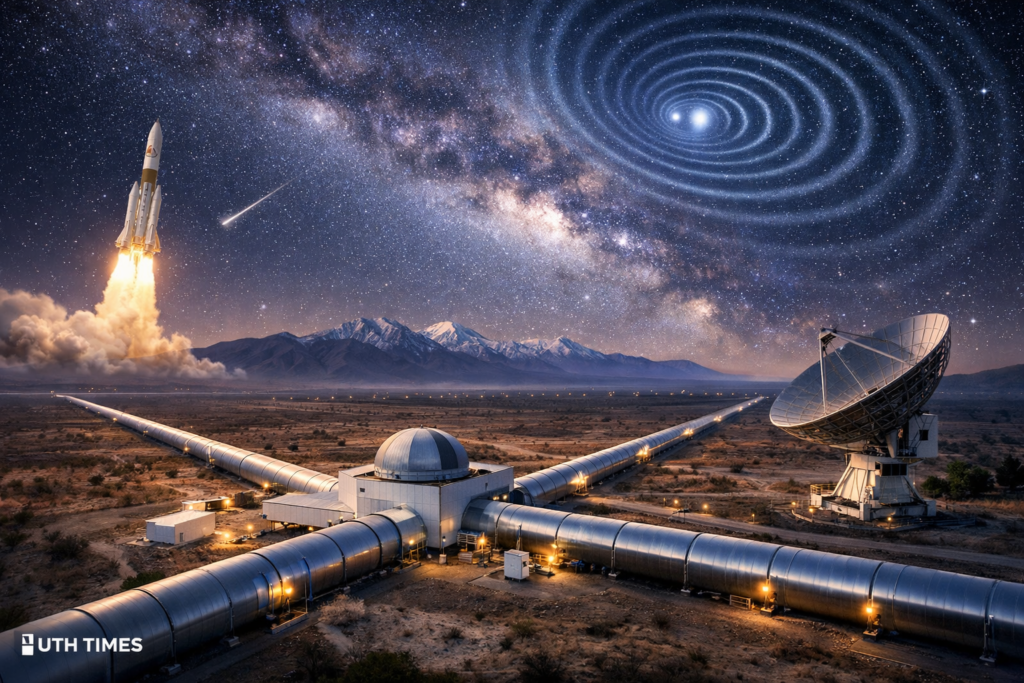
With L&T building one of the most sophisticated scientific instruments ever constructed in India, LIGO-India represents more than a project — it is a statement of scientific ambition.
India is no longer just observing space — it is preparing to hear the universe itself.

