
Trump’s tariff threat may sound daunting, but India of 2025 is not India of 2018. Powered by Modi govt’s Act East policy and Global South leadership, New Delhi has built economic shock absorbers that can turn trade wars into opportunities.
🌏 Act East = The Silent Shield
India’s eastward pivot has rewired global trade flows. Instead of relying excessively on Western markets, India has deepened ties with ASEAN, Japan, Korea, Vietnam, and Australia. With ASEAN trade already at $121B (FY24) and Japan committing ¥10 trillion ($68B) over a decade, the region is emerging as India’s growth engine.
- 🌸 Japan brings capital + credibility with its industrial townships, semiconductor focus, and Supply Chain Resilience Initiative.
- 🚢 ASEAN provides ready markets with an FTA under review (AITIGA) that will cut compliance costs and enhance margins.
- 🇦🇺 Australia’s ECTA fuels double-digit export growth, offering immediate redirection lanes for goods hit by US tariffs.
In short, Act East has installed India’s economic airbags.
💰 Eastern FDI: Fuel for Factories
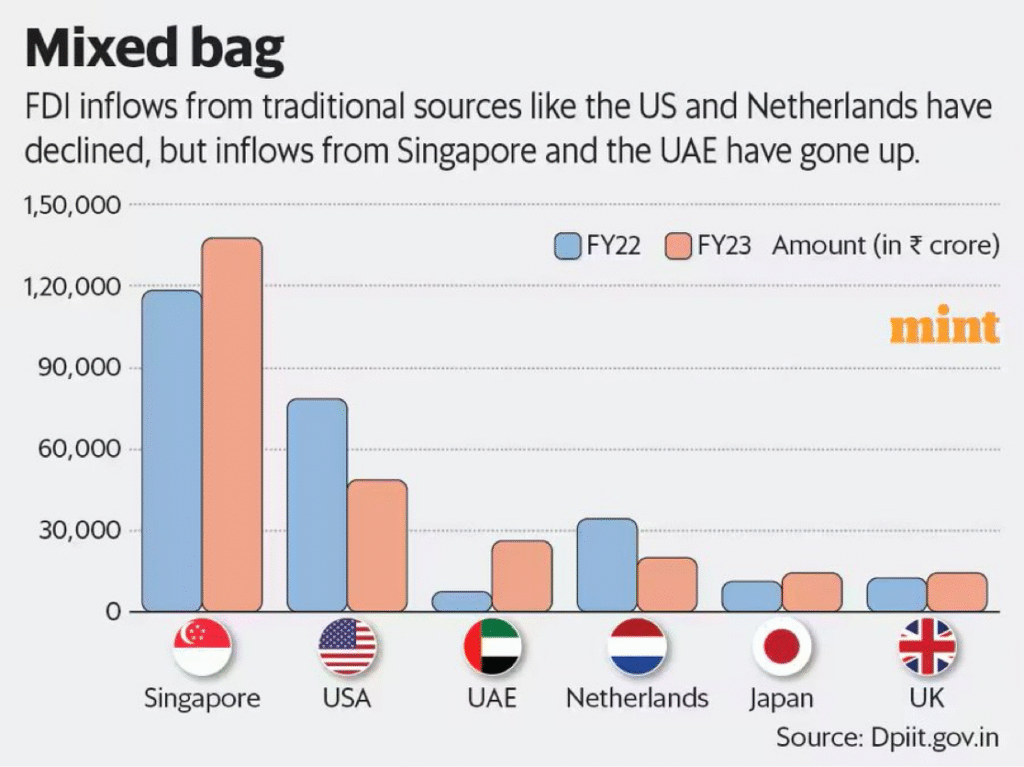
India recorded $81B in FDI in FY25 (+14%), with Singapore, Japan, and Korea leading the inflows. Unlike earlier decades when Western capital dominated, today Eastern FDI anchors India’s capex cycle.
- 🏭 New factories, ports, and logistics hubs are increasingly East-funded.
- 🔋 Investments are flowing into semiconductors, AI, logistics, and industrial clusters.
- 📈 Since 2000, India has crossed $1.07T in FDI, with the bulk arriving post-2014 reforms.
This ensures that if the US market turns protectionist, India still has robust capital fueling its industrial expansion.
📦 New Markets, New Corridors
When tariffs hit, the real game is rerouting demand. India’s eastward markets provide this cushion:
- 🦐 Seafood, leather, and textiles can move into ASEAN retail chains and Japan’s premium buyers.
- 🏗 Engineering goods tap Australia’s infrastructure boom.
- 💊 Pharma and IT expand deeper into Africa and Latin America under Global South partnerships.
Global South leadership doubles as demand insurance, ensuring India’s exports never run dry—even in tariff storms.
🚄 Supply Chains That Outrun Tariffs
Hard infrastructure is India’s stealth weapon. The India-Myanmar-Thailand highway, the Kaladan multimodal link, and Japan-backed port upgrades slash costs and time, keeping exports competitive.
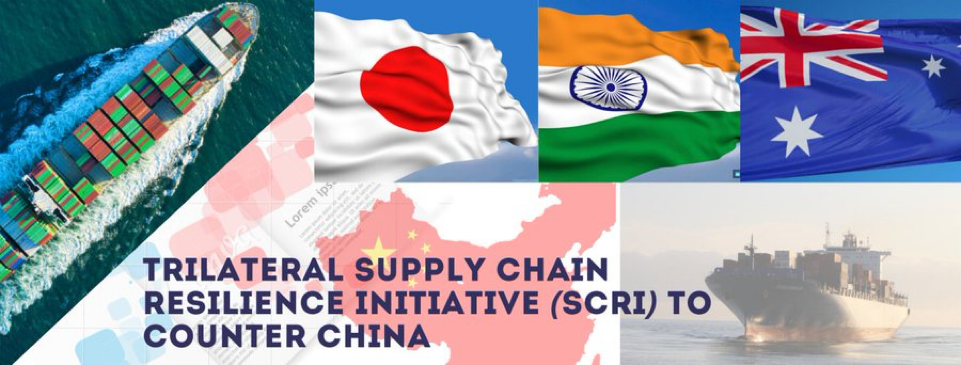
Meanwhile, the India-Japan-Australia SCRI hardens supply webs in autos, electronics, and textiles—precisely the sectors that face tariff risks. By design, these networks redirect flows swiftly from the US to Asia-Pacific markets.
🔑 The Takeaway
India’s tariff shield isn’t rhetorical—it’s structural. Eastern FDI, ASEAN/Australia/Japan trade lanes, and Global South corridors mean India won’t just absorb US tariffs, it will pivot profitably eastward.
Conclusion:
For India, Trump’s tariffs are no longer a trap. They are a test—and Modi govt’s Act East ensures New Delhi passes it with resilience and opportunity.

