
Rivers don’t stop at borders—but power politics begins there. As upstream dams rise, India is responding not with rhetoric, but with steel, towers, and transmission lines.
The Big Move: $77 Billion to Wire the Himalayas

India has unveiled a $77 billion transmission masterplan aimed at evacuating over 76 gigawatts (GW) of hydroelectric power from the Brahmaputra Basin by 2047. This is not a routine infrastructure project—it is one of the largest grid-expansion strategies ever conceived, designed to move clean energy from the remote Northeast to the nation’s industrial heartlands.
🔹 Ultra-high-voltage corridors
🔹 Long-distance, low-loss transmission
🔹 Grid resilience for the next 25 years
This is India betting on electrons over engines.
Why Now? The China Factor Upstream

Upstream, China is rapidly constructing mega-dams on the Yarlung Tsangpo (the upper Brahmaputra). These projects raise concerns over:
- 🌊 Altered water flows
- ⚡ Control over seasonal hydrology
- 🌏 Strategic leverage in South Asia
India’s answer is subtle but strategic: maximize downstream value. If water flows change, India wants the capability to harness every possible unit of energy—quickly and efficiently.
The Scale: 76 GW Is Not Just a Number

To understand the magnitude:
- ⚡ 76 GW ≈ powering 60–70 million homes
- 🏭 Equivalent to dozens of large coal plants—without emissions
- 🔋 Backbone for green hydrogen, EVs, and AI-driven industry
This transmission plan transforms the Northeast from a “remote frontier” into India’s renewable powerhouse.
Engineering the Impossible
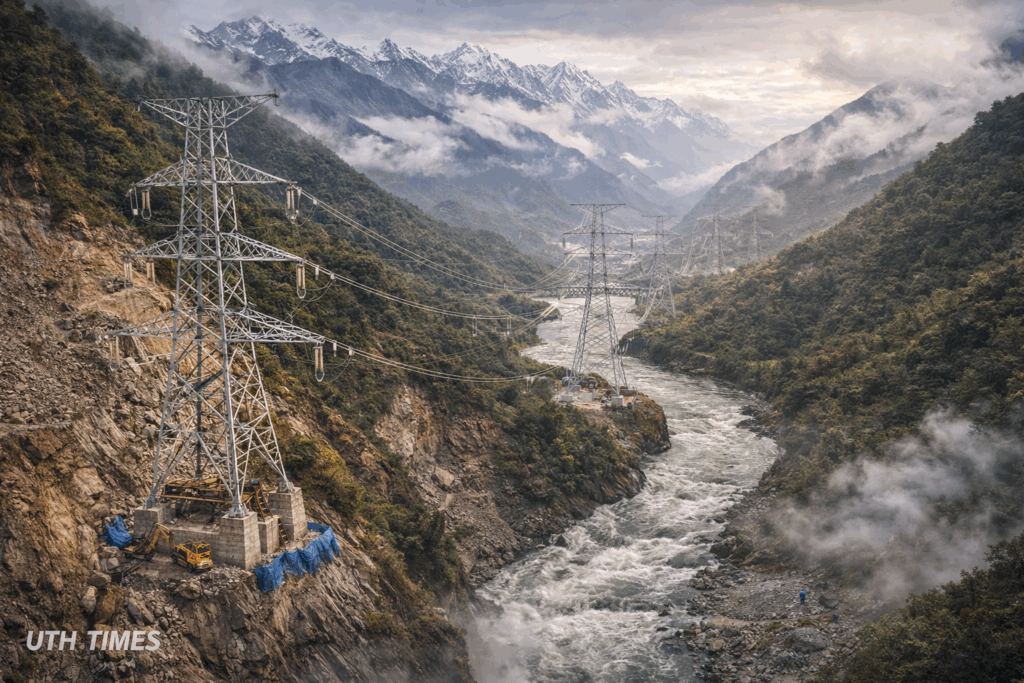
Building grids across seismic zones, dense forests, and steep Himalayan terrain is brutally complex.
⚙️ What makes this next-level:
- Tower foundations on unstable slopes
- Climate-resilient design against floods & landslides
- Integration with a national, synchronous grid
This is not just power evacuation—it is grid diplomacy through engineering.
Beyond Power: Strategy in Steel
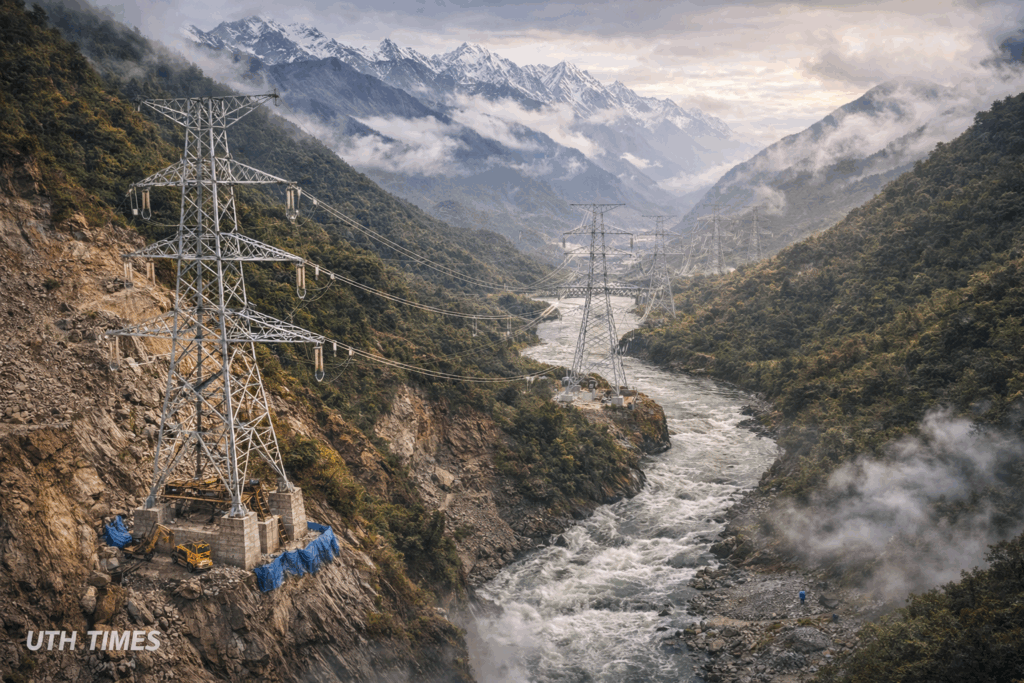
This project delivers three silent messages:
- 🛡️ Energy security without escalation
- 🌱 Climate leadership with credibility
- 🧭 Long-term planning beyond election cycles
Transmission lines may look apolitical—but they decide who controls growth.
Dams may hold water.
But grids decide the future.
By 2047, India isn’t just moving power—it’s moving the balance.

