
🇮🇳 A Giant Leap for Naval Space Power

India just boosted its maritime dominance. On November 2, 2025, the Indian Space Research Organisation (ISRO) launched its heaviest military communication satellite—GSAT-7R (CMS-03)—aboard the LVM3-M5 rocket from Sriharikota. Weighing a staggering 4,410 kilograms, this satellite represents India’s most advanced leap in space-based naval communications and surveillance.
In a flawless mission, the rocket successfully injected GSAT-7R into a Geosynchronous Transfer Orbit (GTO), marking another feather in ISRO’s cap of precision launches.
🛰️ Built for Power: The I-4K Platform Advantage

The GSAT-7R is built on ISRO’s indigenous I-4K satellite bus, a versatile and high-performance platform designed for heavy communication payloads.
Unlike its predecessor, GSAT-7, which launched in 2013, the new satellite carries multi-band transponders that operate across UHF, S, C, and Ku bands — ensuring uninterrupted voice, data, and video links even under the most challenging conditions.
These capabilities enable seamless real-time connectivity between ships, submarines, aircraft, and ground command centers, ensuring that India’s naval operations remain a step ahead of any adversary.
🌊 Strategic Eyes Over the Indian Ocean

GSAT-7R is not just a satellite—it’s a strategic communication lifeline.
With the Indian Ocean emerging as a crucial geopolitical arena, the Indian Navy’s dependence on space assets for secure, long-range communications has intensified.
The satellite’s advanced payload allows for:
- 🛰️ Encrypted communication links across the entire Indian Ocean Region (IOR)
- ⚓ Networked data sharing between naval fleets, air bases, and submarines
- 🔭 Enhanced maritime surveillance and mission coordination during deep-sea operations
This makes GSAT-7R a force multiplier, integrating India’s naval network into a unified, AI-supported information grid — a step toward true net-centric warfare.
🚀 ISRO & Defence Synergy: A New Era of Indigenous Strength

The GSAT-7R project highlights the synergy between ISRO and the Indian Navy, advancing India’s self-reliant defence communications ecosystem under the Atmanirbhar Bharat initiative.
By replacing the decade-old GSAT-7, this satellite not only extends operational longevity but also strengthens India’s strategic autonomy in the region.
It’s an answer to growing maritime challenges, ensuring that India’s blue-water navy remains digitally invincible and strategically unblinded.
🌌 Conclusion: A Silent Sentinel in Space
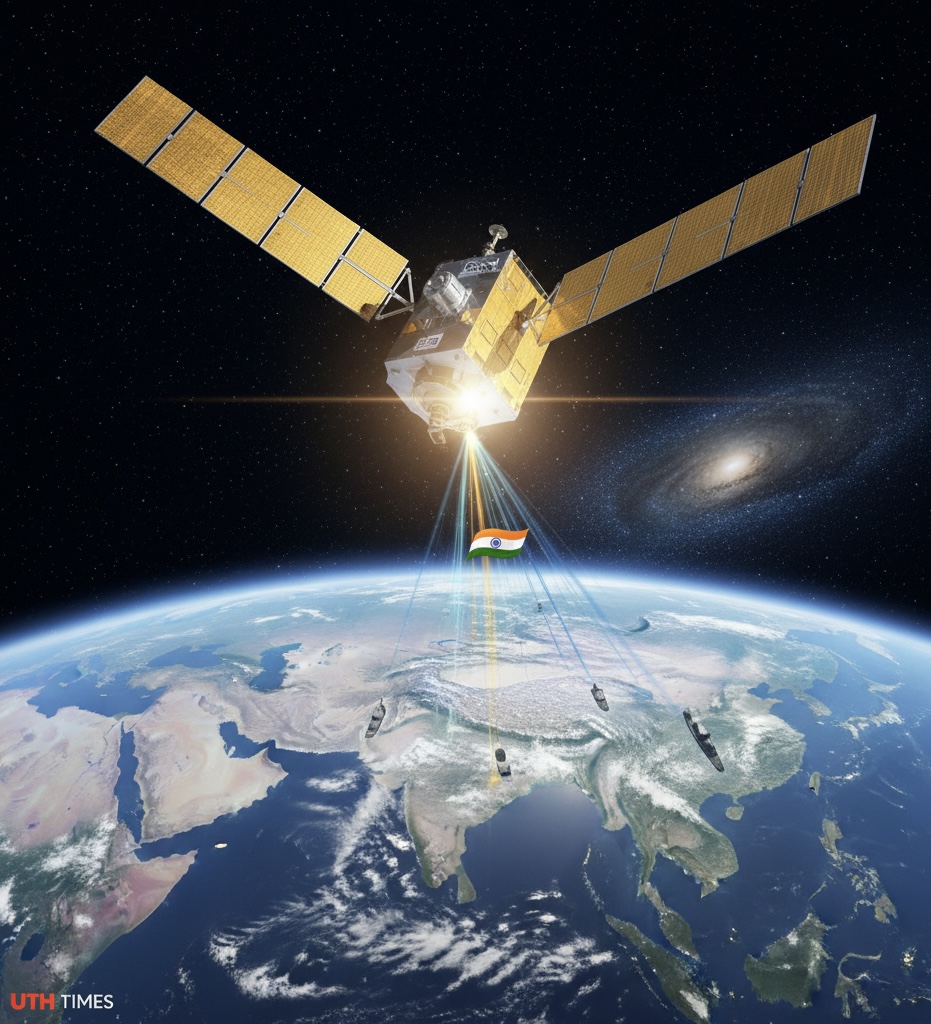
With GSAT-7R now orbiting 36,000 km above Earth, India’s naval communication backbone just became faster, smarter, and far more secure.
It’s not merely a satellite launch — it’s a declaration of technological confidence.
India has once again proven that when it comes to merging space science with national security, the sky is not the limit — it’s the starting line. 🚀🇮🇳

